US says Viejo Luis tequila is a front for Guadalajara drug gang
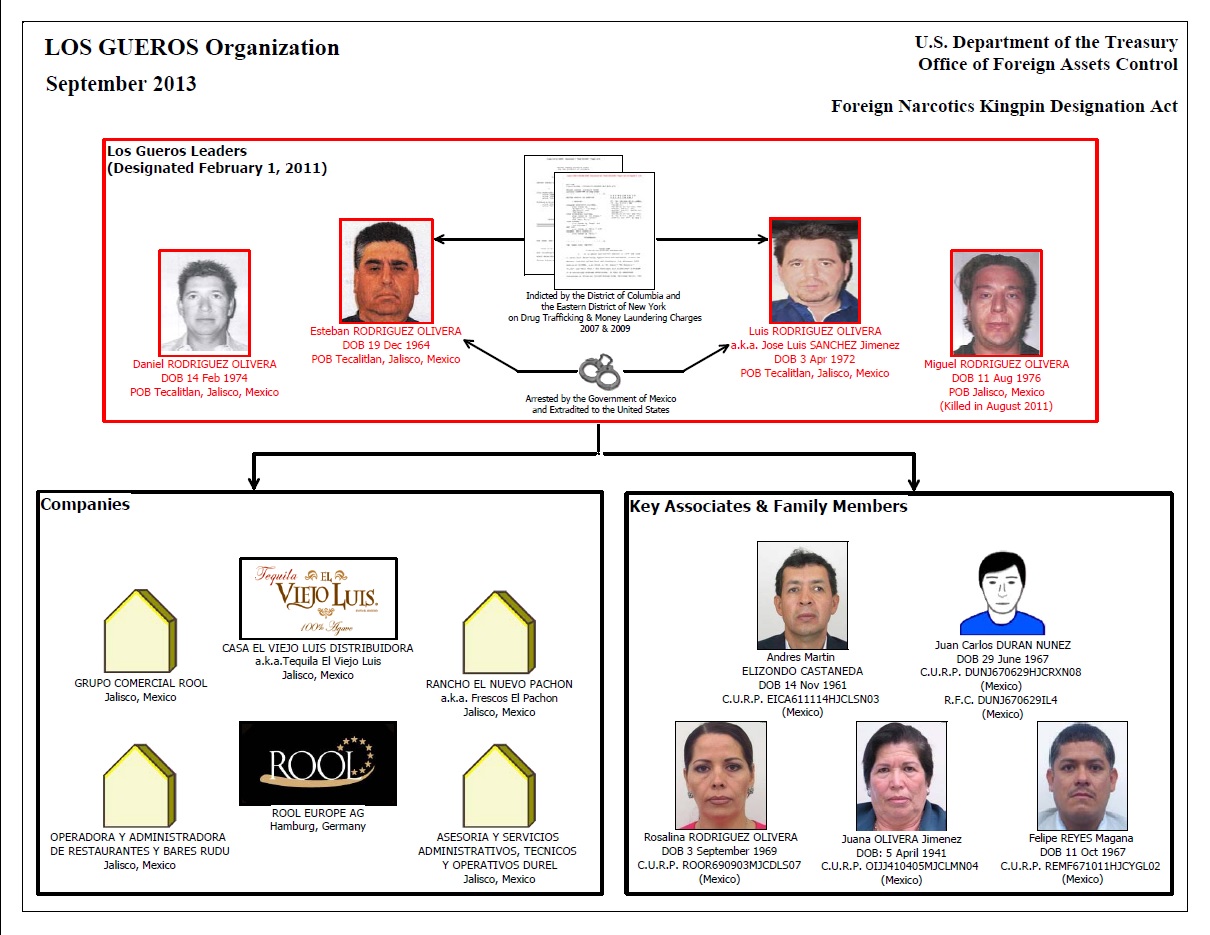
The U.S. Treasury Department has designated six companies – including a prominent tequila producer – under the Foreign Narcotics Kingpin Designation Act for laundering money for a Guadalajara-based drug cartel.
Five individuals, said to be key family members and associates of the leaders of local drug-trafficking organization Los Gueros, were also designated by the Treasury Department’s Office of Foreign Assets Control (OFAC) on Tuesday.
The businesses designated were local tequila firm Casa El Viejo Luis; its two parent companies, Grupo Comercial Rool and Rancho El Nuevo Pachon; German distribution company ROOL Europe; and two related administrative entities based in Jalisco. The Treasury Department says these firms were “owned or controlled by Los Gueros, and/or by individuals acting on their behalf, and are suspected of being used by the group to launder their illicit proceeds.”
The Kingpin Act prohibits individuals or businesses in the United States from conducting financial or commercial transactions with designees, while any assets they hold under U.S. jurisdiction will be frozen.
“Today’s designation of Los Gueros’ business network follows the arrest and extradition to the United States of two of its leaders. This action will further damage Los Gueros’ business empire and impede its ability to reap benefits from the drug trade,” said OFAC Director Adam J. Szubin.
Founded in Guadalajara by four brothers from Tecatitlan, Jalisco, Los Gueros were initially aligned with the powerful Sinaloa Federation and were accused of smuggling large quantities of cocaine from Colombia and Peru into the United States and Europe. The group later split with the Sinaloa Federation, relocated to Leon, Guanajuato, and forged an alliance with Los Zetas, according to the U.S. State Department.
In May 2009, Los Gueros leaders Esteban and Luis Rodriguez Olivera were indicted in New York for trafficking over 100,000 kilograms of cocaine into the United States between 1996 and 2008. The pair were also charged with drug trafficking in the District of Columbia in 2007, in relation to a Mexican Navy seizure of over five tons of cocaine the previous year.
Esteban Rodriguez, 49, was arrested in Mexico City airport in December 2008 and Luis, 41, was then detained in the same airport terminal in December 2011. Both have since been extradited to the United States, while a third brother, Miguel, was killed in an inter-gang dispute in a Cancun shopping mall in August 2011 and the fourth brother, Daniel, 39, remains at large.
“Drug trafficking organizations’ main motivation in the illegal drug trade is making money, and they will go to any length to hide, disguise and safeguard their drug profits,” said Brian McKnight of the Drug Enforcement Administration (DEA) on Tuesday. “Today’s designations will have a direct impact on the businesses owned by Los Gueros and the flow of illicit money. It strikes a powerful blow at the illegal proceeds and exposes the international businesses they used to hide their drug profits.”
“By using aliases and listing close family members and associates on the deeds of their companies, Los Gueros has been able to hide ownership interest in companies and properties for many years,” the Treasury Department added.
While Mexico’s drug gangs frequently invest their earnings in otherwise-legitimate businesses, Casa El Viejo Luis is one of the more high-profile companies to be exposed as a front for money laundering in recent years.
A popular, high-quality tequila, El Viejo Luis has been well received in the United States and Europe and was even promoted in South Africa during the 2010 World Cup. Texas was identified as the first market for distribution in 2009, when Rool-USA became the first and only company completely owned by Mexican investors with a license to import and distribute tequila in Texas. Neither Grupo Comercial Rool or Rool-USA responded to the Reporter’s calls this week.
Deadly tropical storms wreak havoc across Mexico
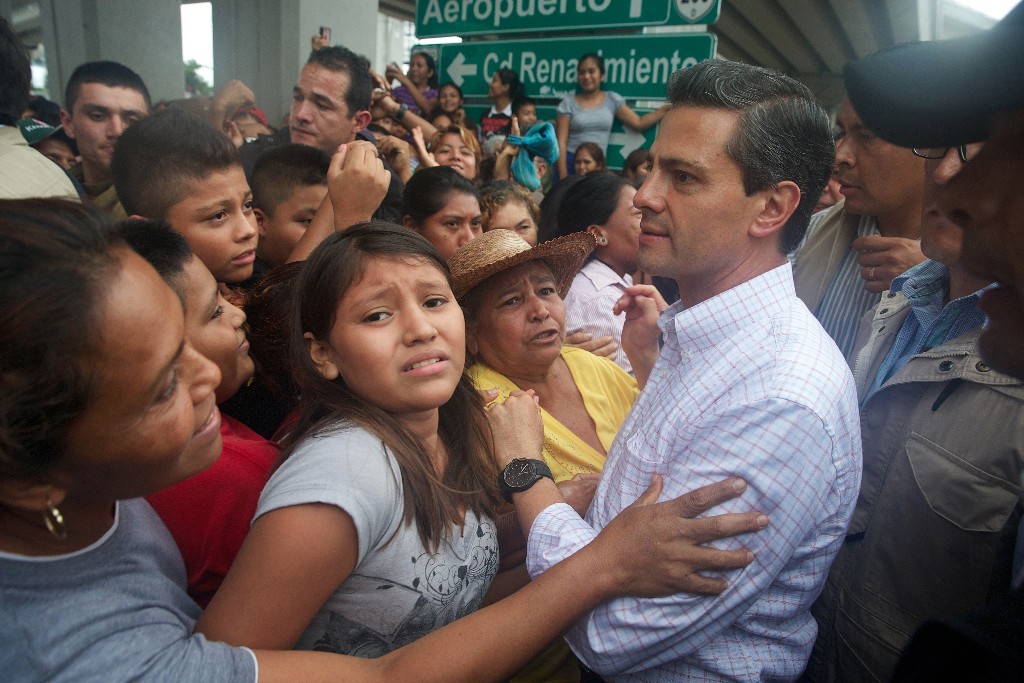
The simultaneous storms left an anarchic trail of floods, landslides and broken infrastructure in their wake. Dozens of people are missing and tens of thousands have been left homeless. At least 80 were killed and the death toll continues to rise.
By Wednesday night, the federal Interior Ministry had declared a state of natural disaster in 155 municipalities, 56 of them in Guerrero, the worst hit state in the country, with at least 72 fatalities.
Over 40,000 tourists who spent the holiday weekend in Acapulco were left stranded in the Pacific resort this week, with the airport severely flooded and the main roads out of the city blocked by landslides.
The military commandeered a commercial center for tourists in Acapulco’s upscale Diamante zone and had flown 5,300 people out of the city on 49 flights by Wednesday afternoon, but this represented just a small fraction of those stuck there. The remainder were left with no other means of returning home, as authorities said it would be Friday at the earliest before the highways leading out of the city could be cleared.
Desperate for food, drinking water and other basics, locals and tourists broke into the Zona Diamante branch of Costco under the watchful eye of the federal police, who made no attempt to detain even the more opportunistic looters who made off with electronics piled into their pick-up trucks. The majority who did not have access to working vehicles were forced to trudge through the pungent brown floodwater, at risk of an unwanted encounter with the crocodiles that had been swept from their natural habitat and onto the city streets.
Elsewhere in Guerrero, the situation was just as desperate. A massive landslide in the mountains to the north of Acapulco left scores of people buried in the village of La Pintada, the majority of them feared dead. On Wednesday, federal rescue teams airlifted out 35 residents, several of whom had been seriously injured, and recovered 15 bodies from the town, which was no longer accessible by road. Another 58 people were reported missing.

Federal Civil Protection coordinator Luis Felipe Puente said 35,000 homes had been damaged or destroyed and 39,000 evacuees were registered across the country by Tuesday afternoon. More than 11,000 houses were destroyed in Guerrero alone and over 12,000 refugees were being cared for in 47 shelters, Governor Angel Aguirre Rivero said on Tuesday.
Across Mexico, the two storms left 415,000 homes without electricity, although power had been restored in 80 percent of these cases by Wednesday, the Federal Electricity Commission (CFE) reported.
To repair the damage done, the federal government has over six billion pesos in reserve in the National Fund for Natural Disasters, Finance Minister Luis Videgaray said. But the Mexican Chamber of the Construction Industry estimates that the severe damage done to roads in at least ten states could alone exceed 40 billion pesos.
The government came under some criticism for being under-prepared for Manuel and Ingrid. Spanish-language daily La Jornada cited unnamed military sources and experts in civil protection who said that the authorities had underestimated the storms, due to a “lack of coordination” and the distraction of the weekend’s independence-related festivities.
Manuel re-formed into a tropical storm on Wednesday and gained hurricane status before making landfall west of Culiacan, Sinaloa shortly after 6 a.m Thursday. Some 45,000 people were left without power across Sinaloa as the state braced itself for an anticipated 200 to 300 millimeters of rainfall. Manuel was expected to revert to tropical storm status as it moves slowly over the land, also causing up to 150 millimeters of precipitation in Baja California Sur, Nayarit, and Sonora and up to 50 millimeters in western Jalisco.
Meanwhile, Mexico’s southeast was prepared for another round of storms, as the National Water Commission (Conagua) warned on Thursday that there was a 70 percent chance of Ingrid transforming into a tropical cyclone in the next 48 hours and bringing very heavy rainfall to Campeche, Chiapas, Quintana Roo, Tabasco, Veracruz and Yucatan. Ingrid was previously downgraded from a hurricane to a tropical storm just before striking Mexico’s Gulf Coast early on Monday morning.
Jalisco suffers as Manuel batters western Mexico
Hundreds of schools were closed, many major roads and highways were blocked and several bridges collapsed, with the southern and coastal areas of the state bearing the brunt of the storm.
The Jalisco Civil Protection agency confirmed that a 26-year-old man died after being swept away by flash floods in the village of Juanacatlan, Tapalpa, while a 12-year-old boy drowned after falling in the Santa Rosa dam in the municipality of Teocuitatlan de Corona.
Another man was reported dead after driving his car into a ravine in Cuautitlan de Garcia Barragan on Sunday, and yet another was reported missing after being swept away as he tried to cross the street in the town of Quitupan. The 42-year-old male, identified only as Mario, was found dead about four miles downstream in the Rio Quitupan on Wednesday.
Governor Aristoteles Sandoval revealed on Wednesday that 1,500 people had been evacuated from their homes as a precautionary measure, and the Jalisco government was still considering declaring a state of disaster in 37 of the state’s 125 municipalities as the Reporter went to press.
“Whenever there is a disaster we will be present, to be in solidarity with our people in every municipality in the state,” Sandoval said after taking part in an aerial inspection of some of the most damaged areas in southern Jalisco on Wednesday.
The municipalities of Tapalpa and Ciudad Guzman suffered the heaviest rainfall in Jalisco, each recording 128 millimeters of rainwater per cubic meter in the first 24 hours of the storm. The coastal municipality of Cihuatlan recorded 68 millimetres in the same period, while another 108.5 millimeters fell in Cajon de Peña, Tomatlan in a 24-hour period from Tuesday to Wednesday.
Chapala was perhaps the only place where such heavy rainfall was welcome. The water level of the depleted lake rose by ten centimeters from last Friday to Thursday, reaching a volume of 3.29 billion cubic meters, 41.67 percent of its capacity, the National Water Commission (Conagua) reported.
Classes were cancelled in 588 schools across eight Jalisco municipalities on Tuesday, State Education Secretary Francisco Ayon said, with over 40,000 students missing classes because of flooding, damage to school buildings and blocked or dangerous roads.
Manzanillo’s international airport was also closed on Tuesday because the access road was blocked, while bridges collapsed in the Jalisco towns of Zacoalco de Torres and Tamazula de Gordiano.
The worst-hit areas in the Guadalajara metropolitan area were Tlajomulco, Tlaquepaque and Zapopan, which suffered flooding, landslides, road damage and increased traffic accidents, while a cargo train on the Irapuato-Manzanillo railway line was forced to halt in Guadalajara as a landslide in Sayula left the tracks blocked.
More heavy rain was forecast in western Jalisco and Nayarit over the coming days after Manuel moved up the Pacific Coast and made landfall in Sinaloa early Thursday morning.
The Zapopan municipal government and the local branch of the Family Development Agency (DIF) are collecting supplies to support families affected by the storms. Donations of clean clothing (old or new) for children and adults; and non-perishable foods – such as bottled water, powdered milk, pasta, rice, tuna, sardines and canned vegetables – are welcome at the DIF Zapopan headquarters at Avenida Laureles 1151 and the municipal palace at Avenida Hidalgo 151, Zapopan Centro.
The Guadalajara Chamber of Commerce (Avenida Vallarta 4095) is also accepting donations of non-perishable food supplies, toilet roll, sanitary towels, soap, shampoo, razors, toothbrushes and toothpaste – but not clothing or bottled water – from Monday to Saturday, 8 a.m. to 8 p.m.
 The Tequila Files