Municipal, state, and federal officers were implicated in the coordinated and sustained attacks, along with soldiers who observed the action and threatened a group of survivors. It was one of the worst crimes in recent Mexican history, but the government was slow to react and its eventual investigation was riddled with glaring holes and confounding contradictions.
In the summer of 2014 it seemed like Mexico’s handsome young president Enrique Peña Nieto could do no wrong. Two years into his term, Peña Nieto had passed major structural reforms, overseen declining levels of narco violence, and imprisoned Joaquín “El Chapo” Guzmán, Mexico’s most wanted kingpin.
Time magazine hailed him on its cover as “Saving Mexico,” but when a group of students arrived in the town of Iguala in southern Guerrero state in late September that year, it ignited a chain of events that would tear this narrative to shreds.
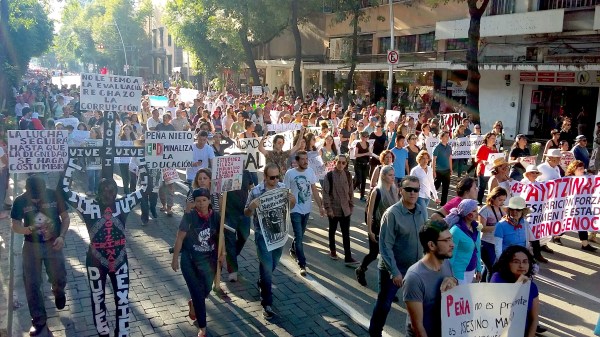
Moments after boarding buses headed for Mexico City, the students from the all-male Ayotzinapa teachers’ college were ambushed by police gunmen. Six people were killed, including one student whose face was flayed; dozens were wounded; and 43 young men were driven away in patrol cars, never to be seen again. Three years later, the students remain missing and Mexico’s presidency and its politics have never been the same.
The president was criticized for waiting a month before meeting with the missing students’ parents and for refusing to investigate the role of the army, fueling widespread suspicion that a cover-up was underway.
His reputation never recovered…
Parents of Mexico’s 43 missing students take matters into their own hands

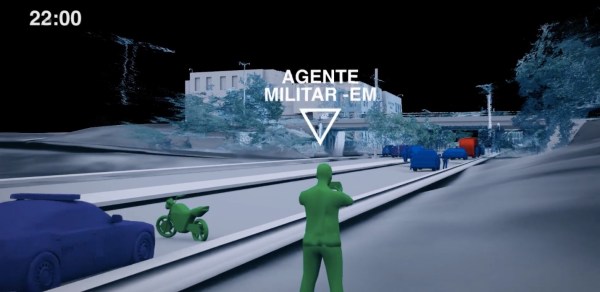
A 3D rendering from research firm Forensic Architecture shows the exact location of the military intelligence officer who observed the attack on a busload of students.
Mario González hoped the Ayotzinapa teacher training college in southern Guerrero state would provide his 22-year-old son César with a pathway out of poverty. But César was robbed of any future when police officers forcefully disappeared him and 42 male classmates on a hellish September night three years ago in the town of Iguala.
Alerted to the incident by one of César’s friends, Gónzalez, a 52-year-old welder from central Tlaxcala state, arrived in Iguala the next morning, but it was too late. The missing students had last been seen packed in patrol cars after a series of ambushes in which police killed six civilians and wounded dozens more.
Three years after the attacks, González is still trying to find his son and bring the culprits to justice. But the Mexican government’s widely discredited investigation has stalled, leaving unanswered questions over the level of state involvement in the crime, and robbing parents and survivors of any sense of closure.
Forced disappearances are not uncommon in Mexico, where over 32,000 people are currently missing, but Ayotzinapa captured the public’s attention more than any other due to the brutal, calculated manner in which the students were vanished, and the government’s inability to find them.
“All 43 families still feel the same pain as if our children had been taken from us yesterday,” González says. “We’re still determined to search for them, find them, and embrace them.”
Making a killing: a special investigation on the risks facing Mexican journalists
Pablo Pérez, a freelance journalist from Mexico City, was driving through the lawless southern state of Guerrero with two colleagues from the capital and four local reporters, when they were held up by hordes of armed men. Pérez was working on a story about locals displaced by drug-related violence. Now he would witness it first-hand.
“We’d just left the most dangerous zone and passed through an army checkpoint, which made us think we were in a safe area,” Pérez told Index shortly after the incident on 13 May. “But no, just one mile down the road we were stopped by a group of 80 to 100 young men, several of them carrying guns. They ransacked our vehicles and stole all our equipment, money and identification. They took one of our cars and left us with the other. They told us they had informants at the checkpoint and that they’d burn us alive if we spoke to the soldiers.”
Shocked but unharmed, Pérez and his colleagues were survivors of Mexico’s worst press freedom crisis in recent memory. A record 11 journalists were murdered last year and 2017 is on course to surpass that grim tally.