Beer duopoly forced to cede ground to microbreweries
The CFC announced early this month that craft or artisan beers must be allowed open and unrestricted access to all restaurants, bars and cantinas in Mexico. Any exclusivity agreements signed with Modelo or Cuauhtemoc can no longer legally restrict the sale of craft beer from Mexican microbreweries in these establishments.
From now on, all exclusive contracts must be written, transparent and time-limited, with clear rules for termination of contract. Furthermore, each company can sign exclusive contracts with only 25 percent of its current retail outlets – and this number must be reduced to 20 percent by 2018.
An independent body will verify compliance with these conditions and report regularly to the CFC. Breach of these conditions will result in a fine of up to eight percent of the guilty company’s annual domestic income. In the case of Mexico’s leading brewer Modelo, which made 51.6 billion pesos from domestic sales in 2012, such a penalty could be as high as 4.1 billion pesos, equivalent to a third of its total profits last year.
These restrictions are the result of an anti-monopoly investigation the CFC opened after SAB Miller, the world’s second largest beer producer, complained in 2010 that the duopoly’s exclusivity contracts were excluding it from access to the lucrative Mexican market worth over 20 billion dollars a year. Mexican craft breweries Minerva and Primus also lobbied hard for the new restrictions.
Ivan Torres of Minerva hailed the CFC ruling as “a great achievement” but warned the “war” between Mexico’s beer giants and its microbreweries will still continue. “Maybe now it will become a dirtier war, because [Modelo and Cuauhtemoc] will have to look at new ways of pressuring outlets into only buying their beers,” Torres told the Reporter.
Mexico is one of the largest producers and consumers of beer in the world, with annual production at 7.8 billion liters and annual consumption averaging 62 liters per capita, according to the National Chamber of the Beer and Malta Industry.
Modelo and Cuauhtemoc have long dominated the industry by offering bars and restaurants financial incentives or free refrigerators in return for exclusive sales. If independent breweries grew enough to be viewed as a threat they would be bought out, with notable examples including Modelo buying Guadalajara lager Estrella, and Cuauhtemoc buying Monterrey craft beer Casta – only to discontinue and eliminate it from the market.
As Mexico’s appetite for stronger, more flavorsome beers has grown in recent years, the duopoly has also sought to control this end of the market, with Cuauhtemoc beginning to sell Weissbier and chocolate stout versions of its popular Bohemia beer, and Grupo Modelo launching stronger craft-style beers Azabache and As de Oros last year.
According to Mexican daily Reforma, Modelo currently holds 54.25 percent of the domestic beer market, Cuauhtemoc has 45 percent, SAB Miller has 0.7 percent and craft breweries just 0.05 percent. However, the latter’s share of the market has already grown fivefold from 0.01 percent in 2011 and the Mexico Brewery Association (Acermex) expects it to reach one percent by 2017 – while Forbes magazine predicts it could even reach three to five percent in the next few years.
US customs error keeps local teens in prison

Sergio Alejandro Torres Duarte, 18, and Julio Cesar Moreno Guzman, 19, were detained at a police checkpoint in Esquinapa, Sinaloa on November 15, 2012, when officers found a package containing 914 grams of cocaine stashed in a secret compartment of their vehicle.
The pair, a month away from finishing their studies at the TecMilenio Preparatoria in Guadalajara, were on their way to a sporting event in Mazatlan in a car belonging to Torres’ father, also named Sergio Torres. Both denied any knowledge of where the drugs had come from.
Torres senior had purchased the blue 2004 Toyota Sienna on February 8, 2012, in an online auction of vehicles seized by U.S. authorities. By June 2012 he had legally imported the vehicle and had it registered with local plates.
Upon learning that his son had been arrested and imprisoned in Mazatlan, Torres began to investigate the vehicle’s origins. Records from The Monitor newspaper in Texas revealed that it had been seized in 2010, with five kilos of cocaine hidden inside.
Prosecutors in Mazatlan contacted the U.S. Customs and Border Protection (CBP) agency in order to verify whether the drugs matched those found in Esquinapa. The results came back positive, with both batches of cocaine being 91-percent pure and sealed in black wrapping marked “good.” The CBP admitted having either failed to detect the last package or forgotten to remove it.
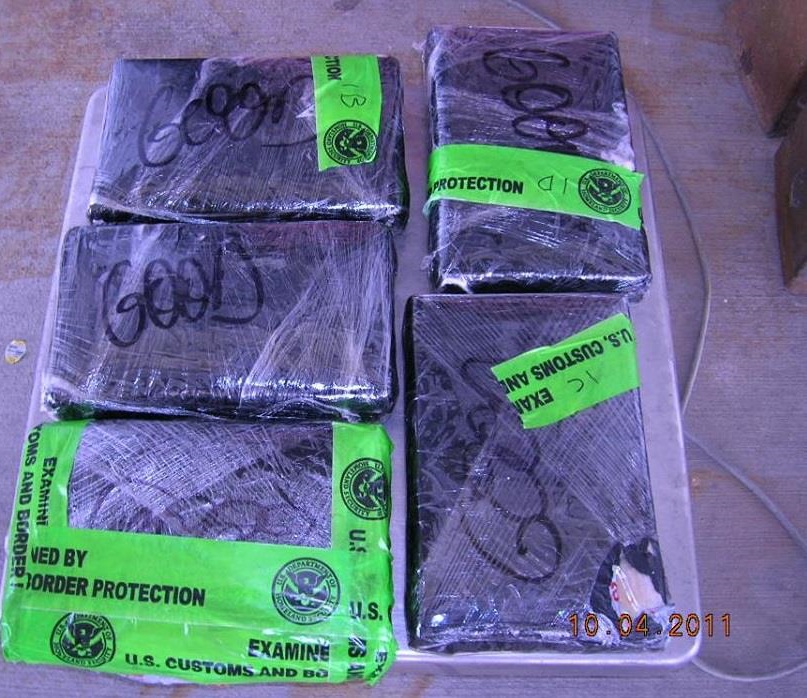
Despite this evidence, the Attorney General’s Office (PGJE) in Sinaloa sent another request to the United States asking for details of the equipment used to test the cocaine, plus a sample from each of the packages seized in Texas. With Torres and Moreno having already spent over eight months in jail, the U.S. government eventually responded that this would not be possible because the evidence had already been destroyed.
Undeterred, the PGJE then solicited new forensic evidence from the United States, a request which could delay the legal process by over six months and is unlikely to yield results given the destruction of the evidence.
Exasperated by this slow process and the absence of justice, the boys’ families – who have been taking it in turn to visit them each weekend at a cost of 7,000 pesos per trip – have begun a media campaign to raise awareness of the case and are considering filing a complaint against the U.S. government through the National Human Rights Commission (CNDH).
Over 1,600 people have joined a Facebook group entitled “Por Un Error de USA” in support of Torres and Moreno, while Twitter users have been highlighting their plight with the hashtags #PorUnErrordeUSA and #SergioYJulioInocentes. Speaking to Spanish-language daily Milenio earlier this week, Torres’ mother Roselia Duarte pleaded for executive intervention, urging President Enrique Peña Nieto to “help us, because we have seen that justice does not exist.”
Same-sex unions bill ratified in Colima
Colima has formally approved same-sex unions, with six of the state’s ten municipalities ratifying the bill passed by the local congress earlier this month.
The amendment to Article 147 of the state constitution means gay couples can now enjoy the same rights as married heterosexual couples, while preserving the term “marriage” as a union exclusively between a man and a woman.
 The Tequila Files