Government foils plot to kill congressmen
Authorities arrested a group of armed men who allegedly plotted to assassinate two leftist legislators in Mexico City last Thursday.
Assistant Attorney General Mariana Benitez said the gang members were captured in a hotel in the capital and have since confessed to planning to kill brothers David and Ricardo Monreal Avila, both federal congressmen from Zacatecas.
“Early today, the raid was successfully carried out without violence,” Benitez said on April 4, adding that authorities had also seized weapons, communications equipment and a vehicle “which they planned to use for the attacks.”
Benitez said that the two intended victims had been warned and placed under protection once the plot was uncovered, based on intelligence information. The authorities did not specify how many suspects had been detained and gave no motive for the planned assassination.
Both brothers represent the Mexican left, with David, 47, a senator for the Labor Party and Ricardo, 52, a congressman for the Citizen’s Movement. The latter served as Zacatecas governor from 1998 to 2004 and worked as a campaign manager in Andres Manuel Lopez Obrador’s failed bids to win the presidency in 2006 and 2012.
“Smokescreen, intimidation, terror and from whom? The truth must rapidly be known,” Lopez Obrador wrote on Twitter on Friday, as well as voicing his “solidarity” with the brothers.
News of the arrests sparked speculation that one of Mexico’s drug gangs could have been behind the plot.
In 2009, the Mexican Army seized over 11.4 tons of marijuana in a raid on a warehouse owned by a third brother, Candido Monreal. The Monreals claimed the warehouse was used for drying chilli and had been broken into and used by a drug gang. Candido was never charged.
Later that year Ricardo accused the Party of the Democratic Revolution (PRD) which then ruled Zacatecas of being infiltrated by organized crime. He subsequently resigned from the leftist party in protest at what he called a smear campaign against him.
Yet this pales in comparison to the events of March 1921, when, for the first and only time in the state’s history, Jalisco was briefly governed by two men from opposing parties.
The historic pair were Salvador Escudero, a poet from Guadalajara who represented the Jalisco National Party, and Basilio Vadillo, a teacher and veteran of the Mexican Revolution from Zapotlan, who represented the Liberal Constitutionalist Party. Both had served in the federal Congress from 1918 to 1920, before competing for the state governorship, along with Carlos Cuervo of the Independent Liberal Party.
The election was marked by irregularities and beset by violence, with both Escudero and Vadillo claiming victory. The former would take up office in Guadalajara in early 1921 while the latter did the same in Chapala.
On December 31, 1920, Escudero had sent President Alvaro Obregon a report documenting his electoral victory and a long list of infringements committed by Vadillo and his party, but Obregon eventually ruled in favor of Vadillo, out of gratitude for his loyal support and the complimentary coverage he had received in “El Monitor Republicano,” a newspaper Vadillo founded in 1919.
Escudero was forced to step down and eventually retired to Lagos de Moreno where his political career came to an end. Yet it was not plain sailing for Vadillo, who would fail to see out his term in office, despite introducing measures against gambling and street fights that earned him the support of broad sectors of society, including the Guadalajara clergy.
Vadillo’s problems began when he fell out with the influential Guadalupe Zuno group, to whom he largely owed his rise to power. Not only did Vadillo exclude the Zuno circle form his cabinet, he also dismissed one of them, Alfredo Romo, from his position as Mayor of Guadalajara.
This led to a conflict with the state Congress, where the Zunistas held a majority and set out to undermine the Vadillo administration and block any legislation he tried to pass. When Congress decided to cut taxes in Jalisco by 10 percent, Vadillo protested, saying that the local deputies cost much and did little. They replied that he did almost nothing and spent too much.
The conflict between Vadillo and the Zunistas came to a head when local politicians affiliated with the Zunistas held a secret meeting with the intention of removing Guadalajara Mayor and Vadillo supporter Jose Suarez. Two of Vadillo’s agents infiltrated the meeting, leading to a shootout which was subsequently blamed on the governor.
Vadillo tried claim immunity to the charges brought against him but a judge ruled in favor of Congress and Vadillo was impeached on March 17, 1922.
In a vain attempt to retain power, Vadillo and his supporters moved to Chapala, in the hope that Obregon would reinstate him. But the president approved Vadillo’s impeachment and sent him into political exile, working for Mexico’s foreign ministry in Norway and later in Denmark.
Monarch butterfly migration in heavy decline
Illegal logging, the use of herbicides and climate change are all thought to have contributed to the sixth drop in butterfly numbers in the last seven years, with the Monarch population in Mexico now only one-fifteenth of that in 1997.
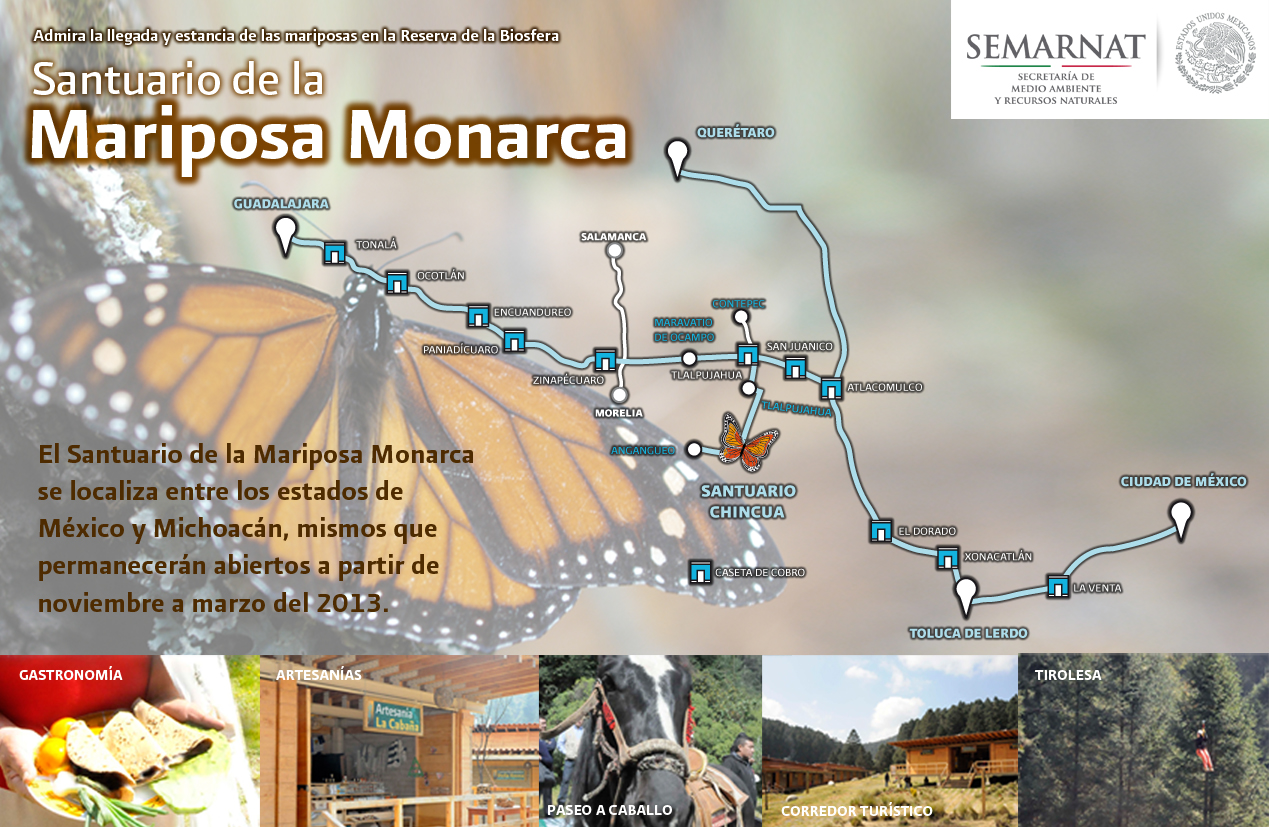
Every year millions of the distinctive orange and black butterflies make the epic journey from Canada and the United States to settle for the winter in the mountainous fir forests of Michoacan and the State of Mexico.
It is an extraordinary migration, with none of the butterflies making the entire round trip. The journey is completed with remarkable precision by several generations of butterflies, most of whom live for no more than eight weeks. Arriving in Mexico in late fall, they begin the northward return journey in mid-March.
Due to the sheer quantity of butterflies that settle in and around Michoacan’s Monarch Butterfly Reserve, the insects are counted by the amount of forest they cover. This winter they covered just 2.93 acres, the lowest figure since records began 20 years ago and 59 percent down from last year’s 7.14 acres.
The figures confirm a long-term statistical trend, which the World Wildlife Fund (WWF) blames primarily on the extensive use of herbicides that kill off milkweed, the Monarchs’ main food source, in their breeding grounds in the United States and Canada. In recnt years farmers have increasingly used herbicides to kill off all plants in their fields except for their genetically modified corn and soybean crops, but the ensuing destruction of milkweed is
extremely damaging for the butterflies that lay their eggs on the plant and rely upon it as an essential food which also provides a poisonous toxin that makes them unpalatable to birds and other predators.
“The conservation of the Monarch butterfly is a shared responsibility between Mexico, the United States and Canada. By protecting the reserves and having practically eliminated large-scale illegal logging, Mexico has done its part,” Omar Vidal, the director of the WWF in Mexico, said recently. “It is now necessary for the United States and Canada to do their part and protect the butterflies’ habitat in their territories.”
Illegal deforestation in Mexico had long been considered a major factor in the decline in butterfly numbers, but an aerial survey in 2012 showed almost no detectable logging for the first time since 200 square miles of mountaintop forests were declared a protected nature reserve in 2000.
But not everyone is convinced that Mexico has done enough to stop illegal logging. Having studied Monarch migration for 55 years and personally witnessed the continuation of small-scale logging in the Michoacan sanctuary on a visit in February, U.S. entomologist Lincoln Brower issued a statement declaring it misleading “to blame the low numbers of monarchs solely on what is happening north of Mexico.”
Brower said that even small reductions of the forest cover can expose the butterflies to potentially fatal lower temperatures, humidity, and direct sunlight. He added that local communities are being allowed to pipe water out of streams, with disastrous effects for the butterflies which do not drink water throughout their long migration until they reach Mexico.
Climate change has also proven a factor in the declining butterfly numbers. Unusually hot temperatures in the United States early last year upset the Monarchs’ breeding patterns, while the hot, dry summer dried out and killed their eggs, as well as reducing the nectar content of flowers.
 The Tequila Files