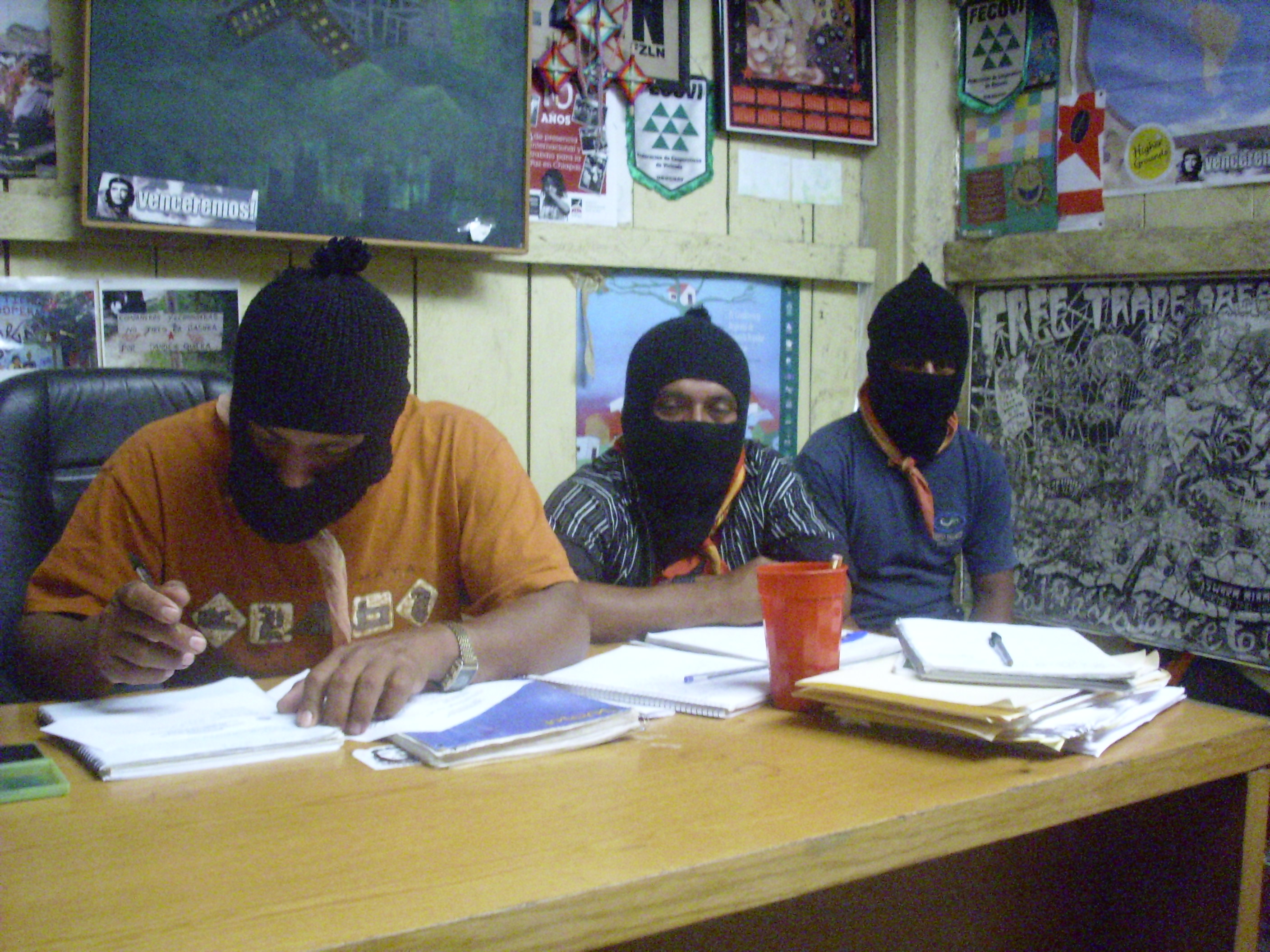
In recent months it has become more common and even accepted for masked men armed with rifles to patrol and set up checkpoints at the entrances to isolated towns in order to keep their communities free from extortion, kidnapping and drug trafficking.
Earlier this year, indigenous Nahuas in the hills of Manantlan in southern Jalisco began organizing themselves in a bid to ward off armed gangs and put an end to illegal logging and mining operations in the area.
Last month, around 150 indigenous residents of Cuautitlan de Garcia Barragan met with local and state officials and the Mexican military in an attempt to resolve security issues. The inhabitants of the town demanded a greater protective presence from local authorities, but also insisted upon being allowed to maintain their own armed civil defense units.
The plan to establish a self-defense group to police the area was eventually abandoned at another meeting on March 17. Of the 1,414 Nahua farmers who work the land in Ayotitlan – Mexico’s largest plot of communal farmland, located in Cuautitlan de Garcia Barragan – around 800 opposed the idea, which was formally rejected in a document signed by the mayor and other local authorities.
The concept of civil defense organizations policing indigenous communities is not new in Mexico – the Zapatistas have lived in complete autonomy in the mountains and jungles of Chiapas since 1994 – but the practice has become increasingly common in the western states of Jalisco, Michoacan, Guerrero and Oaxaca in recent months and even received endorsement from the federal government earlier this year.
“I see the risk of violence, insecurity, drug trafficking, organized crime – for me, that’s more worrying (than self-defense groups),” Jaime Martinez Veloz, Mexico’s new Commissioner for Dialogue with Indigenous Peoples, said in February.
“Let’s see why they are occurring to see if they are legitimate or not. In some cases there is a political motivation, in others it is social,” Martinez added, while Interior Minister Miguel Angel Osorio Chong also expressed “solidarity, trust, and support” for such groups.
However, in certain cases the line between self-defense groups and drug gangs is becoming increasingly blurred. Last week, Mariana Benitez of the federal Attorney General’s Office (PGR) said several vigilantes arrested in the town of Buenavista, Michoacan had “clear connections” to the Cartel Jalisco Nueva Generacion (CJNG).
The vigilantes in Buenavista, situated just five miles from the border with Jalisco, had claimed they were defending the town against the Knights Templar cartel, a fierce rival of the CJNG, but officials say they too have been violating the law and the human rights of people they detain.
Soldiers raided the town and arrested 34 vigilantes after they took over the local police facilities, kidnapped officers and seized police weapons and vehicles in mid-March. Benitez said some of the detainees fired shots during the raid and the soldiers seized a total of 18 assault rifles and 15 pistols.
The vigilantes had raised suspicion from the outset, when around 500 masked men arrived in Buenavista and the nearby town of Tepalcatepec in late February, armed with AK-47s and traveling in luxury SUVs – displaying manpower, weapons and vehicles well beyond the modest means of self-defense groups based elsewhere in Mexico. Wearing white t-shirts emblazoned with the slogan “For a free Tepalcatepec,” they claimed to be financially supported by local businesses and took up defensive positions at the entrances to the town.
The border area between Jalisco and Michoacan has been the scene of a bloody turf war between the CJNG and the Knights Templar since late last year and the presence of heavily armed vigilantes in Tepalcatepec and Buenavista appears to be an attempt by the former gang to extend its territory into Michoacan.
Although Mexican authorities have generally tolerated vigilante groups to date – largely due to the government’s inability to enforce public safety in remote, rural areas – the recent events in Michoacan have marked a turning point.
Wary of allowing criminal gangs to take advantage of any leniency on the part of local authorities, Senator Omar Fayad of the Institutional Revolutionary Party said “the Mexican government cannot allow the existence of ‘self-defense’ groups” such as those in Michoacan. Fayad added that “authorities should analyze them case by case” in order to sort the legitimate self-defense groups from vigilantes working at the behest of organized crime.
City authorities working to pacify street gangs
Twelve street gangs from the rundown neighborhoods of Miravalle, Lomas del Paraiso, Oblatos and El Zalate have struck a peace agreement brokered by the city’s Public Safety Department, Director Carlos Mercado Casillas announced this week.
Through the department’s Prevention of Youth Violence program, local youths are encouraged to dedicate their free time to cultural activities such as making hip-hop music and painting graffiti-style murals, instead of indulging in petty crime. A second phase of the program will then offer them scholarships to study or opportunities for employment.
According to the municipal government, there are around 200 small but violent street gangs in 60 neighborhoods across Guadalajara. In addition, there are over 400 gangs in 29 Zapopan neighborhoods and another 68 street gangs in Tonala.
From October to date, Zapopan’s Public Safety Department has arrested 1,350 people involved in street gangs, of whom approximately 200 were aged under 18. They are commonly found in possession of knives, handguns and drugs, revealed David Mora Cortes, the director of the department.
Zapopan Mayor Hector Robles said this week that the recently established Municipal Training Institute will provide care and training for more than 10,000 young people in 2013, in a bid to keep them from turning to a life of crime. A similar program in Tonala will renovate public parks in order to create a safer environment, as well as providing psychological care for gang members and attempting to integrate them back into society through sporting and cultural activities.
 The Tequila Files