‘Resurgent’ Zapatistas march in silence
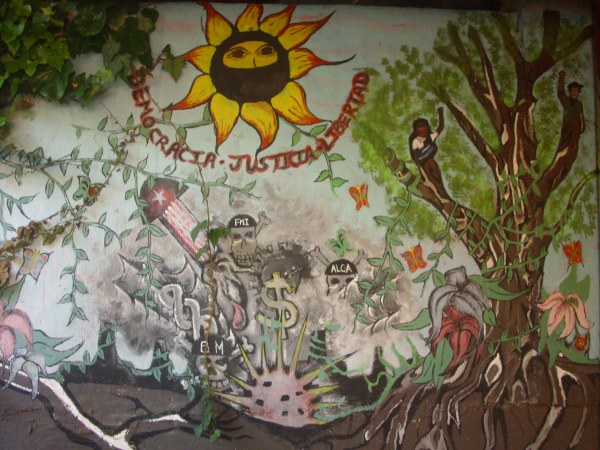
Descending from remote mountain communities, the Zapatistas marched in the rain through the cities of San Cristobal de las Casas, Ocosingo, Altamirano, Las Margaritas and Palenque, without uttering a word.
“Did you hear? That is the sound of your world falling apart. It is the sound of our resurgence,” read a brief communiqué issued by Zapatista spokesperson Subcomandante Marcos.
The Zapatistas are of Mayan descent and their re-emergence coincided with the beginning of a new cycle in the Mayan calendar: a rebirth rather than the apocalypse some panicked westerners had anticipated.
The rebels’ first public act since protesting the government’s militarized approach to the war on drugs in April 2011 was also timed to mark the 15th anniversary of the massacre of 45 Zapatista sympathizers in Acteal, Chiapas.
The Zapatistas believe the Institutional Revolutionary Party (PRI) was behind the massacre and their dignified march was an act of defiance toward their old adversary, which reclaimed power on December 1 after a 12-year absence.
On Sunday, December 30, Marcos issued two longer statements, the first of which was entitled “Don’t we know them?” in reference to the shady history of President Enrique Peña Nieto and prominent members of his cabinet.
“Aren’t you those guys who have always chosen violence over dialogue?” Marcos asked, citing the role that Peña Nieto played in the violent crackdown on peaceful protests in San Salvador Atenco in 2006; and the alleged role of new Education Secretary Emilio Chuayffet in the Acteal massacre in 1997.
“In the coming days the EZLN will announce a series of civil and peaceful initiatives to keep walking alongside the other native peoples of Mexico and the entire continent,” Marcos announced in the other communiqué, revealing only that the Zapatistas will “try to build the necessary bridges toward social movements that have arisen and will arise – not to direct or supersede them, but to learn from them, their history, their paths and destinies.”
The Zapatistas have kept a low profile since Marcos embarked upon “La Otra Campaña” (“The Other Campaign”) during Mexico’s 2006 presidential elections, but continue to live in autonomy in the highlands and forests of rural Chiapas. The recent mobilization was the largest since the initial EZLN uprising on January 1, 1994, when masked guerrillas briefly seized control of several towns and cities across Chiapas.
“19 years ago we surprised them, taking their cities with fire and blood. Now we’ve done it again, without arms, without death, without destruction,” Marcos said.
The scale of the marches showed that the counter-insurgency strategy followed by successive state and federal governments has failed to diminish the Zapatistas’ popularity in their corner of Mexico.
“All political parties, without exception, have attacked us militarily, politically, socially and ideologically … the corporate media tried to make us disappear,” wrote Marcos, “as was evident on December 21, 2012, all have failed.”
Teachers’ union hits out at educational reforms
“We can not allow threats and coercion. Teachers will not be threatened,” Elba Esther Gordillo said at a press conference last week. “Teachers should be stimulated and encouraged to better themselves.”
Gordillo was responding to reforms passed by the Chamber of Deputies last Wednesday which would weaken the grip of the SNTE over educational policy by establishing an autonomous National Institute for the Evaluation of Teachers. The amendments to articles three and 73 of the Constitution would oblige teachers to undergo periodic evaluations in order to obtain professional positions.
Backed by Mexico’s three main parties but opposed by Gordillo’s New Alliance Party (PANAL), the bill received general 424 votes in favor, 39 against and 10 abstentions in Mexico’s lower house. To become law, the reforms must also be ratified by the Senate and 16 local congresses.
Peña Nieto to create 10,000-man security force
Instead of pursuing the heads of drug cartels, Peña Nieto told the National Public Security Council on Monday that he will focus more on reducing crimes against civilians, such as murder, kidnapping and extortion. To this end he will create a 10,000-strong gendarmerie (a military force charged with police duties) to operate in rural areas where the police and army have failed to take control.
“I am convinced that we’re opening a new path, a new route and a new way to address the security of the Mexican people,” he told cabinet ministers, state governors and security officials.
Similar gendarmerie forces are used in European countries like Spain and Italy, although Peña Nieto’s plan to train 10,000 officers has dropped considerably from the 80,000 he had promised on the campaign trail.
While this announcement was more specific than previous pledges to reduce drug violence, the president still offered no timeline for when the force would be established, nor any explanation of how officers would be recruited.
Furthermore – despite having repeatedly promised to move away from the military-led campaign against organized crime favored by his predecessor, Felipe Calderon – he declined to confirm whether he will withdraw the Mexican Army from the front-lines of the war on drugs.
Interior Minister Miguel Angel Osorio Chong was fiercely critical of Calderon’s militarized strategy this week, noting that under the past administration, “financial resources dedicated to security have more than doubled but unfortunately crime has increased.”
“The rate of increase in homicides places us among the highest in the world,” Chong added. “In recent years, because of the violence linked to organized crime, thousands of people have died and thousands of people have disappeared.”
 The Tequila Files