Major parties sign president’s ‘Pact for Mexico’
“The country must be transformed without delay,” President Enrique Peña Nieto said at Chapultepec Castle Sunday, December 2 after unveiling the blueprint for increased economic growth, employment and competitiveness, approved by leaders of the conservative National Action Party (PAN) and the leftist Party of the Democratic Revolution (PRD), as well as his Institutional Revolutionary Party (PRI).
The agreed commitments include 95 of Peña Nieto’s 266 campaign promises, such as pensions for people over 65, concessions for two new national television stations, measures to fight poverty and corruption and to improve education, security, justice and transparency.
While Peña Nieto called it an “unprecedented and important” agreement for Mexico, the non-binding agreement is essentially just a statement of intent, as opposition parties could withdraw their support at any moment and the document does not spell out exactly how all of these ambitious aims are to be realized.
The pact reflects the non-ideological nature of the PRI, with commitments aimed at drawing support from the both the left and the right. While Pemex will remain in government hands, the pro-business PAN will have been encouraged by plans to revise mining royalties and open up the refining and the transportation of oil and gas to competition.
Likewise, the PRD will have been appeased by plans to create two new free-to-air television networks, which would reduce the power of Televisa – widely criticized for its pro-Peña Nieto bias during the election – and educational reforms that would wrestle back power from the controversial and corrupt teacher’s union headed by Elba Esther Gordillo.
Jesus Zambrano, the national leader of the PRD, said signing the pact was “a risk worth taking,” noting that the election had showed that “no single political force can push through their proposals or resolve the grave problems facing the country.”
Yet some party members considered signing the pact a form of betrayal. PRD Secretary General Alejandro Sanchez Camacho said Zambrano signed it in “a personal capacity,” in an action that did not represent the entire party.
Police and students clash as protests turn violent
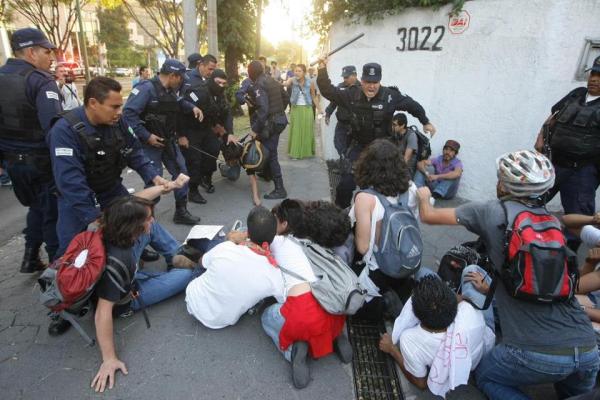
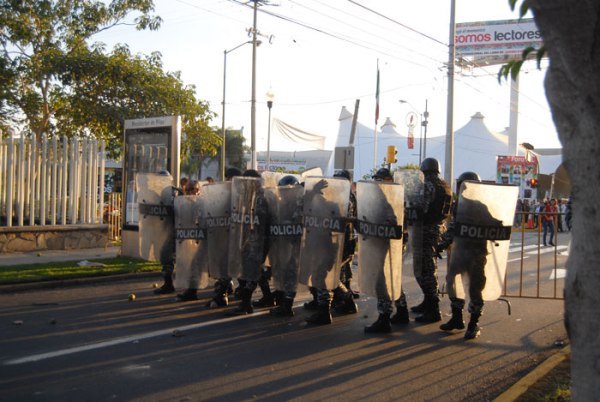
Truncheon wielding riot police arrested 27 protesters outside Guadalajara’s International Book Fair (FIL) after a small number of them threw stones and glass bottles.
Protesters – mostly young students – had gathered at the Tianguis Cultural market early Saturday to express their discontent at the investiture of Peña Nieto, who returned the Institutional Revolutionary Party (PRI) to power after an absence of 12 years. The group swelled to around 500 as they marched to the local PRI headquarters and the studios of broadcaster Televisa, before moving on to the Expo Guadalajara where the FIL was being held.
Rodrigo Cornejo of the #YoSoy132 student movement was present throughout the day. He told the Reporter that the trouble began when a group of four of five people started throwing stones at the PRI and Televisa offices, breaking several windows.
In both cases, Cornejo said “there were police officers 10 to 12 meters away who made no attempt to stop or detain those throwing stones.” Instead, members of #YoSoy132 tried to prevent the assailants from throwing missiles.
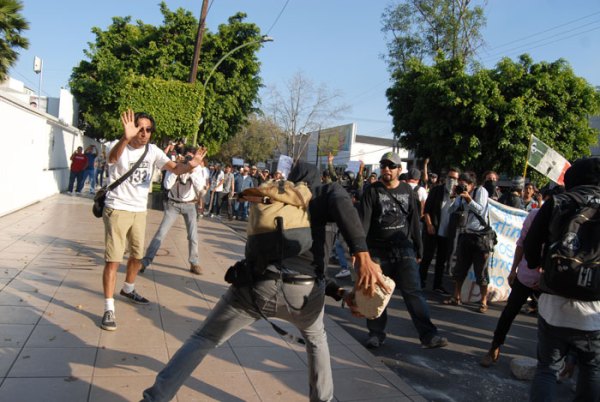
Guadalajara Mayor Ramiro Hernandez confirmed this week that the march was “infiltrated by agent provocateurs who seek nothing more than to create conflict and violence.”
Photographer Juana Cazares was on hand to capture the events for the Reporter. She confirmed there was a “small group of protesters throwing stones and bottles” at the two officers before an increasing police presence.
When the demonstrators arrived at the Expo on Avenida Las Rosas and Mariano Otero, Cazares said there were many granaderos (riot police) awaiting them and blocking their path to the entrance. The protesters began throwing oranges and other objects at the police, who hurled the same missiles back at them, she said.
“The police were daring us to come nearer and the students were shouting back at them,” Cornejo said. When the demonstrators breached the metal fence, the police stormed the crowd with their truncheons. Several officers “beat a group of people that were carrying away a girl who had suffered a broken leg,” Cornejo said.
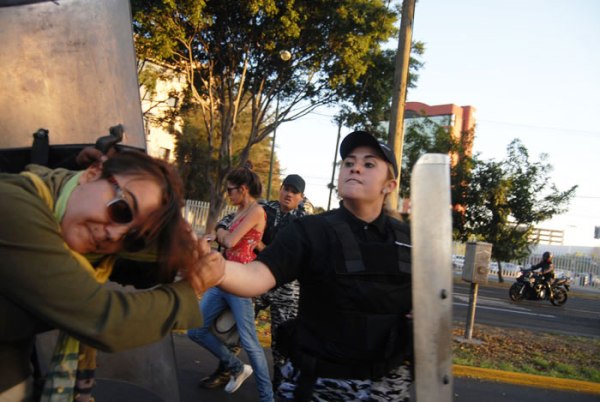
“The police were abusive, they became more violent than the students,” Cazares confirmed. “They even went after young people who were just sitting on the sidewalks.”
The police arrested 27 people, including nine women and one minor. Eighteen of the detainees belonged to the #YoSoy132 movement and at least two were pedestrians walking past the FIL at the wrong time.
“One of them was arrested because he tried to intervene when police were hitting a woman,” Cornejo said.
Marco Antonio Cortes, rector of the University of Guadalajara (organizers of the FIL), said he “categorically rejected” the events that occurred outside the book fair. The university “has always been open to dialogue and the free manifestation of ideas but when violence invades public space we all become hostages,” he said in a statement.
Around 150 members of #YoSoy132 and Andres Manuel Lopez Obrador’s National Regeneration Movement (Morena) marched to the Jalisco Attorney General’s Office (PGJEJ) offices on Sunday to demand the prisoners’ release. They face charges of assault, vandalism and damage to private property and must pay a collective fine of 80,000 pesos, plus bail of 2,000 pesos per person.
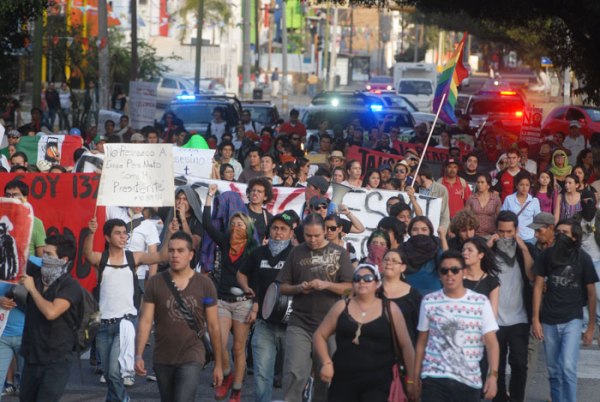
Of the 27 people arrested, two were bailed on Sunday, and eight more were due for release on Monday afternoon, the PGJEJ said. Family members and students have so far raised 60,000 pesos in a bid to free the remainder, Cornejo told the reporter.
Four of the wounded police officers have filed complaints against the protesters with the PGJEJ, while Guadalajara’s Public Security Commissioner Carlos Mercado Casillas said on Monday that there will be an investigation into alleged police brutality during the confrontation with demonstrators.
Similar disturbances occurred across Mexico City during Peña Nieto’s inauguration. Officials in the capital said 103 people were detained, including 11 minors, following clashes between demonstrators and the police.
Twelve officers were injured by groups of what the government described as “anarchists” throwing stones and Molotov cocktails, while at least 76 people were treated for injuries – including 29 who were hospitalized – when the police responded with tear gas and rubber bullets.
Impatient Chivas fire Dutch legend Cruyff
A statement on Chivas’ website revealed owner Jorge Vergara had dismissed Johan Cruyff from his advisory role, just nine months after hiring the Dutch legend to oversee a long-term transformation of the club.
 Cruyff’s “contract had been terminated” because “established objectives had not been met,” the statement read. “The coaching staff will not be affected,” Chivas said, but given that Dutch coach John van’t Schip was appointed by Cruyff, an imminent resignation or dismissal would come as no surprise.
“I don’t know anything. I just heard about it. I’m trying to figure out what’s going on,” Cruyff told Dutch newspaper De Telegraaf on Monday morning. Chivas declined to personally inform their advisor of the decision to fire him, with the Johan Cruyff Institute revealing on Tuesday that the only notice it received came in an email from the club.
One of the most gifted footballers of all time, Cruyff drew plaudits at Dutch club Ajax and Spanish side Barcelona in the 1960s and 1970s. He later returned to coach both teams – again to great acclaim – and is credited with laying the foundations of their hugely successful youth academies.
Vergara hired him on a three-year contract in late February, with the task of building a similar legacy at Chivas, which is unique in its policy of only fielding Mexican players. Cruyff would instill a brand of “total football that enables us to be a team like Barcelona, the best in the world,” Vergara boasted at the time.
Yet such a project would require years of work and Vergara is not renowned for his patience. It appeared to snap as Chivas endured a torrid year, suffering humiliation in the CONCACAF Champions League and scraping through into the Apertura 2012 playoffs, only to lose the quarterfinal 5-2 to Toluca.
The timing of Sunday’s announcement – made during the Liga MX final in which Tijuana defeated Toluca 4-1 on aggregate – appeared a vain attempt by the Chivas public-relations department to bury bad news.
With 11 league titles, Chivas remain the most successful side in Mexican history, yet they have won just one championship under Vergara’s ten-year tenure.
Cruyff is thought to have upset his employer during an October visit to Guadalajara, when he tried to play down expectations by noting that Chivas was no longer a massive club, having won just three championships in the last 40 years. Cruyff also criticized the instability that Vergara had brought about by changing coach ten times in the last decade.
 The Tequila Files