Peyote picking under threat
One of four Wixarika deities, peyote is considered a means of communicating with the gods, and for thousands of years the Wixarika have embarked on pilgrimages to pick the hallucinogenic cactus flower in the mountainous “Wirikuta” area of Real de Catorce in San Luis Potosi.
But a presidential decree issued on October 26 partly prohibited this ancient tradition by outlawing the harvest of fruit from two protected areas in San Luis Potosi.
At a press conference last week, the Regional Council for the Defense of Wirikuta, demanded that the government guarantee their right to pick peyote. The council also called for the cancellation of 79 mining concessions affecting their sacred land.
Since 2009, the Wixarika have been campaigning against mining concessions granted by the Mexican government to Canadian firms. The mining has a devastating impact on the local environment, critics say, with swaths of land destroyed and large quantities of cyanide used in the process.
How a gringo reporter inadvertently sparked Mexico’s Revolution
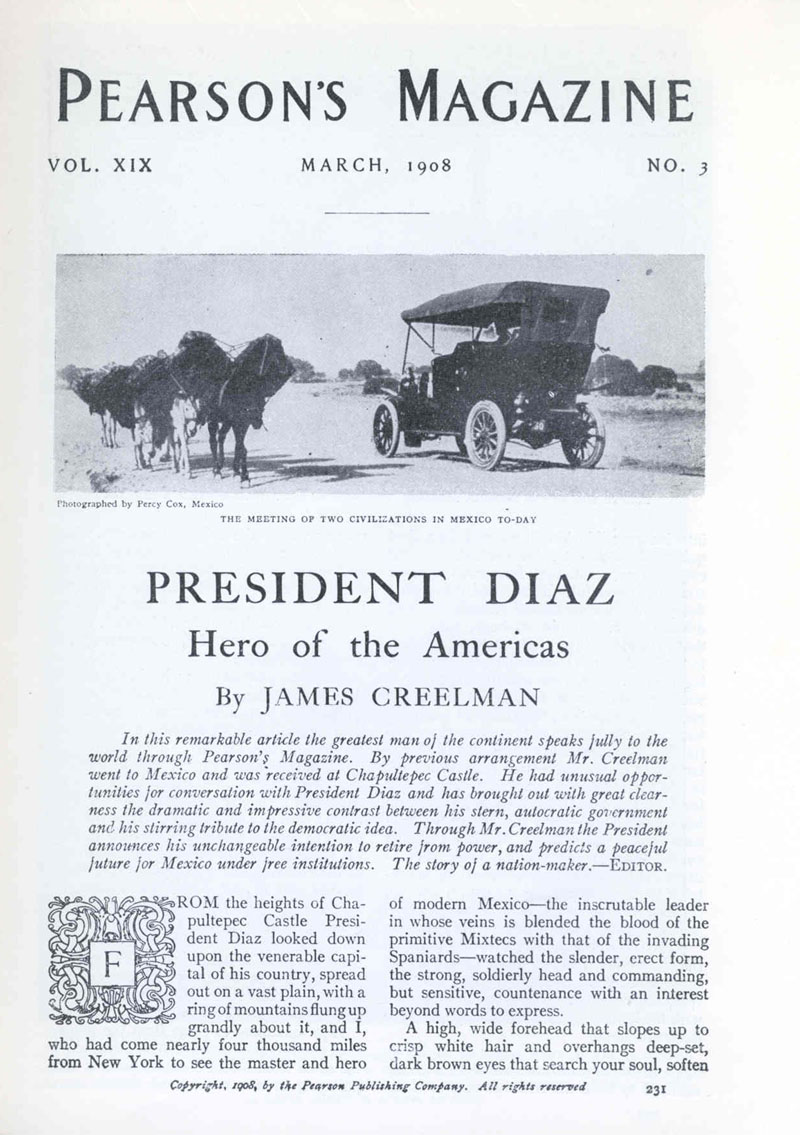
But one of the sparks that helped ignite Mexico’s Revolution came two years earlier, when Diaz granted an interview to Canadian-American journalist James Creelman for Pearson’s Magazine.
“I have no desire to continue in the Presidency. This nation is ready for her ultimate life of freedom,” Diaz famously remarked in the fateful interview at Chapultepec Castle, seemingly paving the way for a more democratic Mexico. “No matter what my friends and supporters say, I will retire when my present term of office ends, and I shall not serve again. I shall be eighty years old then.”
 Defending his three decades in office, Diaz said, “it is a mistake to suppose that the future of democracy in Mexico has been endangered by the long continuance in office of one President. I can say sincerely that office has not corrupted my political ideals and that I believe democracy to be the one true, just principle of government, although in practice it is possible only to highly developed peoples.”
Pressed on Mexico’s one-party system, Diaz responded, “It is true there is no opposition party. I have so many friends in the republic that my enemies seem unwilling to identify themselves with so small a minority.”
But Diaz’s allusion to the possibility of political change soon led his enemies to stand up and be counted.
Most prominent among them was Francisco Madero, a democratic aristocrat galvanized by Diaz’s declaration. Later in 1908 Madero published a bestselling book entitled “The Presidential Succession in 1910” and the following year he founded the first anti-reelection club in Mexico City.
As many similar groups sprung up across the country, Diaz had a change of heart and decided to run one last time. When Nuevo Leon Governor Bernardo Reyes emerged as a popular candidate among liberals, Diaz sent him on a mission to Europe, ensuring he would miss the election.
Despite initially allowing Madero to run for president, Diaz had him thrown in jail and was subsequently re-elected in a fraudulent landslide.
Madero’s influential father had him released from prison, from where he escaped across the border into Texas. From exile he denounced the fraudulent election, before returning to Mexico on November 20, 1910, to lead a revolution.
 Diaz was eventually forced from office and fled the country for Spain in May 1911. Six months later Madero became the new President of Mexico.
This was the only the beginning of Mexico’s complex and long-winded Revolution, as Madero’s former allies Pascual Orozco and Emiliano Zapata would soon grow disillusioned with his moderate reforms.
The Revolution dragged on until around 1920, with the presidency changing hands several times. Meanwhile, Diaz died in exile in Paris in July 1915.
Creelman, the man whose article inadvertently and indirectly kick-started Mexico’s Revolution, died of Bright’s Disease the same year, shortly after arriving in Germany to cover the First World War.
An acclaimed writer for the New York Herald and later the New York World – where he worked under Joseph Pulitzer – Creelman had traveled far and wide throughout his career, covering major events in China, Korea, France, the United Kingdom and Cuba.
A key player in the sensationalist “yellow” journalism prevalent at the time, he famously interviewed Sitting Bull while investigating the death of General Custer, and later became the first English speaking non-Catholic reporter to interview the Pope, Leo VIII.
In 1906 Creelman joined Pearson’s Magazine as associate editor. He later expanded his interview with Diaz for said publication into the 1912 book “Diaz, Master of Mexico.”
Creelman steadfastly believed that journalism was a potent vehicle for social change. But when he wrote, “there is not a more romantic or heroic figure in all the world,” in his vivid and flattering portrait of Diaz, he surely did not envision that his reporting would indirectly contribute to the man’s downfall.

