How Mexico reacted to Obama’s re-election
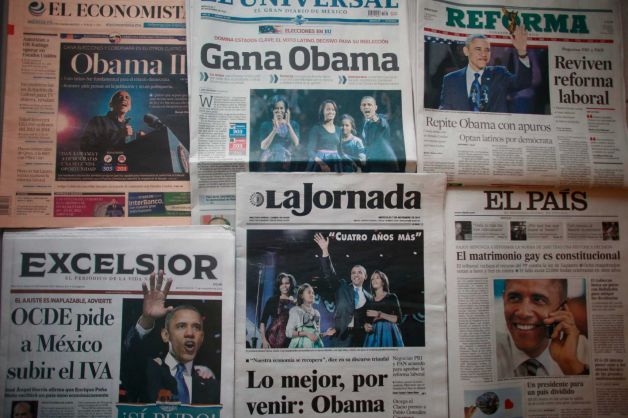
Writing in Reforma, renowned former politician and academic Jorge Castañeda drew three main conclusions: that “Obama won by a larger margin than expected, both in the popular vote (a difference of almost 3 million votes) and in the electoral college (almost 100 votes difference);” that “Obama owes his reelection to the Hispanic vote;” and that “certain segments of the population are much more liberal than you think. This was manifested in several states in favor of same-sex marriage and especially the legalization of marijuana.”
In La Economista, Raul Feliz noted that Obama made history by becoming “the first president to be reelected with the unemployment rate at 7.9 percent since Franklin Roosevelt in 1936, and only the second Democratic president since then to govern for two terms (Bill Clinton is the other).”
“Barack Obama deserves another four years in the White House, and the truth is that the world does too,” Jorge Fernandez Menendez wrote in Excelsior. “Tuesday’s election showed that the toughest, most backward positions of the conservative right have no place in a society that, although polarized, is demonstrating that these are policies of the past.”
Similarly, in Milenio, Diodoro Carrasco Altamirano described Obama’s re-election as “a rejection of the policies of fear, bigotry and misinformation.” The Republicans were defeated because of “the contempt with which they treated minorities,” he added, while “Democrats know that without the black and especially the Latino vote, and the young, and women, Obama would have lost the election.”
In Proceso, Jose Gil Olmos expressed his “surprise that there were millions of votes of Latinos supporting (Obama), despite the fact that his administration expelled more than a million undocumented workers and the issue of immigration policy was not addressed in his campaign.”
The most critical editorial was that entitled “Obama: from hope to the lesser of two evils” in left-wing newspaper La Jornada. “Over the last four years the president lost the halo of hope that accompanied him as a candidate in the 2008 election and has become part of the political establishment,” the editorial said. Abandoning his promises of change, Obama “failed to reform immigration or the financial system, expand the public health system or moderate U.S. militarism and colonialism.”
Moving away from Obama himself, El Universal ran an editorial focusing on the legalization of marijuana in Colorado and Washington. Noting the support for legalization from various current and former Latin American heads of state, the editoral argued that “opening a debate to discuss the pros and cons of each stance seems imperative today, in order to save lives.”
Finally, in a more Mexico-centric opinion piece in Vanguardia, Emilio Rabasa Gamboa wrote that “Enrique Peña Nieto will have an excellent opportunity to change the bilateral relationship with Washington.” Imploring Peña Nieto not to focus only on security issues, he described “immigration reform and economic growth as the two mega-issues on the bilateral agenda with the U.S. that will have a huge impact in Mexico.”
US vote prompts Mexico to reconsider legalizing pot

Speaking on Mexican radio, the head of President-elect Enrique Peña Nieto’s transition team said on Wednesday that the incoming administration would reconsider its anti-legalization stance in light of the developments in the United States.
“These important modifications change somewhat the rules of the game in the relationship with the United States,” Luis Videgaray said. “I think that we have to carry out a review of our joint policies in regard to drug trafficking and security in general … Obviously we can’t handle a product that is illegal in Mexico, trying to stop its transfer to the United States, when in part of the United States, it now has a different status.”
Although the U.S. federal government could yet intervene in an attempt to block the amendments – which contravene federal law – this unprecedented development could eventually pave the way for nationwide legalization or decriminalization of recreational marijuana use.
In recent years, legalization has been touted by a number of former-presidents across Latin America, including Mexico’s Ernesto Zedillo and Vicente Fox, as a means of making progress in the war on drugs.
A report published by the Mexican Competitiveness Institute (IMC) last week estimated that Mexican drug cartels currently earn around two billion dollars a year from smuggling marijuana into the United States.
Carefully cultivated U.S.-grown marijuana tends to be more potent and desirable than its Mexican counterpart, meaning legalization would markedly diminish the market for Mexican produce north of the border. While the trade in stronger drugs such as cocaine, heroin and crystal meth would remain unaffected, the IMC suggested the new laws in Colorado and Washington would cut the cartels’ total earnings by around 23 percent.
Videgaray suggested that legalization would come under discussion during Peña Nieto’s trip to the United States later this month. Mexico’s president-elect congratulated Obama via Twitter on Tuesday night, declaring, “I look forward to personally congratulating you on my next visit to the U.S. and to working together for the benefit of our nations.”
Although Mexico was never mentioned during the presidential debates, Obama’s victory over Mitt Romney on Tuesday would not have been possible without the support of millions of Mexican-American and Latino voters.
Obama won just 39 percent of the white vote and was heavily reliant upon support from ethnic minorities. He claimed 71 percent of support from Latino voters, who made up 10 percent of the electorate, while Romney was backed by just 27 percent.
Despite drawing criticism for not doing more for Latinos during his first term, the president has not only retained, but actually gained popularity since 2008, when he won 67 percent of the Latino vote, to John McCain’s 31 percent.
The United States is home to over 50 million Latinos, the majority of whom are Mexican. These Latinos now represent the country’s biggest ethnic minority and its fastest growing demographic group. Winning them over is becoming increasingly crucial to electoral success.
Obama’s victories in Colorado, Nevada and the crucial swing state of Florida all hinged on Latino turnout. Even in states such as Ohio and Pennsylvania – not traditionally considered Latino strongholds – exit polls suggested Latino voters played a key role in Obama’s triumphs.
The Republican Party was punished by Latinos for its anti-immigrant stance, with the white, conservative Tea Party having helped alienate moderate and Latino voters by driving the GOP even further to the right.
If the Republicans want to remain relevant at national level they will have to stop backing extreme anti-immigrant policies like Arizona’s controversial SB-1070 law and begin to genuinely reach out to the Latino population.
Review: Skyfall

Directed by Sam Mendes (American Beauty) and soundtracked by British pop sensation Adele, Skyfall continues the revamping of the Bond franchise that began with 2006’s Casino Royale.
Change is afoot in MI6 and Craig’s Jason Bourne-influenced Bond eventually finds himself joined by a new M, Q and Miss Moneypenny. The Cold War escapades of early Bond are long gone and even the War on Terror seems to have made way here for the more contemporary “WikiLeaks” era.
Skyfall’s blonde villain Raoul Silva (Javier Bardem) not only bears a passing resemblance to Julian Assange; he also finds himself in possession of data containing the identities of all MI6 agents working undercover in criminal or terrorist organizations around the world. Bond’s mission to plug the leak takes him from Istanbul via London and Shanghai to a showdown in the Scottish highlands.
By painting crazed whistleblowers as the great threat to western democracy, Skyfall seems to have adopted the same conservative platform that this year’s Batman movie, Dark Knight Rises, did in lauding a millionaire vigilante as the hero who overcomes rabid protesters intent on shutting down Wall Street.
Politics aside, this is as enjoyable and action-packed as you would expect, with the finale almost a homage to Home Alone, only with heavy weaponry instead of kids’ booby traps.
Although it fails to scale the heights of Goldeneye or Casino Royale, Skyfall ranks above most recent Bond films and is well worth watching.

