Is Mexican society inherently racist?

It is all too common to see kids selling chewing gum or begging for change at traffic lights in Guadalajara, but the sight of a blonde girl with green eyes doing so prompted a passerby to post her photograph on Facebook last week.
“Let’s spread this photo around,” wrote the user, who said he believed the girl may have been kidnapped “because her parents are brown.”
The photo soon went viral across social networks – it was shared over 68,000 times on Facebook alone – prompting a police investigation. The authorities quickly tracked down the five-year-old, placed her in a Guadalajara orphanage and detained her 23-year-old mother for two days. She was only released when the girl’s grandmother – who also has green eyes – came forward with her birth certificate.
The case touched a nerve among Mexicans, as it seemed to imply that major social problems such as child poverty, exploitation and kidnapping only require swift action when they affect white people. “Is Mexican society inherently racist?” the online community began to ask.
Racism is a seldom addressed topic in Mexico, but it seems the caste system imposed by the Spanish conquistadores some 500 years ago has yet to completely abate, with indigenous communities still among the most marginalized and poverty stricken in the country.
In cities such as Guadalajara, billboards and television adverts frequently use white, blonde models to sell products, as if consumers should aspire to a lighter complexion. While some may consider this a morally questionable practice, it would be overly simplistic to simply blame the advertisers.
Marketing teams are paid to know the preferences of their audience and if they believe that using blonde men and women in their promotional campaigns will win them more customers in Mexico then there must be some truth in it.
But why would Mexicans prefer or relate more to people who barely resemble them? It may be that they are conditioned to think this way from birth.
“Es guerito?” (Is he blonde/light-skinned?) many relatives ask parents when children are born, often expressing slight disappointment if they are moreno (darker skinned).
Children are quick to pick up on such attitudes. Late last year the government’s National Council to Prevent Discrimination (Conapred) released a viral video demonstrating how Mexican society has led kids to adopt prejudiced attitudes from a very young age.
The video showed an experiment in which Mexican children were placed before two dolls: one light skinned and the other dark skinned.
Asked to identify which is “bad” or “ugly” they all pointed to the darker doll. Then asked which is “good,” “pretty” or “which they prefer” they all chose the lighter doll. The vast majority of the brown-skinned children even picked the lighter doll when asked which one they most closely resembled.
While the increasingly cosmopolitan nature of cities like Guadalajara has led to changes in society, it is difficult to entirely eradicate entrenched prejudices, especially when Mexicans have been conditioned to look favorably on lighter-skinned people for centuries.
The idea of an inferiority complex which leads Mexicans to favor foreign people or practices is known as “Malinchismo,” after La Malinche, the Indian women who betrayed her country to become Hernan Cortes’ mistress and interpreter during the conquest of Mexico.
Police foil kidnapping
The police were alerted when the assailants, alleged members of the Cartel Jalisco Nueva Generacion (CJNG), arrived at the Canelos restaurant on Avenida Lopez Mateos in an armored Chevrolet pickup truck and took the owner hostage. The police exchanged fire with the suspects, injuring free and then detaining a fourth, while the victim escaped unharmed.
Inside the pickup, the police found weapons, communications equipment and bulletproof vests bearing the insignia of the CJNG. Following the arrests, the state and municipal authorities uncovered a CJNG safe house in the Bugambilias neighborhood.
Home brewing: the rise of Mexican craft beer

“I called it numero uno from the outset,” he says, explaining that although he is only just beginning to sell it commercially, Uno is actually one of the oldest craft beers in Guadalajara.
A professional sock maker, Lepe started brewing as a hobby nine years ago, producing beer for his own consumption and for family and friends. Learning from books and internet guides, he taught himself to brew in a process he describes as “trial and error.”
The entire brewing process lasts four to six weeks, with Lepe producing Pilsner, stout and chocolate beers. What sets these apart from all other competition is the fact that they are 100 percent wheat beers.
“This is basically my own invention; it’s never been done before in Mexico,” Lepe says proudly.
Lepe’s beers can be found at the Tap Room (Lopez Cotilla 1533), the Beer Box (Niño Obrero 502 and La Paz 2183) and a few restaurants in Guadalajara. He wants to sell in more bars and restaurants and if successful he could one day take up brewing as a full-time profession.
Despite the traditional dominance of Mexico’s beer duopoly Modelo and Cuauhtemoc Moctezuma, the local market for artisan beers has grown considerably over the last two or three years, Lepe notes: “People are showing interest in trying something new; they want different flavors, not just Corona or Moctezuma.”
Guadalajara’s annual Beer Festival, having just held its fifth edition, has helped build a market for stronger, more flavorsome beers than those that Mexicans traditionally favor. Reflecting on his fourth consecutive appearance at the International Beer Festival, Lepe’s fellow brewer Jose Antonio Valdivia says, “People are familiar with more kinds of beer now. They’ll ask for a porter, a stout or a pale ale, not just a ‘dark’ or ‘light’ beer.”
Lepe sold his produce at this year’s festival, although he could not afford a full stand alongside more established brands. “It was very expensive; [the organizers] charge 22,000 pesos for a stand. So several of us got together and we split the cost five ways.”
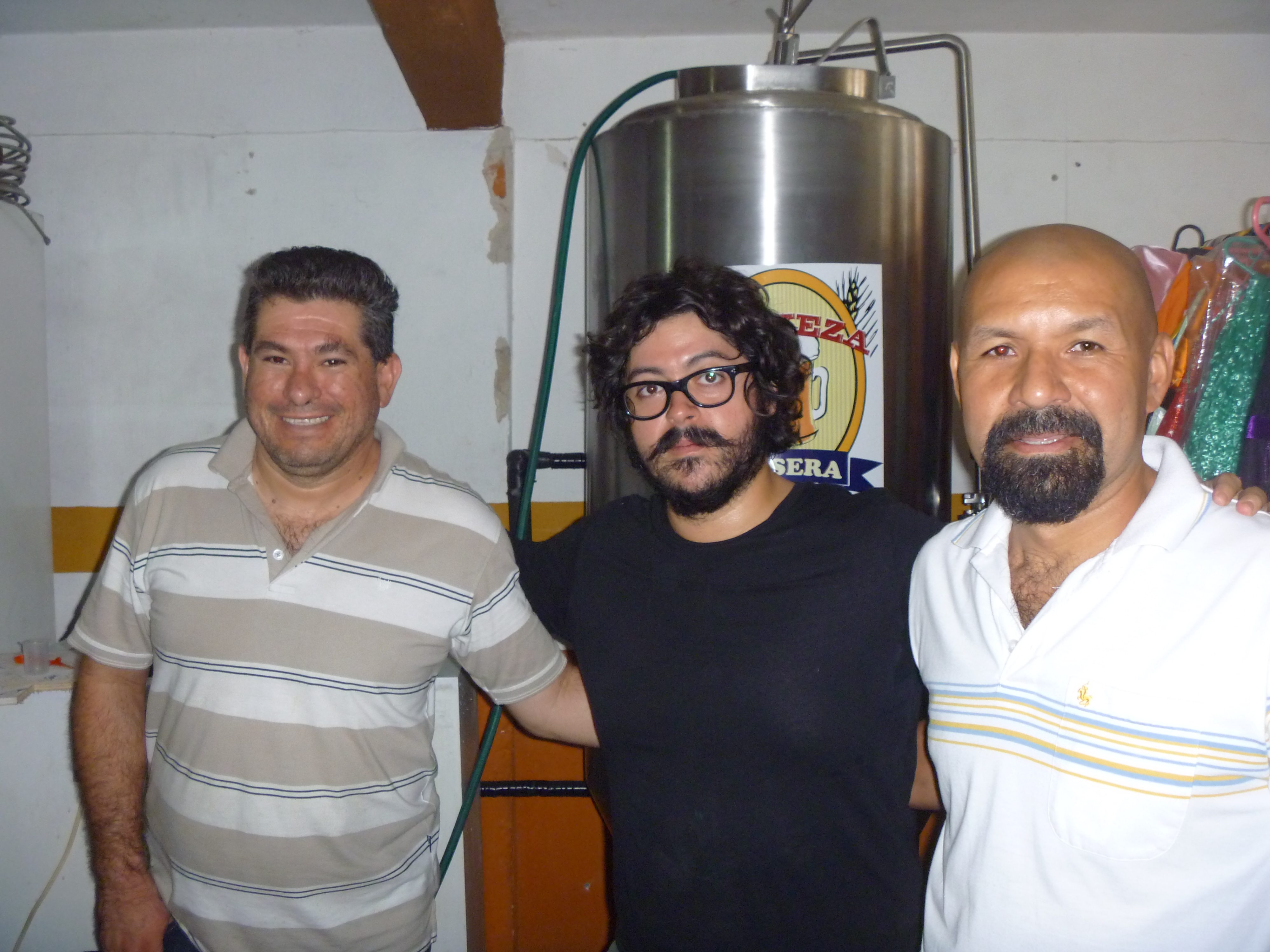 There is a palpable sense of camaraderie among small-time Tapatio brewers, united by their love of quality beers. Lepe’s companion Valdivia opened up his microbrewery in Oblatos to the Reporter this week.
Valdivia runs Sileno beer, producing “1,000 liters of beer per month, all bottled by hand, 100 percent artisanal.”
Silenio has a staff of five, two of whom are currently taking a brewing diploma in Chicago, Valdivia says. His beers, which include the 7.5-percent-proof stout Perla Negra, are available at the Tap Room, Kolsch (La Paz 2123), York Pub (Chapultepec 189) and the Pig’s Pearls restaurant (General Coronado 79).
Of course the major success story in the world of Tapatio microbreweries is the ever-expanding Minerva brand, which has really challenged Mexico’s beer duopoly and is now found in bars, restaurants and supermarkets across the country.
“Minerva is a model for the future. It’s been very successful and it’s grown enormous in eight years,” Valdivia says. For now Sileno remains a much more modest operation and Valdivia says he is still “better known for running courses on how to brew beer.”
One of his current students is Pedro Trujillo, the young face behind Perro Negro, which can be found in the Black Sheep (Libertad 1872/1840) and many other Guadalajara bars.
Trujillo’s latest invention is Muerte Subita (meaning “sudden death” in English, it was inspired by the Belgian beer Mort Subite). Half pale ale, half wheat beer, it features unusual ingredients such as orange juice and coriander seeds fermented in vodka.
The first batch of Muerte Subita has sold out in most local establishments, Trujillo says, but the Pig’s Pearls still stocks a few remaining bottles. “It’s really worth going down to try it,” he assures.
For more information on home brewing and Jose Valdivia’s brewing courses, visit www.cerveceriasileno.com.

