Governor’s brother killed in hotel accident
On vacation at the Punta Serena complex, Gonzalez, 47, was apparently ascending to a tourist area in the early hours of Sunday morning, when he slipped and fell 30 meters into a ravine. Red Cross paramedics transported Gonzalez to nearby Cihuatlan. He was then airlifted by helicopter to Guadalajara’s San Javier hospital, where he was pronounced dead at around midday.
Jalisco Attorney General Tomas Coronado Olmos maintained the cause of death was accidental and suggested Gonzalez had slipped due to wet conditions. Medical forensics experts later confirmed he had suffered fatal third-degree bruises to the skull and abdomen.
“My heartfelt thanks for the many messages of solidairty and support,” wrote Emilio Gonzalez on Twitter on Sunday afternoon. Family and friends attended a funeral held in Guadalajara on Monday morning.
Cesar Gonzalez’s choice to spend his vacation in the coastal resort of Tenacatita may have raised eyebrows among local residents. Tenacatita was controversially privatized in 2010 after Guadalajara businessman Jorge Villalobos bought a 42-hectare plot to be transformed into a luxury tourist complex.
Armed state police officers evicted some 50 local families who were living on the land and subsequently restricted access to the beach – which, under federal law, should be kept open to the public. While Emilio Gonzalez sought to distance himself from the dispute, he did little to support the evictees, who claimed they still had valid legal rights to the property.
Congress at odds with president over Victims’ Law
The proposed Victims’ Law would require the federal government to provide legal, medical and financial aid to victims of organized crime or human rights abuses committed by security forces.
A national registry would be created to record crimes such as kidnappings, while victims or their relatives would be entitled to claim up to 70,000 dollars to compensate injuries sustained, forced disappearances or murder.
Following approval in the Senate, Mexico’s Chamber of Deputies passed the bill unanimously in April. Calderon received the bill in May, but he waited until 8.30 p.m. on July 1 (election day) to reject the legislation, returning it to Congress with a list of objections well after the June 9 deadline.
The Permanent Committee, which assumes legislative duties when Congress is in recess, argued last week that Calderon had missed the window to raise such observations, and voted to return the unmodified bill to the executive for it to be signed into law.
Members of the Movement for Peace with Justice and Dignity (MPJD), which has heavily backed the Victims’ Law, have accused Calderon of waiting until the polls closed so as not to harm the National Action Party (PAN) ahead of the election. The timing of Calderon’s decision also ensured the news was buried among the avalanche of election coverage.
Javier Sicilia, a chief proponent of the Victims’ Law and leader of the MPJD, accused Calderon of showing “disdain for the victims” of the drug war.
A former poet, Sicilia embarked upon a national peace campaign following the murder of his son in 2011. He has been a vocal critic of Calderon’s decision to send the army onto Mexico’s streets to combat the drug gangs – a policy that has resulted in over 50,000 deaths since December 2006.
Calderon’s main objections to the bill concern who would be responsible for providing compensation. He called for a constitutional change obliging state and municipal governments to compensate victims – not just the federal government.
Calderon also proposed that, when possible, compensation be paid by the criminals responsible, instead of the taxpayer. Should the criminal not have the money to compensate the victim, the government would then pay, but subsequently charge the criminal. However, the current difficulties of confiscating assets under Mexican law mean this may not be a realistic proposition and it could serve as a further roadblock to victims receiving compensation.
Chapala man clearing lake with aquatic chainsaw
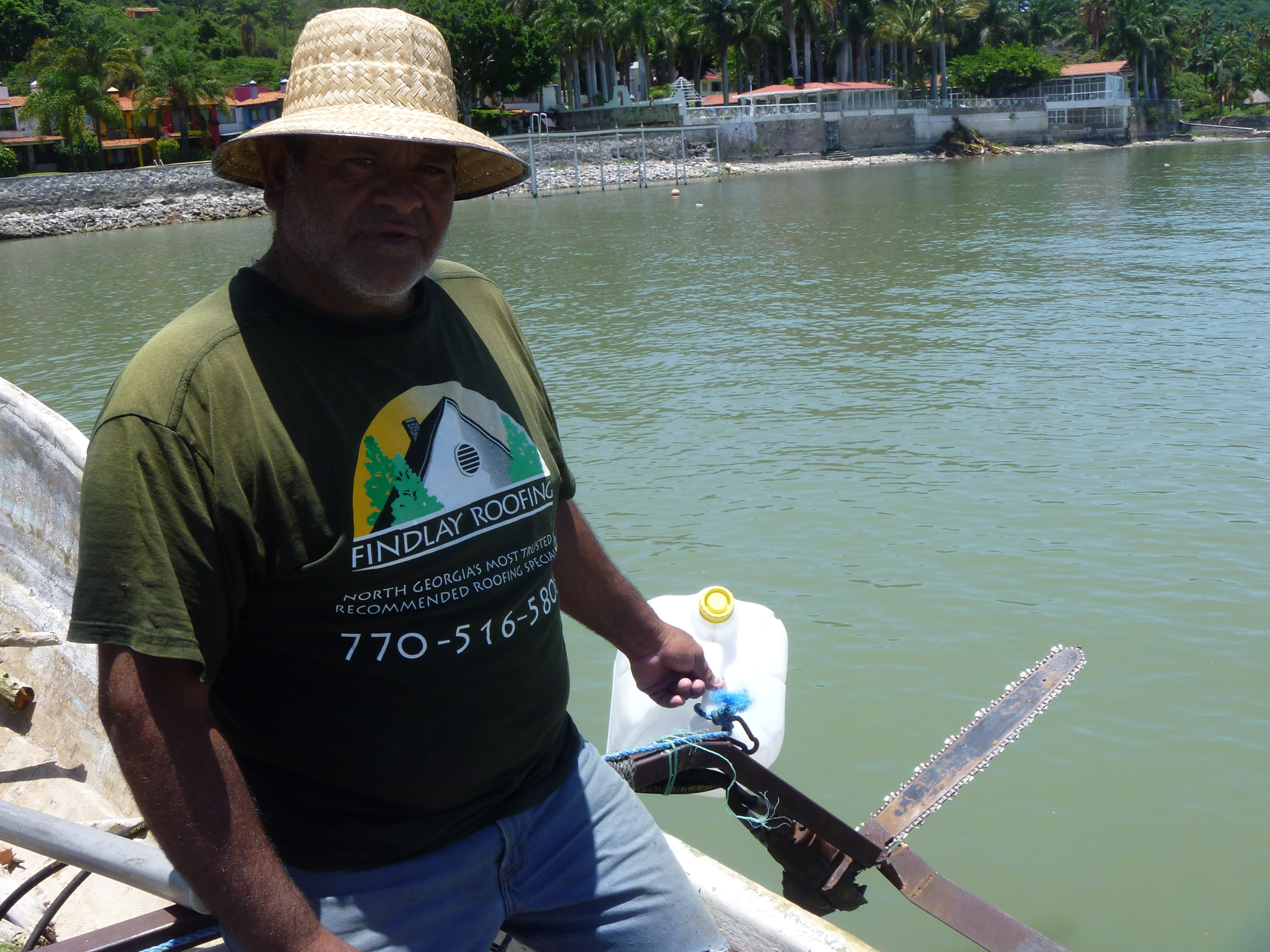
Using technical innovation and his knowledge of Mexico’s biggest inland expanse of water, Chapala native Francisco Javier Ochoa Gallileo has forged his own niche in the Lakeside boating industry.
Having invented a chainsaw that operates underwater, he is paid to clear Lake Chapala of dead but potentially hazardous trees that once grew from the bed of the lake. Two or three meters high, some of the trees stick out above the waterline, while others lie just below it, posing a danger to passing boats.
“We don’t want accidents. I’m the guy who removes the trees so if anything happens it’s a problem for me,” Ochoa explains.
Ochoa earns 100 to 150 pesos for each tree he removes from the the area around Chapala’s waterfront Montecarlo hotel.
Without the luxury of GPS, he uses natural and man-made landmarks around the lake to navigate and pinpoint locations. An experienced boatman, he has also worked recovering sunken vessels or downed planes from rivers and lakes.
Ochoa built his aquatic chainsaw five years ago, and after checking the competition online, he maintains there are “none better” out there. Powered by a hydraulic motor, the chainsaw is attached to a three-meter metal pole and a plastic tank full of air which can be used to adjust depth or even float the saw.
The motor sits in the hull of Ochoa’s small fishing-style boat. It is a simple craft without seats but laden with an impressive haul of timber. Ochoa finds the trees are often too heavy to lift by himself, so he hooks them to a winch adapted from his truck and now attached to a pontoon boat manned by his wife.
Ochoa is well aware of how polluted the water is, but his job requires him to put such concerns to one side. Suddenly, without even removing his shoes, he dives, fully clothed, into the lake.
After a careful process of locating and hooking up a tree that lies beneath the surface, Ochoa’s chainsaw roars into life. He cuts cleanly through the branches in three or four minutes, then dives again into the water, only to reemerge moments later, triumphantly grasping the severed wood.
Aside from cutting trees, Ochoa also has a deal with the University of Guadalajara – which is working to conserve the lake – to remove discarded fishing nets from the water. Once they are no longer of use, fishermen tend to abandon their old nets in the lake, he explains.
“The fish get caught up in them and die for nothing,” Ochoa says. As the nets are never recovered, the fish are left to decompose in the water, further contributing to the contamination that plagues the lake.
Ochoa is paid to remove the nets and prevent the unnecessary death of these fish. There is much work to be done; he says he regularly comes across three or four nets just by trawling an area of 50 meters.
As Ochoa begins to return to shore, the pull starter on his outboard motor snaps. Ever prepared, he takes it in his stride, picks up a large metal pole and paddles back to land. Another day’s work is done.

