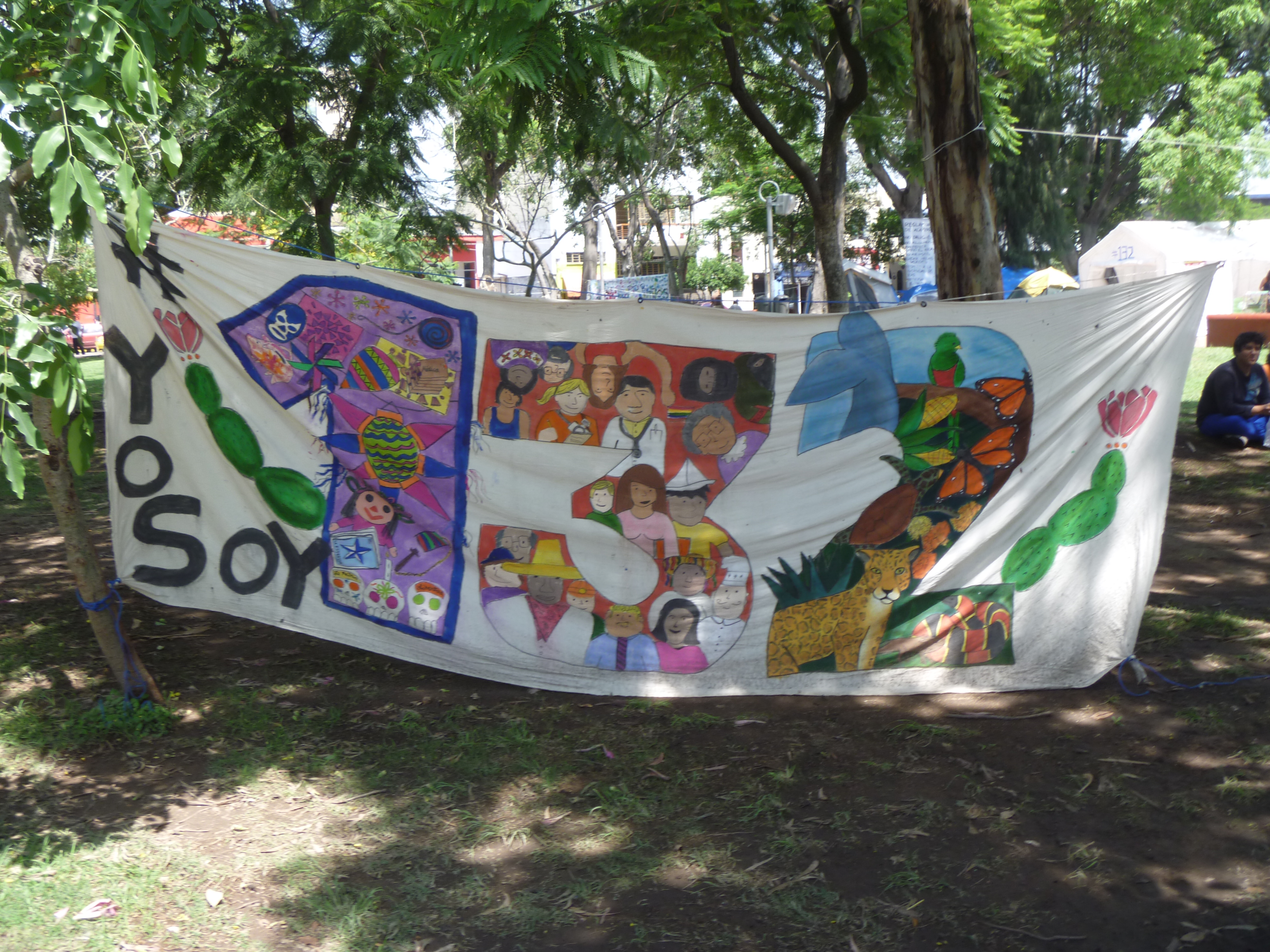
This “Mega March” was among the largest ever demonstrations in Jalisco to be organized by and for citizens – not labor unions or the University of Guadalajara (UdeG) – says Rodrigo Cornejo, a spokesperson for the #YoSoy132 student movement.
Although Party of the Democratic Revolution (PRD) candidate Andres Manuel Lopez Obrador is disputing the outcome of last week’s election, the movement is resigned to the fact that Peña Nieto will soon be confirmed as president-elect.
Saturday’s protest was “merely an expression of popular discontent,” but the idea of #YoSoy132 is “not only to resist the imposition of this candidate” or “call people to demonstrate,” says Cornejo. “The biggest challenge is to focus the movement and undertake concrete actions.”
Yo Soy 132
#YoSoy132 is a democratic organization mostly comprised of students from public and private universities across the country. Often ignored, trivialized or misrepresented by the mainstream press, its aim is to democratize the media and Mexican politics.
While not at work, Cornejo dedicates every waking hour to this goal. A former student at the UdeG, he attended one of the earliest demonstrations in Guadalajara and was chosen to coordinate the movement’s internet and media campaigns.
Later elected to represent Jalisco at national assemblies, Cornejo was one of 640 student delegates to attend a #YoSoy132 meeting in Huesca, Morelos last weekend. Having held previous assemblies in the capital, the students are now keen to prevent Mexico City from being over-represented at the expense of groups from elsewhere.
Although no concrete plans were agreed upon at the meeting, the students drew up a blueprint of ideas for further discussion.
A cornerstone of future action is to broaden the base of the movement, creating alliances with labor unions and indigenous communities. Having met with indigenous groups in Huesca, Cornejo believes #YoSoy132 is “weeks or months from becoming something much larger than merely a student movement.”
Another meeting is planned to take place this weekend in San Salvador Atenco, the setting of a 2006 protest infamously repressed by police under the orders of Peña Nieto, then governor of the State of Mexico. #YoSoy132 did not organize the forum in Atenco; it is joining other resistance organizations with the aim of creating a broad and united political front.
But with many left-leaning organizations eager to join the movement, recent discussions have been focused on how to integrate them without alienating those who do not share their ideas. It is a difficult balancing act.
Preempting repression
Awoken from a materialistic slumber by the return of the PRI, Mexico’s youth is at its most politicized since 1968, when said party slaughtered a generation of student protesters in the Mexico City’s Tlatelolco Plaza.
“I don’t believe that we will have the massacres that we had in the past and I believe now that the country is much better prepared than 30 or 40 years ago to face an authoritarian government, but there are more subtle ways of repression such as legislative censorship and a media empire pushing for its candidate,” says Cornejo.
“But if we don’t stand our ground then we could see a regression to an authoritarian leadership that is different in appearance but has the same character as many years ago.”
 The movement has drawn encouragement from the support it has gained in states such as Jalisco, which are traditionally not as politicized as the capital. #YoSoy132 holds one or two popular assemblies per week in Guadalajara, with an average attendance of 150-200 people.
“We are trying to turn that political awakening into a source of strength,” says Cornejo. In order to consolidate support, there are tentative plans for a nationwide tour to unite different cells of resistance, from the capital to tiny rural municipalities.
“After we sweep the entire country and discover how broad our base can be, we can start planning concrete actions,” says Cornejo, although he admits such a tour will only be viable “if the security conditions allow, especially in the north, where there’s a lot of violence and paramilitary groups.”
“Many delegates from northern Mexico said they did not have the conditions to meet, demonstrate and organize themselves freely,” Cornejo explains. “And not only in northern Mexico,” he adds, in reference to a PRI militant who was photographed and subsequently arrested for threatening student protestors with a handgun during Saturday’s demonstrations in Veracruz.
“It’s been peaceful thus far” in Guadalajara, Cornejo says, acknowledging that the municipal government has provided a police presence at demonstrations. “So far we’ve been both tolerated and protected by the authorities, but we don’t know how much longer that will last.”
One cause for concern is that “we’ve seen people identified with the PRI taking pictures of our faces and making recordings of our assemblies.”
The possibility of repression or an erosion of civil liberties in states governed by the PRI is a real worry to the students, says Cornejo, “especially here in Jalisco, where we enjoyed a climate of relative freedom (during the 18-year rule of the National Action Party – PAN).”
To preempt any trouble, the movement has proposed that Jalisco spearheads the creation of an inter-state organization to highlight or inhibit acts of violence anywhere in Mexico. A meeting will take place in Guadalajara in the next month or two to advance the plans.
Legislative reform
Perhaps the movement’s most pressing priority is media reform. Televisa’s favorable coverage of Peña Nieto provoked outrage among many Mexicans, as did the opinion polls published in newspapers such as Milenio, claiming he enjoyed a 14-point lead (the final margin was just 6.5 percent).
“The media has become so powerful in an unregulated way,” says Cornejo. “It is not a threat to democracy; it is an obstacle to democracy.”
#YoSoy132 supports a legislative project built by the Mexican Association for the Right to Information (AMEDI) which calls for greater plurality in the media currently dominated by giants such as Televisa and TV Azteca. In order to lesser their influence, the students believe citizens should “have easier access to independent media such as community radio and small newspapers and magazines.”
The movement is also pushing for campaign reform, favoring a second round of voting to decide closely fought elections, such as the presidential election of 2006, which was decided by a narrow margin of 243,934 votes.
“We are going to try to push the reforms through existing citizen-sponsored legislative initiatives,” Cornejo explains. This will require the movement to inform society why such reforms are necessary, as well as mounting continued demonstrations to pressure politicians into backing them.
Although wary of the “danger inherent in making a frank coalition with the left,” Cornejo says “we believe that if we grab enough political capital perhaps the left will help push through those reforms.”
The fractured left
While overtly anti-Peña Nieto, #YoSoy132 remains a non-partisan movement with no affiliation with Lopez Obrador or any other candidate. Although many of the students share leftist ideas, Cornejo notes “the left in Mexico is severely fragmented” and “disorganized.”
“There is widespread corruption on all sides of the political spectrum but particularly on the left,” he says, noting that many saw Lopez Obrador as simply the “least terrible candidate.”
This fragmentation of the left put paid to the gubernatorial ambitions of Citizen’s Movement candidate Enrique Alfaro, the popular choice of many young people in Jalisco.
Having split with the Jalisco branch of the PRD, which is effectively controlled by members of the UdeG elite, Alfaro “faced not only a lack of support but active opposition from very powerful political players that have been in the state for decades, namely (former UdeG rector) Raul Padilla,” says Cornejo. Local members of #YoSoy132 are “very much against [Padilla’s] political influence and the stranglehold he has on our university.
“He had an unfair influence on the political process here. He was the kingmaker in this election and we saw that very clearly,” adds Cornejo, suggesting Padilla used his clout to swing the election against Alfaro and in favor of PRI candidate Aristoteles Sandoval.
Given the UdeG’s violent past, in which armed student unions “acted as gangsters at the behest of the university,” Cornejo is aware of the danger of making powerful enemies.
“There is a real possibility of violence on behalf of the university if it feels threatened by the movement,” he says. “Thus far nothing has happened because there hasn’t been any direct confrontation, but should there be a head-on collision between the democratic demands we are making and their reluctance to make any meaningful reforms, there could be violent conflict.”
Occupy GDL
Just as a campaign appearance by Peña Nieto at Mexico City’s Universidad Iberoamericana sparked the emergence of the #YoSoy132 movement back in May, his subsequent election gave birth to Guadalajara’s equivalent to Occupy Wall Street.
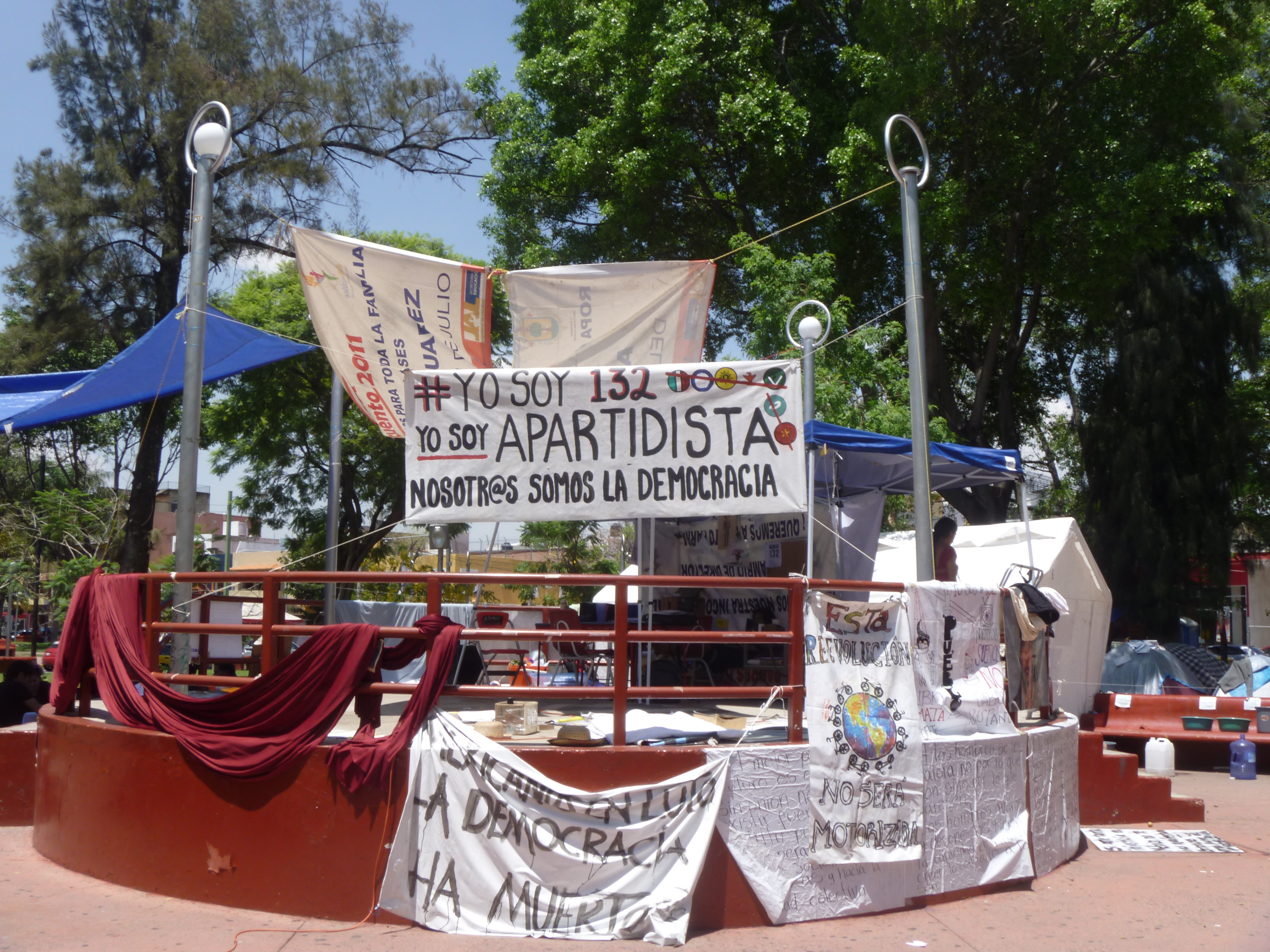
Members of #YoSoy132 set up a camp in the Parque Revolucion initially planned to last 132 hours, but they ended up staying there for 10 days. The idea was to provide a point of contact between the students and general society.
“This has to be more than a student movement. It must be more inclusive and it should represent civil society,” says Cristina Martinez, a UdeG graduate who is coordinating efforts at the camp.
Around 30 to 40 people joined the camp, running workshops, handing out flyers to raise awareness and compiling computer databases of those ready and willing to help the movement.
The media has been quick to focus on #YoSoy132’s use of modern technology, drawing parallels with the Occupy movement and the Arab Spring. Yet such coverage is often highly distracting, diverting attention anyway from the purpose and aims of the protests.
Social media makes coordination quicker and easier, but it is no substitute for face-to-face discussion, says Cornejo. On the contrary, online debate of a serious subject can cause “severe misunderstandings.”
The movement has struggled due to a lack of clear communication, organizational problems and clashes of egos, Martinez admitted. The camp was due to be abandoned Thursday morning, although an information point will remain in the park for the time being.
Undeterred by any setbacks, students, together with other elements of society, will continue their struggle. Theirs is a young and flawed but well meaning movement, grasping in the darkness for the right path toward a brighter future for Mexico.
Vote recount confirms Peña Nieto victory
The Institutional Revolutionary Party (PRI) candidate won 19.2 million votes, 38.21 percent of all ballots cast. Andres Manuel Lopez Obrador of the Party of the Democratic Revolution (PRD) remained in second place with 15.9 million votes or 31.59 percent.
Josefina Vazquez Mota of the ruling National Action Party (PAN) won just 12.8 million votes, 25.41 percent of the total.
Based on a recount of ballots from 78,469 of the nation’s 143,132 polling booths, the new figures are virtually unchanged from the results of the quick count released on the night of the election. Lopez Obrador dropped by 0.06 percent of the vote while Peña Nieto rose by 0.05 percent.
Despite the outcome, Peña Nieto is still not officially the president-elect. Lopez Obrador has charged the PRI with vote buying, vowing to present evidence at 6 p.m. on Thursday which proves Peña Nieto’s party bought at least five million votes.
Under Mexican electoral law, all challenges presented by the political parties must be resolved before a final result is declared.
The Federal Electoral Tribunal (TEPJF) will determine whether the voting took place in accordance with electoral law, and whether the alleged irregularities would have changed the outcome. The TEPJF must then name the president-elect before the September 9 deadline.
In Jalisco, PRI candidate Jorge Aristoteles Sandoval Diaz has been named the governor-elect. Sandoval won the state election with 1,309,836 votes, while Enrique Alfaro Ramirez of the Citizen’s Movement came second with 1,160,870 votes, the Jalisco Electoral Institute (IEPC) confirmed on Sunday.
In the national congressional elections, IFE confirmed the PRI won 15.6 million votes, (31.3 percent) the PAN received 13.1 million (26.3 percent) and the PRD came third with 9.3 million (18.6 percent).
This will leave the PRI with the largest number of representatives in both the Senate and the Chamber of Deputies, but without an outright majority in either house. IFE has until August 23 to confirm the number of seats assigned to each party through proportional representation.
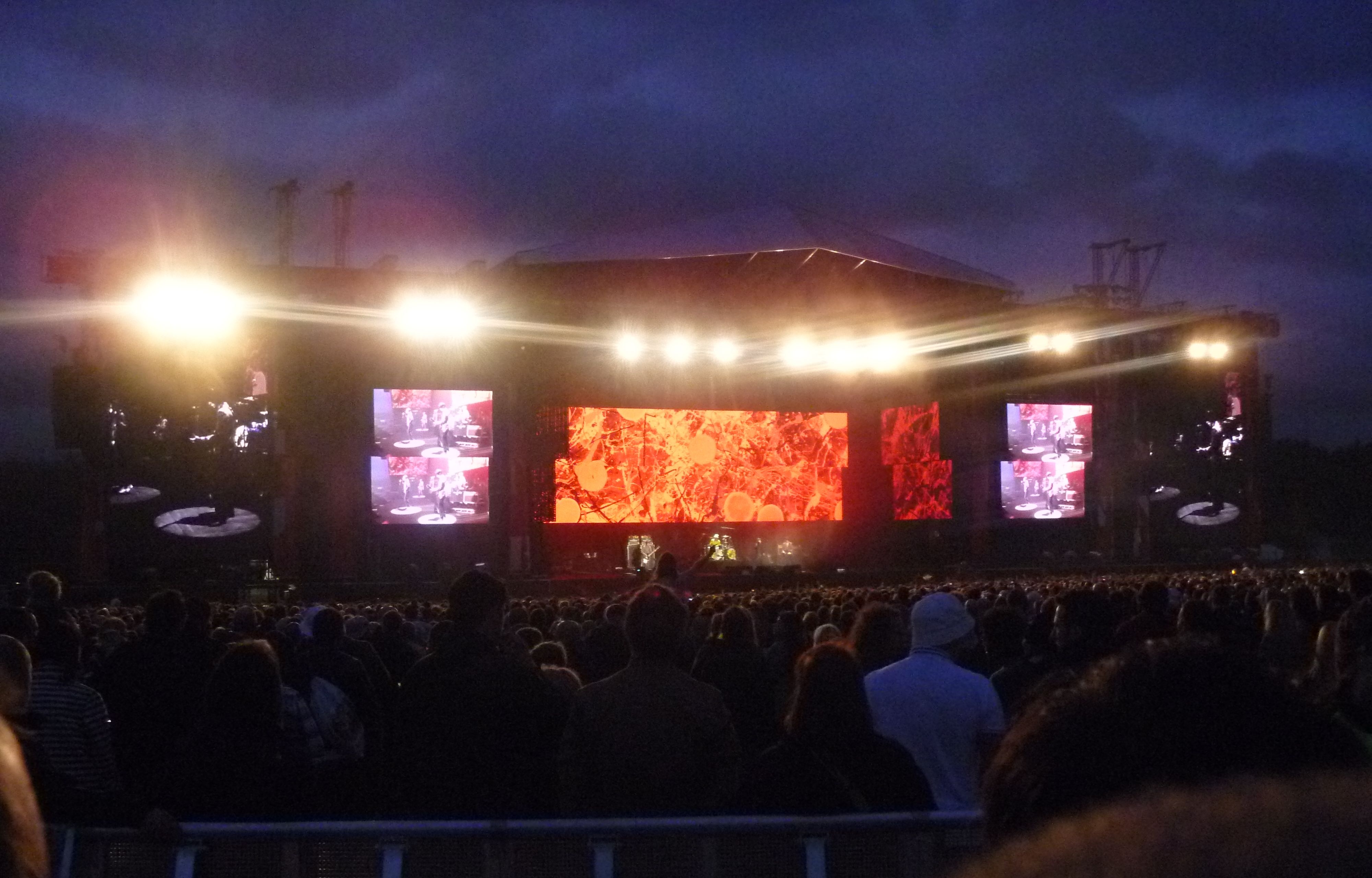
The Roses’ first major British performance in 16 years (they played a short free concert in Ian Brown’s hometown of Warrington in May), the Heaton Park gigs had been billed as the focal point of the reunion.
On 29th June they played the first of three dates in front of 75,000 people per night. The tickets were snapped up like gold dust last October, making these the fastest selling rock concerts in British history.
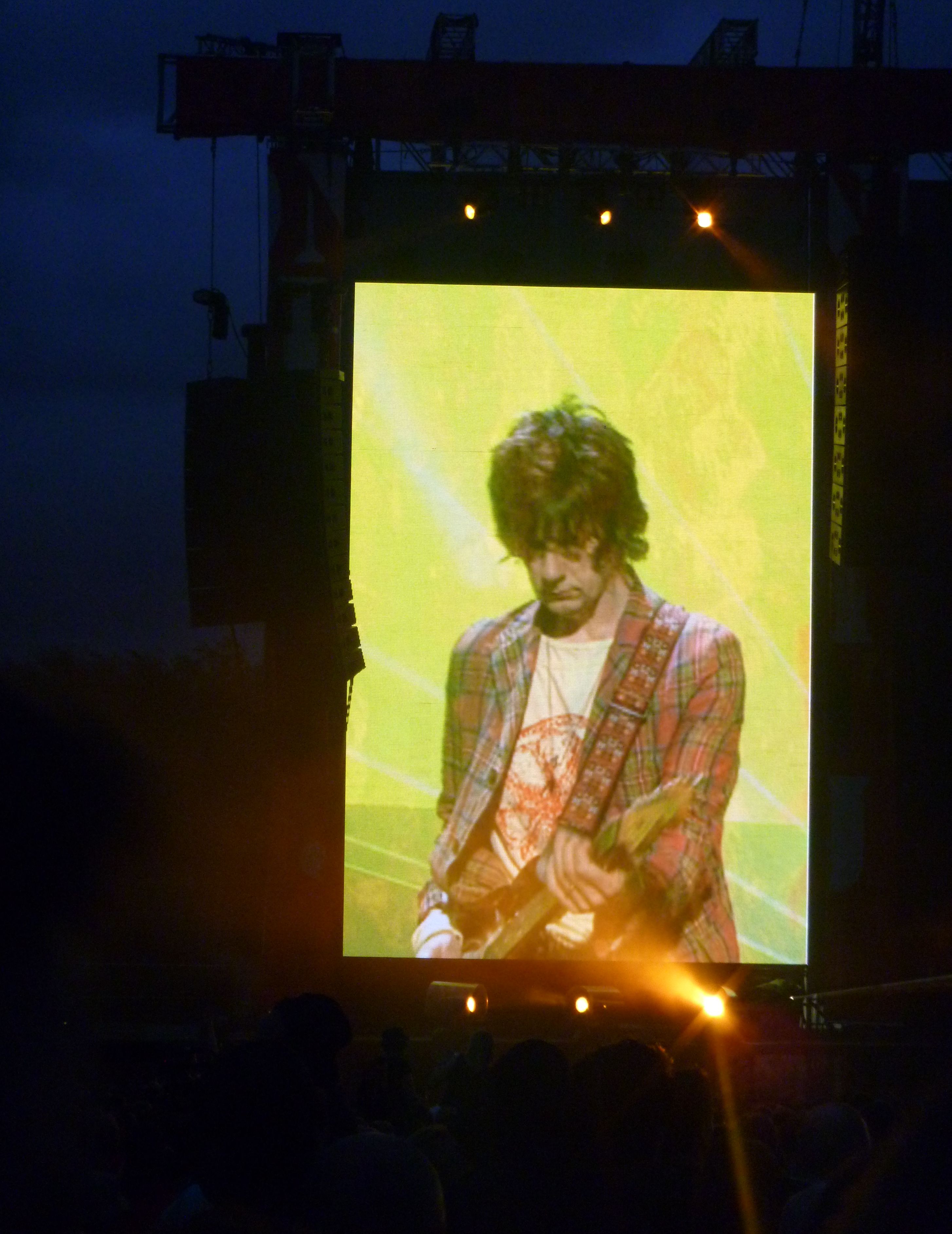 The event was essentially a festival with the Roses headlining every night and cherry-picking their support acts.
Following the Wailers’ feel-good set of Bob Marley classics, and a rousing performance from Primal Scream, the Roses duly sauntered onstage to the rumbling bassline of traditional opener “I Wanna Be Adored”.
They were in scintillating form, having rehearsed for months before embarking on a brief warm-up jaunt across Europe to iron out any creases in their sound.
The Roses may have been an inconsistent live act in the past, but the return of Reni – whose funky drumming was sorely missed during their last tour in 1995-96 – has been crucial to the success of the reunion.
Ian Brown’s voice has been the subject of much criticism, but he sounded better on Friday than he has in years, with any off-tune moments barely noticeable thanks to the efforts of the entire crowd on backing vocals.
The Roses performed their classic debut album in its entirety, having even relearned to play every note in “Waterfall” backwards in order to recreate its trippy twin brother “Don’t Stop”.
After running through a few early b-sides, plus the anthemic “Ten Storey Love Song”, the band moved up a gear with an epic rendition of “Fools Gold” midway through the set. Reworked and over 10 minutes long, it became a showcase for John Squire’s guitar heroics, with snippets from the Beatles’ “Daytripper” and the Roses’ own “Driving South” popping up alongside the catchy main riff.
Next up was “Something’s Burning”, an overlooked b-side from 1990, when the band was at its peak. A dark, jazzy, drawn-out number in a similar vein to “Fools Gold”, it is as good as anything the Roses ever put down on record. Live, it suffered slightly from Squire’s decision to give it the blues treatment, in lieu of its original, funkier sounding wah-wah licks.

The second half of the set was sensational, with the crowd belting back every word of every song, hit after hit. Highlights included a euphoric “This is the One” and the Led Zeppelin-esque “Love Spreads”, complete with Ian Brown rapping a segment of Eric B. & Rakim’s “Paid in Full”.
Brown also injected a bit of punk attitude into the proceedings, dedicating anti-royalist anthem “Elizabeth My Dear” to “those parasites 200 miles down the road celebrating 60 years of tyranny” – a reference to last month’s sycophantic Jubilee celebrations.
Next up was the closer “I am the Resurrection”, with a stunning instrumental outro even longer than on record, before a barrage of fireworks brought this celebratory occasion to an end.
But Heaton Park was not the end of the reunion, nor was it a complete nostalgia fest; it was a welcome back party. With a world tour and a new album on its way, the Stone Roses are back to reclaim their crown as the greatest band in Britain.