Frontrunner untroubled in final debate
Most commentators adjudged Vazquez Mota to have performed best in the debate, but with less than three weeks to go this is unlikely to change the outcome of the July 1 election. At best, the boost might help her reclaim second place from Andres Manuel Lopez Obrador of the Party of the Democratic Revolution (PRD).
After relentlessly attacking frontrunner Enrique Peña Nieto of the Institutional Revolutionary Party (PRI) throughout the first debate, Lopez Obrador adopted a less confrontational approach this time around, opting to focus more on policies.
Eliminating corruption is the primary task facing Mexico’s next president, he said, claiming this could result in savings of 300 billion pesos. Lopez Obrador also said he would increase economic growth from four to six percent, albeit without explaining exactly how he would do so. All in all it was a somewhat underwhelming performance from the leftist veteran.
With little to gain and much to lose, Peña Nieto was unmemorable but solid. Wisely choosing to stay out of the fray, he came through unscathed, with little or no damage done to his profile or his lead in the polls.
Among his proposals, Peña Nieto said he would streamline Congress by eliminating 32 senators and 100 federal deputies. While the PRI has blocked most reforms proposed by the current PAN government, such a move would make it easier for Peña Nieto to pass legislation should he become president.
The debate was centered on three topics: politics and government; Mexico in the world (an area largely ignored by most of the candidates); and social and sustainable development. Surprisingly, New Alliance Party (PANAL) candidate Gabriel Quadri set much of the agenda, obliging his opponents to state their views on hot-button issues such as gay marriage and abortion, while also proposing a free trade agreement with China.
As in the first debate, Quadri was articulate and charismatic, but he suffered when Vazquez Mota called him out as a pawn of Elba Esther Gordillo, controversial leader of the National Educational Workers Union (SNTE) that created the PANAL.
Vazquez Mota was the most aggressive participant throughout, but the squabbles between her and Quadri suited Peña Nieto just fine, as he simply sought to protect his position as frontrunner.
With Lopez Obrador uncharacteristically tame, the fiercest opposition to Peña Nieto came from outside the venue, where student demonstrators from the #YoSoy132 movement vented their anger at the PRI candidate.
Throughout the afternoon 3,000 to 5,000 young people took part in several #YoSoy132 marches across the city, converging before the debate at the Parque de las Estrellas beside the Expo. To ensure the protests did not get out of hand there was a strong security presence, with hundreds of soldiers, police and even members of the Presidential Guard on duty.
None of the candidates made direct reference to the grassroots movement that has sprung up over the past month, although Vazquez Mota noted that “today students can protest without fear of an authoritarian government,” before evoking the massacres of student demonstrators under the PRI in 1968 and 1971.
Vazquez Mota also mocked Peña Nieto for “hiding in the bathroom” after he was heckled by students during a recent appearance at the Universidad Iberoamericana.
After the debate, the three main candidates united with local representatives of their respective parties at landmarks across the city
Peña Nieto appeared downtown before around 2,000 PRI supporters, while Vazquez Mota held a rally on the Matute Remus suspension bridge at Lopez Mateos and Lazaro Cardenas. Having laid out 10,000 seats, the PAN only managed to attract 2,000 people, while upsetting locals by seriously disrupting traffic for hours.
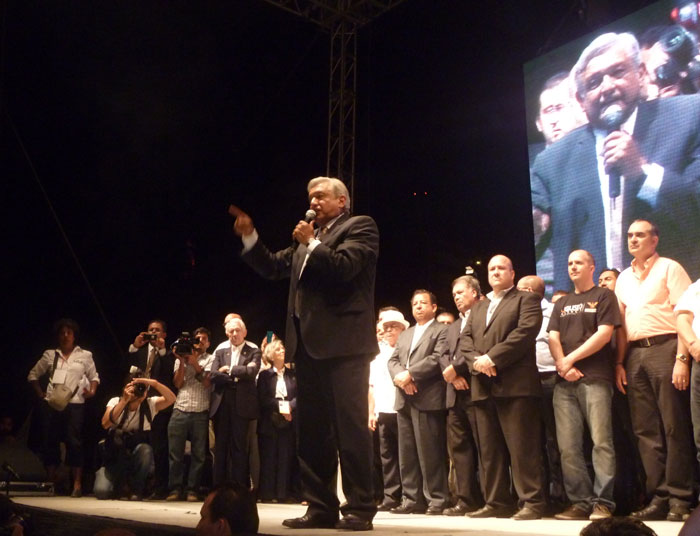
The biggest rally was that staged between Los Arcos and the Minerva glorieta by Lopez Obrador and Enrique Alfaro, the Citizen’s Movement candidate for governor of Jalisco.
The pair drew around 6,500 enthusiastic supporters and the mood was festive, with Alfaro drawing plaudits for a strong performance in Sunday morning’s gubernatorial debate at the Expo.
Having failed to mention the #YoSoy132 movement in the debate, Lopez Obrador now paid tribute to Mexico’s youths, saying they were “fundamental” to “increasing our chances of winning.”
Babies in illegal adoption ring returned to mothers
In a shocking revelation, nine of the children had been sexually abused, confirmed FIND Foundation President Juan Manuel Estrada, a private investigator in Guadalajara who helped uncover the child-trafficking ring.

Seven suspects are in federal custody in Mexico City, including two women accused of scouring poor neighborhoods in search of babies. Two others were released from prison six weeks ago due to a lack of evidence: the 21-year-old woman first arrested for allegedly seeking to “rent” her baby, and a grandmother accused of complicity in the adoption ring.
The illegal adoption operation involved taking newborn children from poor mothers and handing them over to foreign couples seeking to adopt.
It had been happening for years, with the most recent case involving Irish couples who were introduced to their would-be adoptees in a Guadalajara hotel, before being taken to temporary accommodation in Ajijic. Easily blending in with the large expatriate community, they would live there with the children while the adoption process was completed, usually within three to 12 months.
Aside from legal costs, the Irish couples were charged for all medical fees, plus 1,200 pesos per week during the pregnancy period to those mothers yet to give birth. There has been no suggestion that the adoptive parents were to blame for the alleged sexual abuse or were aware the process was not legitimate.
The cases were processed in the neighboring state of Colima, where legal oversight in such matters seems to be more lax than in Jalisco. There may have been as many as 300 illegal adoptions approved in Colima in the last five years alone, Jalisco Attorney General Tomas Coronado Olmos revealed this week.
A formal warrant has been issued for the arrest of Carlos Lopez Valenzuela and his associate from Guadalajara firm Lopez y Lopez y Asociados, who are suspected of arranging the illegal adoption of Mexican babies to foreigners since as far back as the 1980s.
Among the suspects still being held is Mario Melendez Orozco, an independent, Chapala-based taxi driver who frequently transported those involved to and from Guadalajara. Melendez was well known among the expatriate community and had many clients in the Lakeside area.
Jalisco authorities returned all but one of the 11 infants to their mothers on Friday (the exception being an under-age mother, whose pregnancy was the result of rape, who is still undergoing tests to prove her maternity).
“They are the victims and the offended parties,” said the mothers’ lawyer Yuri Marquez Gomez. She said her clients were all illiterate women from neighboring slums on the outskirts of Guadalajara.
The mothers said they were tricked into believing their babies were being photographed for an anti-abortion campaign. They signed contracts worth 500 pesos a day to release their children for up to 15 days at a time, purportedly to be photographed in different sites across Jalisco. The children were actually being secretly shown to Irish couples looking to adopt.
Social networking impacts Mexican election
These websites have already impacted upon the current campaigns, providing a means for young people to spread information among their friends, organize mass protests and feel more engaged in politics.

Gaffes by presidential frontrunner Enrique Peña Nieto of the Institutional Revolutionary Party (PRI) have been roundly mocked online and it is no coincidence that he began to dip in the polls at the same time as the #Yo Soy 132 movement emerged.
The non-partisan campaign took its name from the 131 students at the Universidad IberoAmericana who, after heckling Peña Nieto, posted a video on YouTube to prove they were in fact students and not thugs sent by another party, as the PRI had claimed.
Coordinated via social networks, #Yo Soy 132 has organized protests across the country criticizing the role of mainstream media outlets such as Televisa, which is frequently accused of bias in favor of Peña Nieto.
The advent of Twitter means Mexicans no longer need to rely on the likes of Televisa for news. Major broadcasters cannot decide anymore whether the public hear about a certain story because it is already being tweeted in real-time.
With staff dedicated to running their social networking campaigns, the presidential candidates are all seeking to amass the biggest online support base.
Having long trailed Peña Nieto (@EPN) in the Twitter stakes, JosefinaVazquez Mota (@JosefinaVM) of the National Action Party (PAN) recently overtook him. As of Thursday, 11.20 a.m., she had 816,575 followers to Peña Nieto’s 767,252. Party of the Democractic Revolution (PRD) candidate Andres Manuel Lopez Obrador (@LopezObrador_) trailed with 654,060 followers.
However, Peña Nieto had by far the largest support base on Facebook, with 3,027,456 users “liking” his page. Vazquez Mota had 1,710,163 “likes” and Lopez Obrador just 469,014.
These figures are not an accurate reflection of the polls, as most surveys currently show Lopez Obrador leading Vazquez Mota in second place. There are several reasons why they should be taken with a pinch of salt in terms of forecasting the elections.
Firstly, social networkers tend to be young people from Mexico’s biggest cities. The views of older voters or those from more rural areas are under represented on Twitter and Facebook. According to Internet World Stats, 42 million people in Mexico have internet access, equivalent to just 36.1 percent of the population (Jalisco is home to 7.4 percent of all Mexico’s internet users, with 38.6 percent of the state population enjoying internet access.)
Secondly, being followed or liked on these sites is not necessarily an endorsement. For example, as of Thursday there were 341,303 people talking about Peña Nieto on Facebook, but much of this discussion ranged from the satirical to the fiercely critical.
Finally, many of these online supporters do not even represent real people. Many of Peña Nieto’s Twitter followers have been exposed as fake bots with generic avatars, no followers and no followings – presumably created by campaign staff to make the candidate appear more popular.
Expo hosts presidential, gubernatorial debates
Mexico’s presidential candidates will engage in a battle of wits in the second and final televised debate on Sunday night at the Expo Guadalajara trade show and convention center. Earlier in the day, the four candidates for governor of Jalisco will face off in their second debate.
Andres Manuel Lopez Obrador and Josefina Vazuez Mota will hope to gain ground on frontrunner Enrique Peña Nieto of the Institutional Revolutionary Party (PRI) with less than a month before voters go to the polls on July 1. The fourth candidate, Gabriel Quadri of the National Alliance Party (PANAL), will also participate although he is only polling around five percent.
The debate begins at 8 p.m. and will be broadcast live on both Televisa and TV Azteca.
The candidates for the Jalisco governorship will also debate at the Expo on Sunday, at 10 a.m. Enrique Alfaro of the Citizens’ Movement and Aristoteles Sandoval of PRI currently lead what increasingly appears a two-horse race to control the state.
While the Federal Electoral Institute (IFE) organized the first two presidential debates, the #Yo Soy 132 movement has organized a third debate in which the participants will respond to questions from students. Lopez Obrador, Vazquez Mota and Quadri have all agreed to take part, although Peña Neto declined after #Yo Soy 132 declared itself in opposition to his candidacy. The debate is set for Tuesday, June 19 at 8 p.m. and will be broadcast live via YouTube.

