Between a rock and a hard place: Mexico’s journalists face threats from cartels, the government and even each other
“I hope the government doesn’t give in to the authoritarian temptation to block internet coverage and start arresting activists,” Mexican blogger and activist Alberto Escorcia told Index on Censorship magazine.
Escorcia had just received a series of threats for writing an article about recent unrest in the country. The next day the threats against him intensified. Feeling trapped and unprotected, he began making plans to flee the country.
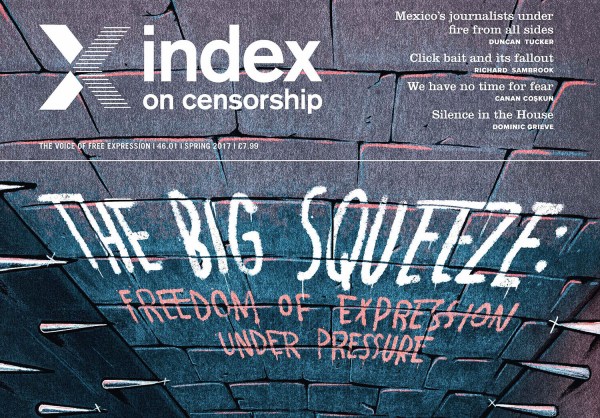
Many people are concerned about the state of freedom of expression in Mexico. A stagnant economy, a currency in freefall, a bloody drug war with no end in sight, a deeply unpopular president at home and the belligerent Donald Trump administration freshly installed in the USA across the border, these forces are all creating a squeeze in 2017.
One of the biggest tensions is Mexico’s own president. Enrique Peña Nieto’s four years in office have brought sluggish economic growth. There has also been resurgent violence and a string of corruption scandals. In January this year his approval ratings plummeted to 12%.
But when journalists have tried to report on the president and his policies they have come under fire…
Click here to read this article in full at Index on Censorship
Debunking fake news: not a laughing matter

This account of the supposed murder of two clowns is an example of fake news in Mexico.
Disinformation thrives in times of public anxiety. Soon after a series of reports on sinister clowns scaring the public in the USA in 2016, a story appeared in the Mexican press about clowns being beaten to death.
At the height of the clown hysteria, the little-known Mexican news site DenunciasMX reported that a group of youths in Ecatepec, a gritty suburb of Mexico City, had beaten two clowns to death in retaliation for intimidating passers-by. The article featured a low-resolution image of the slain clowns on a run-down street, with a crowd of onlookers gathered behind police tape.
To the trained eye, there were several telltale signs that the news was not genuine…
Click here to read this article in full at Index on Censorship
Despite being handcuffed at the wrists and flanked by Interpol agents, fugitive Mexican governor Javier Duarte wore a disconcerting grin moments after his arrest in Guatemala on Saturday. It was the smirk, many Mexicans observed, of a man accustomed to getting away with it.
Having allegedly embezzled 55 billion pesos ($2.97 billion) in public funds in just six years, the portly 43-year-old former governor of Veracruz state has come to personify the rampant corruption and impunity that plague Mexican politics. Yet analysts say his arrest, like that of Tomás Yarrington, another fugitive ex-governor captured in Italy six days earlier, is an example of “selective justice” that will do nothing to solve these deep-rooted problems.
Six months after fleeing the country with the alleged support of dozens of political allies, Duarte was caught at an exclusive hotel beside Lake Atitlán where he and his wife had been staying under false names and paying in cash. Duarte, who has always maintained his innocence, now faces extradition to Mexico, where he stands accused of money laundering and organized crime.
On Monday, President Enrique Peña Nieto, who had previously called Duarte his friend and lauded him as part of a “new generation” in the ruling Institutional Revolutionary Party (PRI), called the arrests “a firm and forceful message from the Mexican state against impunity.”
Yet the Mexican public is not convinced. Both fugitives were captured in Interpol-led operations after managing to slip out of Mexico undetected. Duarte fled Veracruz in a government helicopter allegedly lent to him by his interim successor, while Yarrington reportedly had eight state police officers assigned to protect him even after five years on the lam…
 The Tequila Files