Vazquez Mota hopes feminine touch can win over electorate
I went down to the FIL this week to see the two candidates most likely to win next year’s presidential election. First up, the female underdog and slightly less boring of the two: Josefina Vaquez Mota.
Favorite to win the National Action Party (PAN) nomination, Vazquez Mota is on the verge of becoming the first female presidential canadidate from a major party in Mexican history.
Under Mexican law, official campaigning cannot begin until February, so Vazquez Mota made the high-profile appearance under the pretext of promoting her new book “Nueva oportunidad: Un México para todos” (New Opportunity: A Mexico for everyone). National frontrunner Enrique Peña Nieto of the Institutional Revolutionary Party (PRI), who officially registered as a candidate this week, will also talk at the FIL on Saturday.
Put together for campaign purposes, Vazquez Mota’s book consists of 22 interviews with the likes of Costa Rican President Laura Chinchilla, former Spanish Prime Ministers Felipe Gonzalez and Jose Maria Aznar, and even former Real Madrid soccer star Emilio Butragueño.
At the presentation, Vazquez Mota outlined her strategy against organized crime, based on what she had learned from speaking with former Colombian presidents Cesar Gaviria and Alvaro Uribe. Both agreed that “negotiations with organized crime was the worst” course of action, while it was necessary to go after the cartels’ profits, follow the money trail and bring the guilty before law.
“People started to believe them when judges and politicians linked to organized crime began to fall, and that’s what we need to do in Mexico. There must be no more predilections or privileges,” she affirmed.
Her references to “politicians involved” in drug trafficking were likely a ploy to remind the public of the endemic corruption and collusion between politicians and criminals throughout the PRI’s 71-year reign. She also described Mexico as a former “authoritarian state,” implying that it will return to be one if the PRI win next year’s election.
Vazquez Mota also sought to use the occasion to broaden her appeal to the left, speaking sympathetically of peace activist Javier Sicilia, who has been one of the fiercest critics of President Felipe Calderon’s militarized security strategy.
The panista also stressed her admiration for powerful women on both sides of the political spectrum, such as the neoconservative former U.S. Secretary of State Condoleezza Rice and Chile’s former Social Democrat President Michelle Bachelet, both of whom she interviewed for the book.
She spoke at length of her conversations with the latter, who warned her the press “are going to ask you things they would never ask a man, like ‘how many kilos do you weigh?’ or why ‘do you comb your hair that way?’”
Vazquez Mota also recalled Bachelet’s advice that “if you become president, never fall in the temptation of putting on a moustache to govern. Be yourself and govern like a woman.”
Book Fair prize winner slams president, PRI
At a press conference after receiving the Romantic Language Literary Prize – worth 150,000 dollars and which he donated to animal-friendly charities – Vallejo slammed the Institutional Revolutionary Party (PRI) as “the seed of all cartels in Mexico” and accused President Felipe Calderon of the National Action Party (PAN) of “having done nothing for Mexico.”
Ahead of next year’s presidential election, Vallejo warned the electorate to “always remember that there are no public servants but opportunists.” He urged the people “not to vote, not to be fooled by the scoundrels of democracy,” because “it is immoral to choose the bad to avoid the worst.”
Novelist and columnist Luis Gonzalez de Alba criticized Vallejo’s attack on Calderon, accusing him of inciting violence against the president. Vallejo had declared “if a tyrant comes to power unelected, kill him,” in reference to the allegations of voting fraud that surrounded Calderon’s narrow and controversial electoral victory in 2006.
Such incitements are “the last thing we need in this country,” argued Gonzalez, suggesting that these inflammatory statements fall into the realm of law, “because inciting crime is a crime in itself.”
Born in Medellin in 1942, Vallejo has lived in Mexico since 1971 and officially became a Mexican citizen in 2007. The controversial author of “Our Lady of the Assassins” was praised by the FIL jury for being a “truly original character of Spanish-language literature,” who expresses “his emotions through the voice of an artist who embodies the reality of a strange world and imagination.”
Mariachi earns UNESCO recognition
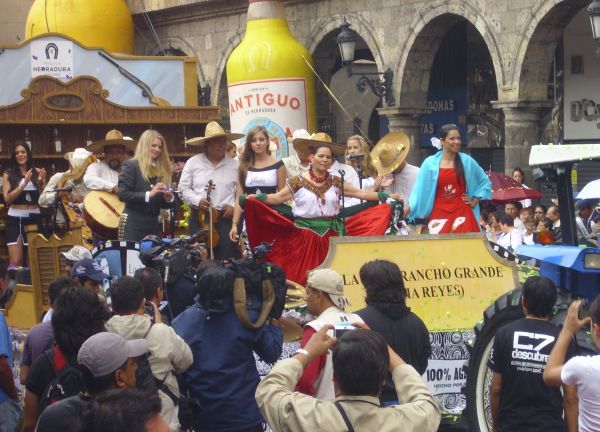
Mariachi, which originated in Jalisco and is considered Mexico’s most traditional and recognizable form of music, was chosen last weekend by UNESCO officials at a summit in Bali, Indonesia.
The “intangible” aspect of the heritage designation is to highlight cultural practices and traditions that lack a physical presence, differentiating them the from castles or ancient relics commonly found in UNESCO World Heritage Sites. When a tradition or custom enters the list, countries must commit to take steps to protect them.
Traditional Mexican cuisine is one of five Mexican contributions among the 213 cultural practices and expressions of intangible heritage previously registered from 68 countries. Other practices include Spanish flamenco and Argentine tango.
Mariachi was among 19 new additions, which also included Portuguese Fado music, French horse riding, South Korea’s ramie weaving technique and Turkey’s keskek meat dish.
According to the UNESCO committee, “mariachi music conveys values that promote respect for the natural heritage of regional Mexico and the local history, both in Spanish and in indigenous languages from the west of the country.”
To celebrate the committee’s decision, a mariachi band entered the meeting room and sang “El son de la negra,” one of the genre’s most emblematic songs.
Jalisco Secretary of Culture Alejandro Cravioto declared that “there is no Mexican musical expression more widespread throughout the world, and this universality had to be reflected in the list of intangible heritage.”
Cravioto said mariachi accompanies the Mexican people’s journey through life, “being present from baptism to burial.” He also noted that, along with Mexican food, it is the only element that migrants can always carry with them.
“Mariachi is a tradition that has managed to put one foot squarely in the 21st century. It has real roots as a spectacle and as a fundamental aspect of many dates important to Mexican families,” added musician and researcher Luis Ku, who wants measures to be taken to support mariachi heritage as as consequence of the UNESCO recognition.
Those who dedicate their lives to mariachi music have called for serious academic research on the genre, claiming a cultural bias against mariachi has existed for decades.
“Of course this is great news, but the party will end and then things are forgotten. This should be exploited to put mariachi in the place it deserves. It seems incredible, but even now, after so many years, many intellectuals still despise mariachi, despite the roots, tradition and how nice this music is,” said musician and television host Cornelio Garcia.
“It’s weird, but that happens in Mexico, but instead it is greatly appreciated elsewhere … they even have mariachi in Harvard!” Garcia concluded by calling for the University of Guadalajara to host an assembly of the topic.

