
The environmental activists and former guerrilla Raul Muñoz leads El Salto’s biggest vigilante group.
Jesús Morones, the owner of a candy shop in El Salto, a rugged industrial area on the southeastern fringe of the Guadalajara metropolitan area, says he’s been robbed at gunpoint eight times.
“Last time they beat me and locked me and my family in here for 10 minutes while they took what they wanted. They were looking for money but they even took a box of chocolates to snack on afterwards,” he says. “My son was crying and one of the bastards even grabbed my wife’s buttocks.”
With the police providing little or no protection against this kind of violent crime, inhabitants of Guadalajara’s forgotten outskirts have begun forming vigilante groups known as autodefensas, or self-defense squads. Vigilantes have famously fought drug gangs in the nearby states of Michoacán and Guerrero in recent years, but their emergence in the major city of Guadalajara, the capital of the state of Jalisco, is more recent and hardly reported.
Gazing out over El Salto’s scorched scrubland as he patrols the dirt roads of his rundown neighborhood, Raúl Muñoz, a 59-year-old former guerrilla, says he leads the largest of 27 autodefensa cells scattered across the town.
Constantly wary of halcones, or hawks, as cartel lookouts are known, Muñoz points out several black pickup trucks with tinted windows. He says they probably belong to members of the Jalisco New Generation Cartel, or CJNG in Spanish. He adds that the cartel has “complete control” of El Salto and the neighboring municipality of Tlajomulco…
Mexico rode into Saturday’s Copa América quarter-final with Chile on a wave of mounting momentum, unbeaten in 22 games and with the biggest support of any team in the competition. They left shellshocked, struggling to make sense of their worst ever defeat in a major tournament. Their fans were fleeing Santa Clara’s sold-out Levi’s Stadium in droves long before this eviscerating 7-0 humiliation was over. Those that stayed took to ironically cheering every Chilean pass with cries of “olé!” while one Mexican journalist described it as “the blackest night in the history of Mexican football”.
It was also a night of vindication for Chile’s Juan Antonio Pizzi, who had overseen just one win in his first five games after replacing Jorge Sampaoli in January, but has now masterminded three consecutive victories in the last eight days. His side pressed relentlessly and they repeatedly ripped Mexico’s defence apart, with Eduardo Vargas claiming four goals and taking his tally in the tournament to six in four matches. La Roja’s title defence remains alive and they now face Colombia in Wednesday’s semi-final, with a repeat of last year’s final against Argentina looking increasingly likely…
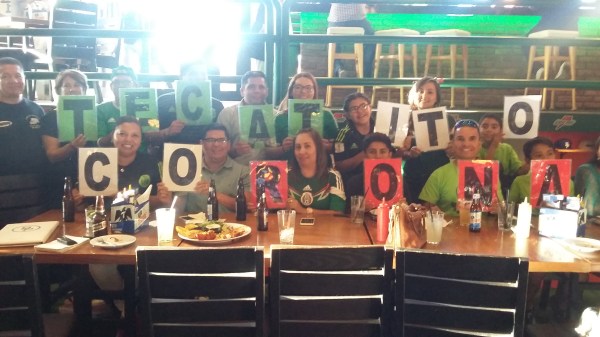
Tecatito Corona’s friends and family cheering him on at a bar in Hermosillo during the Copa América.
With 79 minutes expired on the game clock, Martha Elena Ruíz is in agony. Mexico are trailing 1-0 to Venezuela in the Copa América in a game they need to tie in order to finish atop their group and avoid tournament favorites Argentina in Saturday’s quarter-final. Nervously sipping a Tecate beer at a sports bar in Hermosillo, an industrial city in the heart of the Sonoran desert, Ruíz is sitting beside her husband, Narciso Corona, three of their children, and a dozen other friends and relatives, all proudly wearing Mexico jerseys.
“Bien, hijo,” she says in encouragement as her son, Jesús “Tecatito” Corona, picks up the ball 30 yards from goal and just left of center. “Vamos mi amor, vamos.” Seconds prior, the 23-year-old Corona, sporting what one commentator described as a “Pebbles Flintstone haircut,” had skirted past several defenders and curled the ball just wide of the far post. It would have been a stunning goal. This time he pulls off something even more spectacular, somehow skipping between five opponents before slamming an unstoppable shot into the back of the net. The bar erupts, with his family members screaming for joy and exchanging elated hugs and high fives.

Tecatito with his childhood team. He’s the one kneeling in front of the coach. Courtesy Corona family.
The game finishes 1-1; Mexico stay atop Group C and Corona is named man of the match. Minutes later he texts his mom to tell her he loves her and that he dedicates the goal — arguably his most impressive yet for Mexico’s national team — to his family.
Having come on as an 18th minute substitute after Javier Aquino went off injured, Corona had been at the heart of all of Mexico’s best moments, relentlessly driving forward as if affronted by his omission from the starting lineup, even if it was only intended to keep him fresh for the next round…
 The Tequila Files