Human rights organizations and the parents of Mexico’s 43 missing students have criticized the government’s efforts to prematurely close the case on the young men who were abducted by corrupt police officers in the southern state of Guerrero last September.
Until now the students from the Ayotzinapa teachers college had officially been classified as missing, but Mexico’s Federal Attorney General, Jesús Murillo Karam, claimed in a press conference on Tuesday that his office now has “legal certainty” that they were murdered by members of the Guerreros Unidos drug gang.
The government has 487 strands of evidence that “have allowed us to… come to the conclusion beyond a doubt that the students were abducted and killed, before being incinerated and thrown into the San Juan river, in that order,” Murillo said.
This explanation did little to convince the many critics who have pointed out an array of inconsistencies in the official account of events. Moreover, it is unclear how there could be complete legal certainty over who killed the students or disposed of their bodies when not one suspect has been tried or convicted of such crimes…
Click here to read this article in full at Latin Correspondent.
Mexican President Peña Nieto in fresh conflict-of-interest scandal
Mexican President Enrique Peña Nieto has denied any wrongdoing after becoming engulfed in another scandal involving luxury properties, government contractors and accusations of conflict of interest.
An investigation by the Wall Street Journal revealed on Tuesday that Peña Nieto purchased a house at an exclusive country club in Ixtapan de la Sal in his native Mexico state just weeks after becoming governor of the state in 2005.
Peña Nieto bought the property from Roberto San Roman, a businessman whose construction company went on to win over $100 million in state government contracts from 2005 to 2011. The same firm, Constructora Urbanizadora Ixtapan (CUISA), which had never before carried out federal projects, has also won at least 11 federal contracts since Peña Nieto became president in late 2012.
Peña Nieto’s office released a statement on Wednesday affirming that the house was purchased legally at full market value of $372,000 and publicly disclosed among his assets. However, the identity of the seller of the property had not been known until now, the Wall Street Journal reported.
CUISA has denied that the sale of the property resulted in it gaining favored status under the Peña Nieto administration. The company said it won the contracts by offering the most competitive bids and emphasized that it has launched another 48 unsuccessful bids for federal contracts since Peña Nieto became president.
Peña Nieto’s office stated that he is not involved in the awarding of public contracts, but this is not the first time that he or those close to him have made use of luxury homes provided by favored contractors…
Click here to read this article in full at Latin Correspondent.
Mexican army faces questions over fate of 43 missing students
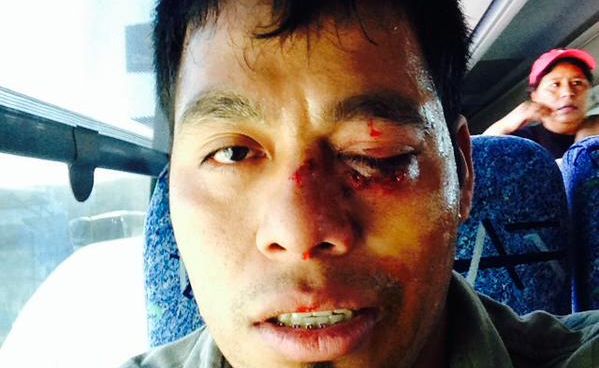
Omar Garcia suffered a black eye and a bloodied face in a clash outside the army base in Iguala last week.
Four months on from the abduction and probable massacre of 43 students in southern Mexico, the survivors and the victims’ families have turned the focus of their relentless fight for justice on the Mexican army.
At least 97 suspects, including scores of corrupt police officers, gang members and the local mayor and his wife, have been arrested in connection with the disappearance of the students in the town of Iguala, in Guerrero state, on 26 September.
The Mexican government has questioned but not charged 36 soldiers, and repeatedly denied allegations of the army’s involvement in the disappearance of the students. Yet their families are demanding a deeper investigation as well as unrestricted access to the military bases where they suspect the 43 young men may have been held.
Omar Garcia, a 24-year-old student who was threatened by soldiers after escaping from the police gunmen that fateful night, has been a leading figure in the campaign for justice ever since.
“We have reason to believe that the army was involved in the disappearance of our companions,” Garcia said. “They were there that night. They probably covered up, facilitated, or played a leading role in the disappearances.”
On 12 January, Garcia suffered a black eye and a bloodied face as protesters and relatives of the missing students were beaten and tear-gassed by military police upon trying to force their way into the army headquarters in Iguala. The military base lies just over a mile from where the 43 students disappeared after a series of shootings that left six civilians dead.
The students all came from poor, rural areas and were training to become teachers at Guerrero’s left-wing Ayotzinapa college. Ironically, they had travelled to Iguala to commandeer buses so that they could attend a demonstration in Mexico City commemorating the massacre of scores or even hundreds of student protesters by the Mexican army on 2 October 1968.
Upon arriving in Iguala, Garcia told The Independent that the students split into two groups. At about 8 p.m. he received a call from the others saying that the police were shooting at them. When Garcia and his companions arrived at the scene they found a group of students huddled outside the bullet-riddled buses in a moment of respite. They tried to call ambulances, lawyers and the press, only for another attack to begin…
Click here to read this feature in full at The Independent.
 The Tequila Files