Mexico’s Knights Templar accused of attacks on Oxxo stores
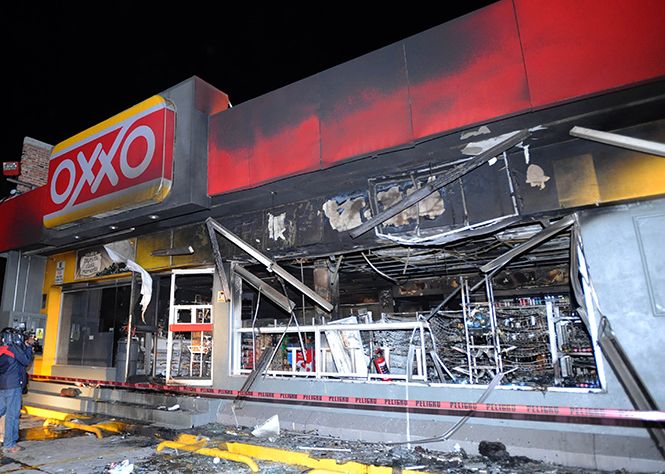
As many as nine branches of Oxxo, Mexico’s most ubiquitous convenience store, were targeted in a series of coordinated attacks on Sunday night.
There were no fatalities but at least three people were injured after gunmen opened fire and threw Molotov cocktails at the stores in Hidalgo and the neighboring State of Mexico.
Hidalgo’s Public Security Secretary Alfredo Mayorga attributed the attacks to the Knights Templar cartel based in nearby Michoacan.
“These organized crime groups used high-caliber firearms, the Templars committed these acts and therefore we must reinforce the Tula area, we are on a state of alert,” Mayorga said on local radio.
All Oxxo stores in the region were closed after the attacks which began at around 9 p.m. Many of the stores were seriously damaged and the assailants reportedly stole from the cash registers in some of the outlets.
“We understand that the authorities are taking action to restore order and protect the citizens, and we expect this to take place as soon as possible for the benefit of all,” said FEMSA, which runs the prominent Oxxo chain, in a statement on Monday.
Coordinated terrorist-style attacks on major corporations are not common in Mexico, but the Knights Templar has been implicated in several similar incidents in recent years. In October 2013, the gang was said to be responsible for burning two dozen electricity and gas facilities across Michoacan, leaving over 400,000 homes without power for hours.
The Knights Templar was also previously accused of firebombing gas stations in the neighboring state of Guanajuato in 2012, as well as attacking distribution centers and delivery trucks belonging to PepsiCo subsidiary Sabritas.
The Knights Templar is currently locked in a bloody war with vigilante groups and the Mexican armed forces in the troubled state of Michoacan.
Gay couple demand end to discrimination in Guadalajara bars

Most people would not think twice about kissing their partner during a night out but on New Year’s Eve Pedro David Siordia Mora and Michael Grendell found themselves ejected from a Guadalajara nightclub for engaging in a modest display of public affection.
The security staff at Barezzito even called heavily armed police officers to ensure that the gay couple left the premises. Given that the Mexican Constitution explicitly prohibits discrimination based on sexual preference the police officers should actually have told the security guards that what they were doing was illegal, but things do not always work that way in Mexico.
“We kissed a couple of times and the security guards told us that it wasn’t a gay bar and that we had to leave,” Siordia said. This was not an isolated incident, he noted.
“In other cases they’ve not let homosexual couples enter because they’ve been holding hands in the line,” he added, while “two months ago two girls were also thrown out of a bar called Planta Baja for kissing and holding hands.”
“This incident took me a little bit by surprise because I thought this bar seemed a little more upscale, where you’d have wealthy, better educated and more open minded patrons,” added Siordia’s boyfriend, Grendell, an English teacher from New York. “I think in Mexico appearances are a big thing. Everyone wants to be seen a certain way and look a certain way. This bar obviously has a certain image in mind and for whatever reason we didn’t fit that. But I would have expected a place like this to be more gay friendly.”

Angered and upset at having suffered such blatant and illegitimate discrimination, Siordia filed complaints with the municipal and state governments, human rights organizations and Mexico’s Consumer Protection Agency (Profeco).
He also organised a peaceful protest outside the bar at 10 p.m. on Friday, 10 January. Around 30 demonstrators, including homosexual and heterosexual couples, gathered in the light rain to participate in a simultaneous, flash mob-style kiss and hand out flowers tagged with messages such as “respect,” “inclusion,” and “stop homophobia” to those entering Barezzito.
“We wanted a public apology and an end to discrimination against same-sex couples,” Siordia said. The protesters appear to have won the former, with the Barezzito staff pledging to issue a public apology via their social networks, but it remains to be seen whether there will be any change to the discrimination that LGBT couples suffer in many local bars and nightclubs.
Stay tuned for a more in-depth feature on the fight for LGBT rights in Guadalajara and across Mexico in the next week or two.
Severed head discovered in Tlaquepaque
A homeless man searching for scrap metal among the weeds of a vacant lot in Tlaquepaque’s Canal 58 neighborhood made a grisly discovery on Wednesday evening.
At around 9 p.m. Sergio Mejia Garcia, 25, came across a severed human head half wrapped in cloth and a black plastic bag.
The head, whose eyes were missing, was that of a young man aged between 15 and 25. Judging by the advanced state of decomposition, experts from the Jalisco Institute of Forensic Sciences (IJCF) estimated that it had been severed three to four weeks earlier.
It is believed to be the head of Juan “El Pelos” Pablo, whose decapitated body was discovered on December 12 just three blocks from where the head was discarded. Local police officers said Pablo was a local drug addict, Guadalajara daily El Occidental reported.
It is unclear who was behind the killing and no arrests have been made to date.
 The Tequila Files