Wal-Mart Mexico hit by fresh allegations from US
House Representatives Elijah Cummings and Henry Waxman wrote a letter to Wal-Mart CEO Michael Duke on Tuesday, warning that freshly uncovered internal documents suggest the company “may have had compliance issues relating not only to bribery, but also to ‘questionable financial behavior’ including tax evasion and money laundering in Mexico.”
Following the letter’s publication Tuesday, shares in Wal-Mart’s Mexican subsidiary fell 5.6 percent the following day. The company issued a statement on Wednesday affirming that “it has no knowledge that (it) is being investigated by Mexican authorities concerning these issues.”
The U.S. Congressional investigation of Wal-Mart’s Mexican operations began in April, following allegations published in the New York Times that the company had paid multiple bribes to secure store permits and subsequently covered up the practice.
The two Democrats complained in Tuesday’s letter that Wal-Mart had repeatedly “failed to provide the documents we requested” on the company’s internal investigation, and had not allowed them to speak to employees involved in the bribery allegations.
Photographer enamored with ‘magical’ Lake Chapala

Having won a number of international prizes for his photographs of the lake, Casillas is now planning an ambitious project to not only document its beauty, but also raise awareness of the pollution endangering Chapala.
“The government is not doing much for the lake,” he says. “I want the people to see what they would lose if the lake dies.”
Born in California, Casillas grew up in the United States and Mexico, an experience which led him to embrace the “Chicano” identity, before eventually settling for good in Guadalajara.
Now 51, he has worked as a photographer for 25 years. Addicted to artistic expression, as a child and later a student, he loved drawing, painting, ceramics and graphic design.
“I then discovered photography while studying communication sciences at ITESO,” Casillas recalls. “I like it because of the freedom of movement. It enables you to travel and meet people, it’s a lot more sociable than being locked in a room painting all day.”
Casillas’ photography has been displayed in almost 100 exhibitions, of which around 70 have been in Guadalajara, about 20 elsewhere in Mexico, and the remainder abroad, as far afield as London, Buenos Aires and Spain.
Casillas has also won around 30 prizes at local, national and worldwide levels. Last year he was named “Citizen of the Year” by the Zapopan city council for his extensive work focused on the identity of Zapopan. In the past few months he has also won prizes in Monterrey and the Spanish city of Andalucia.
Casillas currently teaches communication in the Instituto de Ciencias, having also given classes in film, theatre, photography and television reception at the University of Guadalajara and ITESO.
Casillias sees himself as an artist, but also a proponent of civil rights and social movements. He is moved by images of Mexican culture or human suffering, but also enjoys capturing landscapes, rivers, lakes and the ocean.

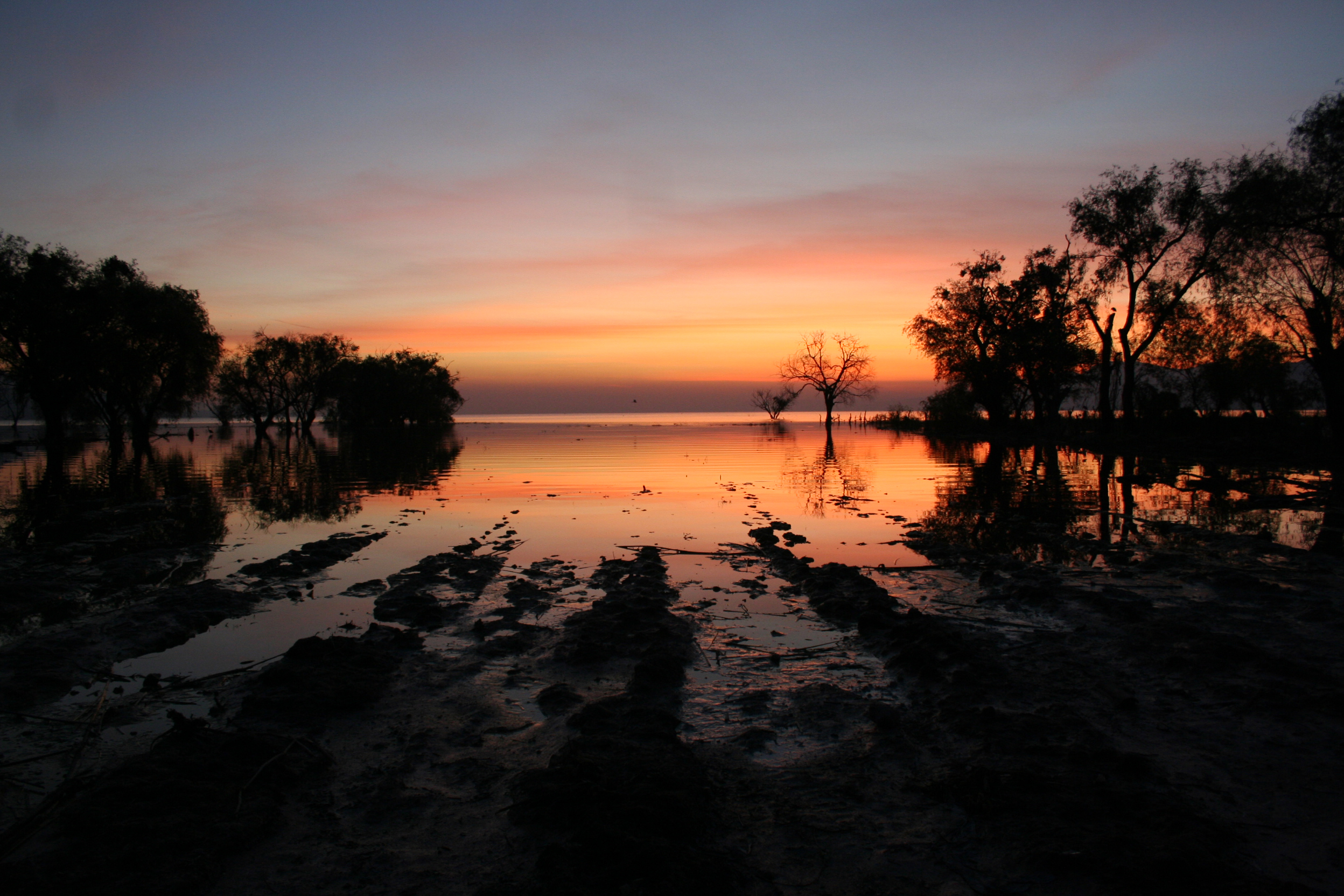
“There’s something magical about bodies of water,” says Casillas, who, having grown up beside the ocean in California, now considers Chapala a calming place of refuge. He especially enjoys taking photographs of the lake at sunrise and sunset, noting the orange, red, violet and purple shades reflected on the surface.
Last November one of Casillas’ Chapala shots earned him third place in a competition run by the Adaptation Fund, which was established by adherents to the Kyoto Protocol with the aim of combating and drawing attention to climate change. He has also won two of four seasonal prizes in a competition run by the Wildfowl and Wetland Trust (WWT), a nonprofit conservationist organization in Great Britain.
While the majority of entrants are British, there is one international category, which Casillas has dominated with his photographs of Chapala in the winter and spring. There is still one seasonal winner to be announced, with the overall winner awarded a trip to New York and the Niagra Falls.
Should Casillas win that he would then compete with the British winners from every other category for the grand prize of an expedition to the Antarctic. “I’m not sure if it’s a prize or a punishment,” he jokes.
Aside from entering competitions, Casillas is looking for sponsors to help him realize an ambitious personal project in aid of Lake Chapala.
“I want to travel 300 kilometers, walking, cycling and in bus, around the lake,” he explains. “I want to make a map showing where people fish, where tourists come, where the government recycles water and where people dump trash.”
Pollution affects not only the water quality, Casillas says, but also the trees that surround the lake, the fish that swim in it and the birds and fishermen that live off them – not to mention the negative effect it has on local tourism.
“I want to hold an exhibition in each of the ten municipalities around Chapala, showing how beautiful the lake is, but also demonstrating the problems,” Casillas says.
On this tour, he would produce both artistic photographic work, highlighting local flaura and fauna, as well as an investigative documentary, with environmentalists invited to hold conferences on how to solve the lake’s problems.
Casillas hopes to raise at least 100,000 pesos to fund the project. If anyone is interested in helping out or making a donation, email Casillas at hugo9551@hotmail.com
Narcos blockade Michoacan highways after bloody battle with feds
Five alleged Templars and at least four federal officers were killed in a raid that commenced around 4 p.m. in the town of Holanda, a suspected cartel stronghold in the mountainous Apatzingan region.
Police backed with Black Hawk helicopters exchanged fire with gang members heavily armed with fragmentation grenades, AK-47 and AR-15 assault rifles and high-power .50-caliber Barrett rifles. Investigators later recovered shell casings from over 500 rounds of ammunition and the remains of three grenades used by the Templars.
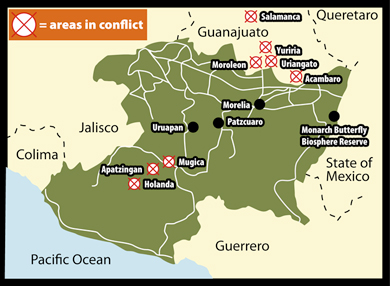 The Templar responded to the raid by torching at least 30 vehicles, including buses and police cars, to form “narcobloqueos” blocking the Lazaro Cardenas-Uruapan highway, three roads in Apatzingan and another in the municipality of Mugica.
Several wounded police officers were taken to the Mugica general hospital, but they came under fire again from another gang member waiting there to finish them off. A police vehicle and a private van were set alight in the ensuing chaos as the hospital was evacuated.
Armed Templars also carried out a wave of attacks on Saturday, burning five gas stations and several vehicles in southern areas of Guanajuato state.
A splinter group from Michoacan’s La Familia cartel, the Knights Templar gang emerged in 2011 and now controls much of the state and neighboring Guanajuato.
In response to the weekend’s violence, the federal government deployed additional federal police units to Apatzingan on Monday, equipped with 20 armored vehicles, 30 all-terrain SUVs and two more Black Hawk helicopters.
The Mexican Army has also established a checkpoint on the Siglo 21 highway outside Apatzingan with advanced tracking equipment to detect any explosives, weapons or suspects entering the municipality.
Located in the tropical Tierra Caliente region, Apatzingan is about 120 kilometers southwest of state capital Morelia. The Morelia bus terminal was closed for 16 hours following the narco-blocades on Friday, but buses have since resumed operations in all areas of Michoacan.
“La Tierra Caliente is a problem region,” said La Jornada editor Hector Mendieta, “but Michoacan is a big state.”
Mendieta drove to the popular tourist destinations of Morelia and Patzcuaro this week.
“The highway was very calm and I saw about six convoy of soldiers patrolling the road,” he noted. Despite the recent disturbances in other parts of the state, Mendieta believes these colonial cities are still safe places to visit.
“Everything was fine in Morelia, it did not feel unsafe at all,” he said, while “Patzcuaro was crowded with tourists from the United States, South America, Europe and Japan.”

