PAN candidate hits out in wire-tapping row
In a case that echoes both Watergate and the ongoing News International phone-hacking scandal, National Action Party (PAN) candidate Josefina Vazquez Mota accused frontrunner Enrique Peña Nieto of the Institutional Revolutionary Party (PRI) of tapping her phone line.
Vazquez Mota initially alleged that members of the government had wiretapped her in a private phone conversation during the PAN presidential primaries. That conversation was posted online by a Mexican news outlet on Monday, leading Vazquez Mota to accuse the PRI of also listening in and leaking the recording to embarrass her.
“Send a warm greeting to Genaro Garcia Luna, who records us instead of recording El Chapo, and a very loving greeting to Alejandra Sota, who filters all our phone calls. Pinche Sota,” Vazquez Mota told campaign coordinator Agustin Torres Ibarrola in the recording on the La Silla Rota political website.
Both Secretary of Public Security Garcia Luna and Sota, a presidential spokesperson, are members of President Felipe Calderon’s cabinet. Although Calderon and Vazquez Mota are both members of the PAN, they are not close political allies and the president favored his treasury secretary Ernesto Cordero as the party candidate to succeed him.
The conversation apparently took place prior to the PAN primary in January, in which Vazquez Mota defeated Cordero. With her reference to “El Chapo,” Vazquez Mota implied the government should be focusing on catching Mexico’s most wanted drug lord, Joaquin “El Chapo” Guzman, instead of wiretapping members of its own party.
It is unclear how La Silla Rota obtained the recording of the conversation. Editor Felipe Gonzalez claimed he did not know the source of the audio.
Once it was made public, Vazquez Mota was quick to blame her presidential rival Peña Nieto in a bid to divert attention from internal divisions.
“Whose interest is it in? And who benefits from this kind of spying and leaks? It is the Institutional Revolutionary Party, and its candidate, Enrique Peña Nieto, which has routinely carried out such practices,” she alleged in a press release on Monday, after filing a formal complaint with the Attorney General’s Office (PGR) for violation of private communications.
“Ultimately we are in the same party and party unity is the most relevant and important to us,” Vazquez Mota added later, in an attempt to restore harmony within the PAN.
Interior Minister Alejandro Poire denied that the federal government spies on anyone. In a thinly veiled reference to the PRI’s history of engaging in such practices, he said the days of government committing political espionage were in the past.
Javier Lozano Alarcon, spokesman for the National Executive Committee (CEN) of the PAN, also accused the PRI of wiretapping – “a sport it has practiced for many years,” he said.
Lozano’s PRI counterpart Eduardo Sanchez denied any accusations that his party was responsible, affirming that they “totally reject such practices.”
Turning the focus back on the government, he added, “it is regrettable that they are using state institutions and mechanisms of criminal investigation to conduct political espionage. This is unacceptable. A democratic government cannot allow it.”
Under Mexican law, campaign season begins March 30. The former governor of the State of Mexico was due to begin his nationwide campaign for the presidency at midday in the Plaza Tapatia in front of the Hospicio Cabañas. From there he was expected to join former PRI Mayor Jorge Aristoteles Sandoval Diaz in the Plaza de la Liberacion, to officially launch his campaign for the Jalisco governorship.
Beginning its campaign in Guadalajara illustrates the PRI’s determination to reclaim both the presidency and the state of Jalisco, which has been a National Action Party (PAN) stronghold for the past 18 years. Previously, the PRI governed the state for six uninterrupted decades.
While we will be seeing plenty of publicity promoting the candidates in the coming months, under Federal Electoral Institute (IFE) rules, governmental propaganda is forbidden on both television and radio once the March 30 deadline has passed. This is to prevent politicians in office from exploiting their positions to promote partisan agendas.
The official campaign period lasts until until June 27. Mexicans then go to the polls on Sunday, July 1.
Migrants get their benefits five decades late
“I want to apologize. As president of Mexico, I ask for your forgiveness,” Calderon told ex-braceros in the Jalisco municipality of Acatic on Saturday, as he handed them Bansefi debit cards preloaded with 38,000 pesos. “It’s late, yes, but as the saying goes, ‘no deadline is not met and no debt goes unpaid.’”
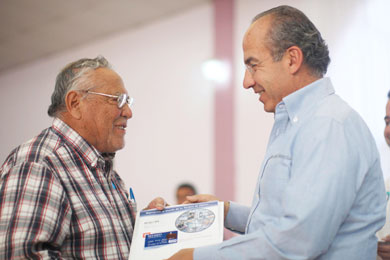 The Bracero (“strong arm”) guest worker program, which ran from 1942 to 1964, was initially prompted by a demand for manual labor during World War II. Under a series of laws and diplomatic agreements, approximately 2.5 million Mexicans were allowed to work on a temporary basis in the United States, mostly in agriculture and the railroad industry.
Controversially, the U.S. government deducted ten percent of the workers’ wages during the first seven years of the Bracero Program, supposedly to fund pension schemes and provide an incentive for the Mexicans to return home after their contracts ended. But the money vanished, apparently after U.S. authorities remitted it to Mexican banks.
The ex-braceros, who never received the social benefits they were promised while working north of the border, have campaigned for decades for the money they are owed, demanding 100,000 pesos each.
President Vicente Fox promised to address their grievances during his successful election campaign in 2000, but was slow to act after taking up office. In 2004, hundreds of frustrated ex-braceros invaded Fox’s ranch in San Cristobal, Guanajuato, demanding action.
The following year the federal government finally announced a compensation scheme of 38,000 pesos per person, but many ex-braceros balked at the paltry sum. The initial pay outs were made to 7,800 ex-braceros who worked between 1942 and 1946, with widows and heirs also eligible to collect the settlements.
Calderon was accompanied last weekend by Interior Minister Alejandro Poire, who said 27,457 former migrants have now been paid, equivalent to 26 percent of the 193,000 that the government acknowledges are owed money.
Gilberto Parra, the leader of Jalisco’s ex-braceros, was scathing of the government’s efforts, slamming Calderon’s words as “untimely, unfortunate and untrue.” Parra said there is “much cynicism” in the president’s declaration that “today we are paying all the laborers of Jalisco and Mexico. So mission accomplished.”
Parra said there are still thousands of former braceros who were not considered for repayment. According to the Jalisco Center for Migrants and the Elderly, 250,000 braceros migrated from Jalisco to the United States between 1942 and 1964, but just over 22,000 are able to prove it. By saying the debt has now been paid off, Parra believes “Calderon has eliminated the possibility of there being another list” of beneficiaries.
While the president claimed that “in good conscience, I have done everything I could,” Parra said he was in fact forced into action by the protests and the Mexican Congress, which approved the payments. The ex-bracero leader added that the only possibility of extending the benefits to those not presently covered is by compelling Congress to pressure the next president of Mexico.

