Two reported dead in narco-blockade chaos, as federal police show off captured drug kingpin
These coordinated “narcobloqueos” were provoked by the capture of the leader of the Cartel de Jalisco Nueva Generacion (CJNG), following a shootout with security forces at his Zapopan home.

Chaos reigned as the emergency services were flooded with calls, cell phone lines were down for hours and social networks were ablaze with rumors and false information.
Reports of incidents involving buses, trailers and private automobiles came in close succession throughout the early afternoon. Governor Emilio Gonzalez then confirmed that gangs had commandeered 25 vehicles in 16 separate incidents – 11 of them in the Guadalajara metropolitan zone.
The blazing buses caused severe traffic jams in several parts of the city and a massive mobilization of police and emergency services. According to witnesses, in most incidents groups of three to six armed men signaled for the buses to stop.
They boarded the vehicles and asked passengers to disembark quietly and calmly, before dousing the buses in gasoline. They then departed hastily after igniting the fuel with matches, molotov cocktails or fragmentation grenades.
Two people were killed amidst the chaos. Bus driver Moises Corona was burned to death when his Turquesa-line vehicle was set alight by armed men at the junction of Puerto Guaymas and Las Torres in Zapopan.
“He turned to me … and walked a bit and then boom! It exploded with glass and everything, and then huge flames,” said his wife, who witnessed the incident. “He wasn’t able to get out and save himself.”
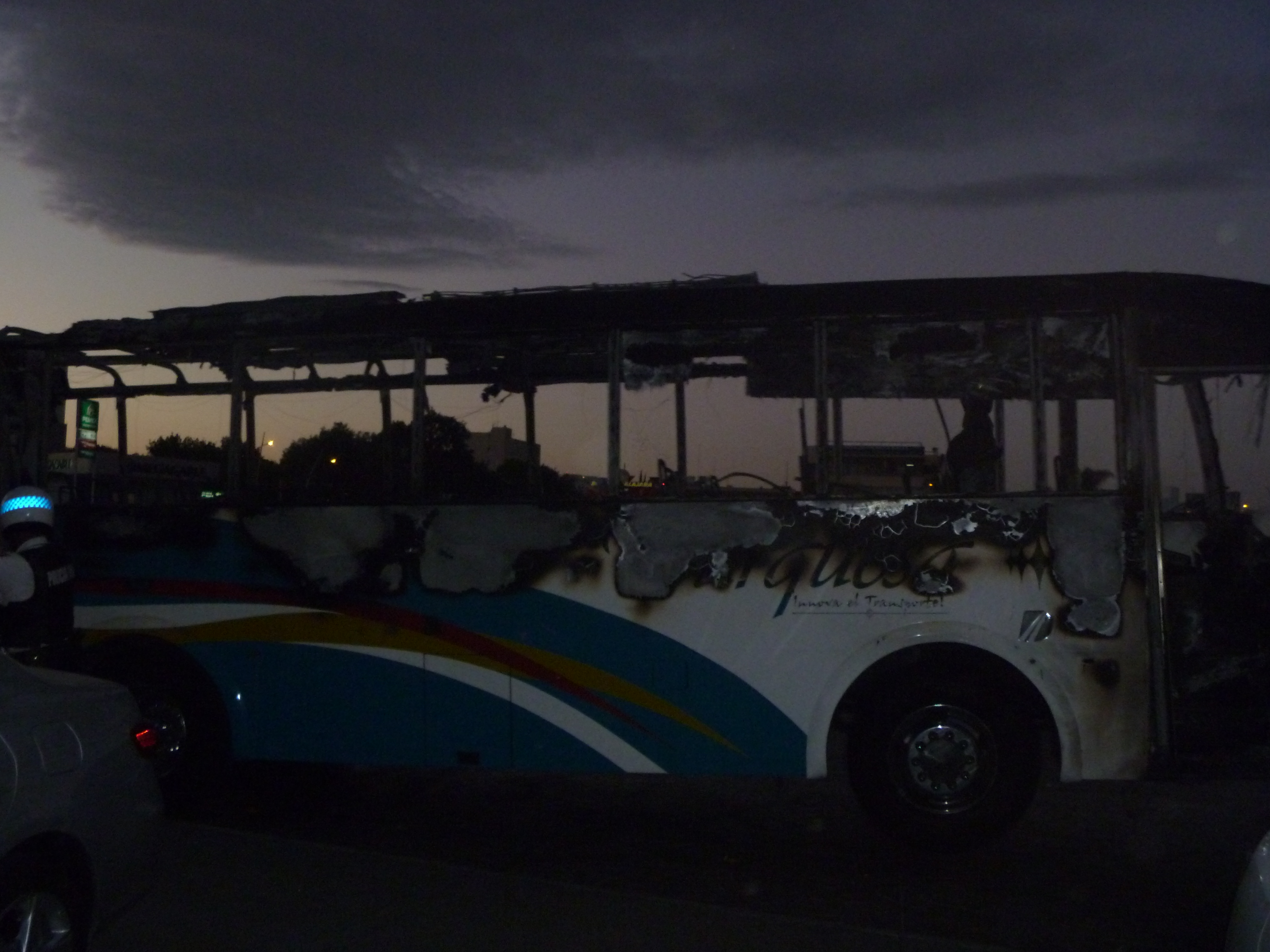
One of the criminals was also shot dead in a firefight with police in San Juan de Ocotan.
“These criminals seek to inject fear and take control of our society,” said President Felipe Calderon on Sunday, affirming that neither his government nor the people of Jalisco will permit it. “We are going to help Jalisco to preserve the security and peace that we all aspire to.”
The spark that lit the streets ablaze was the arrest of CJNG kingpin Erick Valencia Salazar earlier on Friday.
Known by the alias “El 85,” Valencia worked in allegiance with the powerful Sinaloa Cartel headed by Mexico’s most wanted drug lord, Joaquin “El Chapo” Guzman. He was also a close ally of the Sinaloa Cartel’s regional boss, Ignacio “Nacho” Coronel, who was killed by security forces in Guadalajara in July 2010.
Coronel’s death – along with the breakup of another organization known as the Milenio Cartel – left a power vaccum in Guadalajara. Valencia sought to fill it by forming the JNCG, while rival gang members founded a group called La Resistencia and forged an alliance with the Sinaloa Cartel’s fiercest adversaries, Los Zetas.
Valencia was also head of the “Matazetas” or “Zeta Killers,” a subdivision of the CJNG established last year to hunt down their rivals, who had begun making inroads into Jalisco via southern Zacatecas. The Matazetas were deployed in Michoacan, Morelos, Guerrero and most infamously in Veracruz, where last September they dumped the bodies of 35 alleged Zetas in broad daylight on busy city streets.
Parading Valencia before the media on Monday, the Attorney General’s Office said he “controlled drug trafficking along part of the Pacific route, principally in the port of Manzanillo, Colima, where he coordinated the importation of cocaine and ephedrine (a chemical used in crystal meth production) from Colombia and China.”
Valencia was arrested along with his second-in-command, Otoniel Mendoza, who goes by “Tony Montana,” the name of Al Pacino’s iconic drug lord in the movie “Scarface,” and a third man, Jose Luis Salazar Gutierrez. They were captured in a carefully orchestrated raid on Valencia’s home in the Lomas Altas neighborhood of Zapopan.
Having sealed off the streets around the building, members of Mexico’s Special Forces descended by helicopter around midday Friday. A 15-minute firefight ensued, in which Valencia was wounded in the right hand by a grenade and Mendoza was struck in several places by shrapnel.
Following the arrests, a search of the premises turned up six handguns, 37 assault rifles (including 19 AR-15 rifles with fitted grenade launchers) two machine guns, two Barret rifles, three fragmentation grenades, 119 magazines for different weapons, 69,000 cartridges, three silencers, communications equipment and false documentation.
The subsequent disturbances across Jalisco began around 1 p.m. A Defense Department spokesperson suggested they were carried out to distract security forces from taking further action against the cartel. A similar wave of blockades and violence broke out in February 2011 after the arrest of two leaders of La Resistencia.

In total, 19 people were arrested on Friday: the three men detained in the initial raid and 16 others suspected of involvement in the blockades. The Jalisco Attorney General’s Office presented 15 of the suspects to the press on Friday night. They were all handcuffed and none spoke. No questions were allowed.
Four were later released for lack of evidence when it transpired they were innocent vegetable sellers from San Juan de Ocotan. On Monday morning, Governor Emilio Gonzalez announced four more suspects had been arrested in connection with the narcoblockades.
Incidents were confirmed at the following locations:
- Las Torres and Puerto Guaymas
- Rayon and Miguel Blanco
- Enrique Diaz de Leon and Avenida de los Maestros
- Lazaro Cardenas and Cruz del Sur
- Colon and Isla Raza, by the Tren Ligero Station
- Cinco de Mayo and the Periferico ringroad
- Juan de la Barrera and Deportes in Tlaquepaque
- Carretera to Nogales, at Venta de Astillero
- Carretera to Chapala, at the corner of the Periferico
- Carretera to Zapotlanejo, near the Puente Grande in Tonala
- Carretera to Morelia, just after San Agustin in Tlajomulco
- Carretera libre to Colima, at the Atoyac turnoff
- Carretera from Sayula to San Gabriel
- Carretera from Ocotlan to Tototlan
- Carretera from Mascota to Talpa
- Carretera from Tototlan to Atotonilco
Butterfly sanctuary hit by double blow
The number of butterflies migrating to the biosphere reserve in Jalisco’s neighbor state is down by as much as 30 percent this year, according to analysts from the National Commission of Natural Protected Areas.
The number of orange and black butterflies spending the winter months in Michoacan’s 56,259-hectare reserve has declined over the past five years due to several factors, including increased use of herbicides, the threat of natural predators and, most importantly, extreme weather conditions.
“Sometimes there are droughts or adverse weather conditions for the reproduction of the butterfly in the United States and Canada. In this case the number of butterflies that arrive in Mexico is already depleted,” said Felipe Martinez, deputy director of the Monarch Butterfly Sanctuary.
The reserve is also facing problems of a different nature. Heightened security warnings by the U.S. State Department regarding travel in Michoacan have seen the number of visitors drop by 33 percent.
Some areas of the state have suffered a rise in drug-related violence in recent years and the latest warning from the U.S. government suggests tourists “defer non-essential travel to the state of Michoacan except the cities of Morelia and Lazaro Cardenas.”
Such warnings “definitely affect us and this is reflected in the number of visitors coming to the reserve each year, where around 20 or 30 percent used to be foreign tourists,” said Martinez. “On average there were over 150,000 visitors and today we have trouble reaching 100,000.”
There have been no reported incidents of violence in the sanctuary and the survival rate of human visitors is far better than that of their butterfly counterparts. Each winter between 60 million and one billion monarch butterflies migrate from the United States and Canada to Michoacan and the State of Mexico.
Remarkably, no butterfly ever makes the entire round-trip, as their lifespans vary from just two to seven months. The newborn butterflies make the return journey north to the same sites as their ancestors from pure instinct.
To lessen their chances of being assaulted, raped, kidnapped or even killed en route to the U.S. border, increasing numbers of migrants are shunning the shorter but riskier journeys via the Gulf coast or the center of the country, in favor of the Pacific route which brings them through Guadalajara.
Traveling from border to border via the Gulf takes about nine days, while the central route takes 20 days and traveling up the Pacific coast takes over a month.
“This is the most strenuous route of all. It’s almost 35 days straight,” said Luis Enrique Gonzalez Araiza of FM4 Paso Libre, a non-profit organization that provides aid for migrants.
FM4 Paso Libre runs a shelter and kitchen for migrants on Avenida Inglaterra. The number of people coming has risen to about 35 per day from just 20 last September.
Most migrants remain in Guadalajara between 24 and 48 hours before boarding the next train. Few stray far from the tracks and their presence is obvious around Avenida Inglaterra, which runs parallel to the railroad.
They often solicit passersby for food or money but police officers assigned to the area say they have not registered crimes committed by migrants. In fact, the greatest danger the migrants pose is to themselves. Attempting to board the moving trains can be extremely hazardous and serious injuries to migrants, including loss of limbs, are not uncommon.
It is estimated that around 400,000 migrants make the perilous journey through Mexico every year.
According to a report on the abduction of migrants by the National Human Rights Commission (CNDH), 11,333 migrants were kidnapped while traveling through Mexico between April and September 2010.
Southeast Mexico is the riskiest area, where 67 percent of abductions occurred, followed by the north with 29 percent. Just 2.2 percent of kidnappings took place in the central area which includes Jalisco.
By taking the Pacific coast route to the border, migrants can minimize the risk of being press-ganged into working for drug cartels or killed if they refuse. One of the most notorious cases occurred in the northeastern state of Tamaulipas in 2010, when 72 Central American immigrants were massacred by Los Zetas for being unable to pay ransom fees and refusing to work for the criminal gang.

