Narco carnage in Guadalajara
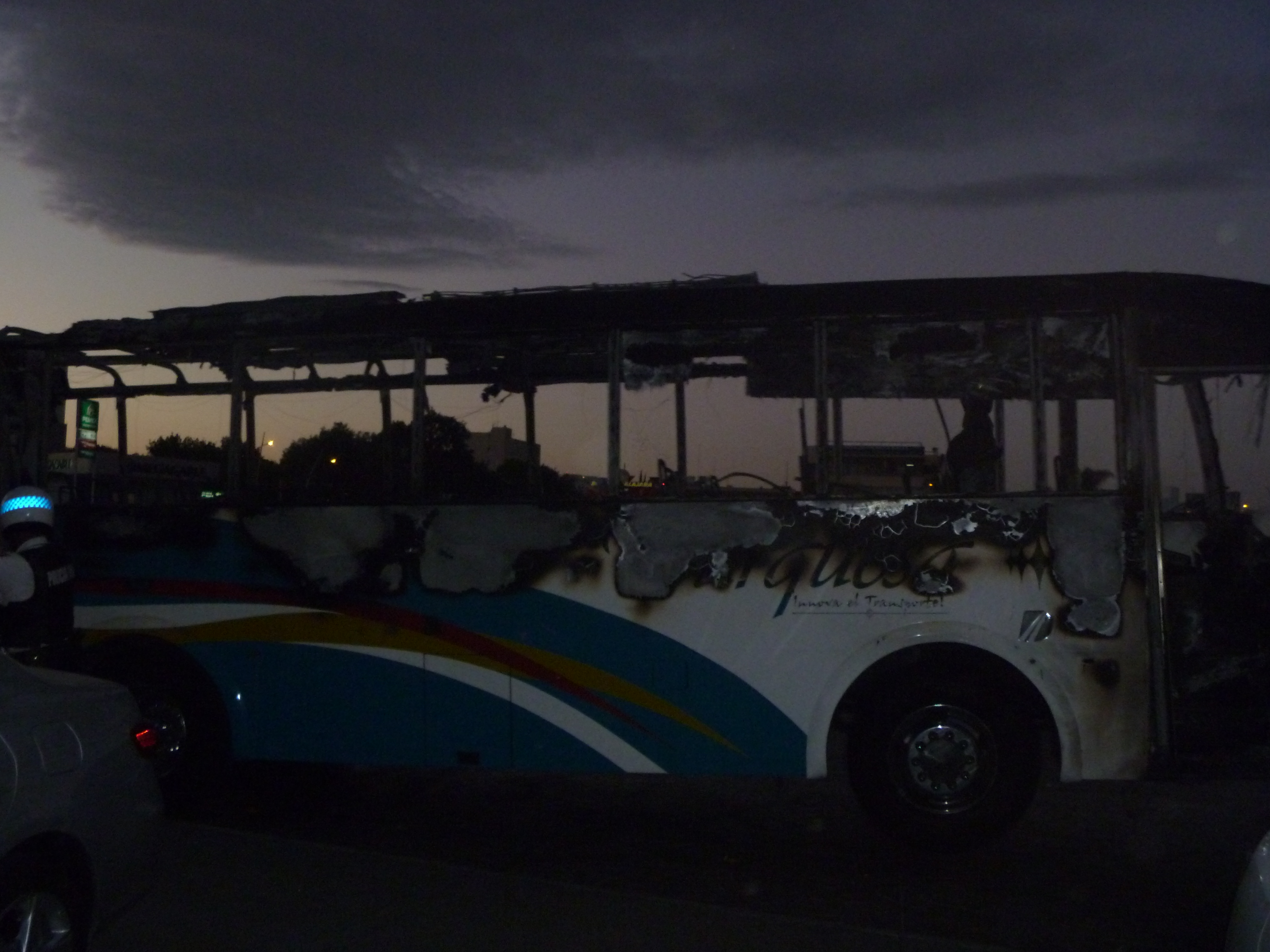
Armed men caused mass panic on the streets of Guadalajara on Friday, burning buses to block off traffic in retaliation for the arrest of Erick Valencia Salazar, the leader of the Cartel de Jalisco Nueva Generacion, earlier in the day.
Valencia was detained along with his second in command after Mexican soldiers stormed a house in the Lomas Altas neighborhood in Zapopan at around midday.
Shortly afterwards, armed men began boarding public buses, forcing the passengers off at gunpoint and burning the vehicles at major intersections across the city.
In the evening I went to a press conference given by Jalisco Governor Emilio Gonzalez, who confirmed that gangs seized 25 vehicles in 16 separate incidents – 11 of them in the Guadalajara metropolitan zone.
Gonzalez said suspects have been arrested, but refused to elaborate or take further questions. Earlier, Zapopan authorities said nine people been detained in connection with the narcoblockades.
Returning from the press conference I saw one of the burned out buses being towed away past the iconic Minerva fountain. It was the same Turquesa bus in which a man was burnt to death, having apparently refused to leave the vehicle.
– See updated story here for full details.
Opinion polls at odds as PAN closes gap on PRI
The president courted controversy by presenting Banamex executives with an opinion poll that showed National Action Party (PAN) candidate Josefina Vazquez Mota just four points behind frontrunner Enrique Peña Nieto of the Institutional Revolutionary Party (PRI).
 The left-of-center Party of the Democratic Revolution (PRD) responded by filing charges of inteference in the electoral process against Calderon before the Electoral Crimes Prosecutor (Fedape).
“I can only reiterate the role of the president as absolutely respectful of the electoral process and befitting a head of state,” Vazquez Mota said in response to the controversy.
While Calderon’s words are unlikely to have a major impact on the outcome of the election, there is an unwritten law in Mexican politics that outgoing presidents do not get involved in election campaigns. His actions have also shone light on the increasingly common use of opinion polls as political propaganda.
Vazquez Mota has clearly gained ground on Peña Nieto in recent months, but not to the extent that Calderon claimed. The details of the poll cited by Calderon have not been made public, but a few days earlier the PAN had released another survey by Mercaei showing that Vazquez Mota trailed Peña Nieto by only five points.
Electoral advisor Marco Antonio Baños Martinez said the survey in question was not registered with the Federal Electoral Institute (IFE). Under Article 237 of the Federal Code of Electoral Institutions and Procedures (Cofipe), anyone seeking to conduct an election poll must register with the IFE and reveal its methodology before releasing results.
Peña Nieto’s campaign team dismissed the survey as “an anomaly,” noting that “independent surveys … with more weight” show their candidate’s lead is much greater than four or five points.
A survey by polling firm Buendia & Laredo for El Universal shows Peña Nieto with 48 percent of support, Vazquez Mota with 32 percent, and leftist candidate Andres Manuel Lopez Obrador trailing with just 20 percent. The survey of 1,000 people was conducted between February 8 and 13 and has a margin of error of 3.5 percentage points. It shows Vazquez Mota peaked at 35 percent in early February, having risen from just 23 percent last November.
Another survey by pollster Consulta Mitofsky also places Vazquez Mota 16 points behind Peña Nieto, but it puts her on 24 percent of the vote and Peña Nieto on 40 percent. Conducted February 6 to 8, after Vazquez Mota won a clear victory in the PAN primaries, the nationwide poll was based on personal interviews with 1,000 registered voters, with a margin of error of 3.1 percent.
The results indicate the gap between the two frontrunners has shrunk by five points since their December survey, while Lopez Obrador remains stable with 18 percent support. In comparison, a Mitofsky poll from last March showed Pena Nieto had the backing of 49 percent of voters, while Vazquez Mota mustered just 14 percent.
Although the Universal and Mitofsky polls are consistent regarding the size of Peña Nieto’s lead, the eight-point disparity in their estimations of the support for both leading candidates exceeds the margins of error, suggesting that such surveys should be taken with a pinch of salt.
As Lopez Obrador once warned, “the polls should be observed with caution, because they become fashionable at election time.”
He should know. In the run up to the 2006 presidential election, most surveys showed the former mayor of Mexico City enjoyed a slim but consistent lead over PAN candidate Felipe Calderon.
In the last polls conducted eight days before the election, both Reforma and El Universal gave Lopez Obrador a two-point lead over Calderon. Consulta Mitofsky put Lopez Obrador three points ahead, while Milenio gave him an even stronger lead of 4.9 points.
In the end (notwithstanding widespread allegations of electoral fraud) Calderon was judged to have won by a razor-thin margin of 243,934 ballots, equivalent to 0.58 percent of the vote. The lesson learned? Do not trust the polls.
Yet Lopez Obrador himself was happy to rely on surveys of public support to decide who would win the PRD nomination last year. The latest study by Covarrubias y Asociados – the pollster he chose to conduct the survey upon which his nomination rested – put Lopez Obrador in second place with 30.23 percent of the vote.
The results show he trails Peña Nieto who is on 42.26 percent, but leads Vazquez Mota, who apparently commands just 27.17 percent of support. This is the only survey that places Lopez Obrador ahead of the PAN candidate.
Perhaps the most intriguing survey was one conducted by Reforma in January that showed 59 percent of voters remain undecided. While Peña Nieto currently enjoys a healthy lead, such a high number of undecided voters could potentially swing the election in any direction.
In comparison, in March 2006 only 28 percent were undecided, while just 20 percent had doubts ahead of the 2000 election. This suggests something of a crisis of Mexican democracy in 2012. After years of corruption, rigged elections, violence and political in-fighting, many people feel little affiliation for any of the country’s political parties.
The PAN has lost some support due to a high unemployment figures, rising wealth inequality and, most significantly, the substantial rise in drug-related violence that has left around 50,000 people dead in the past five years under the Calderon administration. In the meantime, many of those who supported the PRD in 2006 have swung back to the more centrist but historically authoritarian PRI.
The PRI was notorious for corruption and rigging elections during its 71-year unbroken rule, but it has now been 12 years since Mexico has experienced a priista government. Many young voters cannot remember life under the PRI, a fact which may serve in the party’s favor as it attempts to rebrand itself as a new, more moderate force in Mexican politics. Most polls suggest that so far such a strategy is working, despite the president’s attempts to convince the public otherwise.
Former US envoy to Mexico calls for perspective

“Breaking through the noise of election year rhetoric on both sides of the border is essential if we are to gain a more complete understanding of the situation on the ground in Mexico,” wrote Antonio Garza, who served as ambassador to Mexico from November 2002 until January 2009.
In spite of concern over the recent expanded travel warnings issued by the State Department for U.S. citizens in Mexico, Garza urges that “this is no time to lose faith in Mexico, or mischaracterize the situation there. I’m optimistic about our allies and partners to the south, and there’s every reason for the U.S. to remain steadfast in our support.”
Garza cited a recent report from Gary Hale of the Baker Institute in which he affirmed that “Mexico is a friend, not an enemy.” The former ambassador agreed: “no truer words could be spoken. Among the threats to our nation’s security, violence in and from Mexico is simply not a specific threat to the U.S.”
Hale’s assessment, along with recent testimony before the U.S. Senate by General James Clapper, the Director of National Intelligence, “brings some much needed balance and perspective to the challenges facing Mexico and its impact on the U.S. Here’s hoping our elected leaders not only take time to hear it, but act accordingly,” said Garza.
“Both note that it’s an undisputed fact that most of the violence and killings in Mexico are trafficker-on-trafficker. They roundly reject the assertion by some in the U.S. that we designate Mexico’s drug cartels as foreign terrorist organizations.”
Appointed by President George W. Bush, Garza stepped down after Barack Obama named his successor, Carlos Pascual. To read Garza’s column in full visit http://www.cisionwire.com.

