Calderon pleads with US: No more weapons
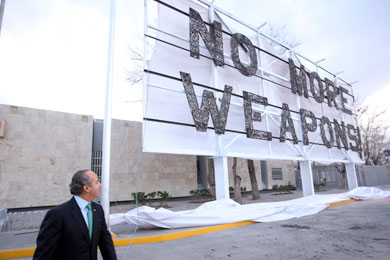 The three-ton billboard is written in English and can be seen from across the border in El Paso, Texas. Its letters are made from weapons seized by Mexican authorities.
“We need your help to stop this violence. We need you to reduce your consumption of drugs and to dramatically reduce the flow of money to criminal organizations in Mexico,” Calderon declared, looking across the border. “But beyond the topic of drugs, the best way that you, the American people, can help reduce the violence in Mexico is through legislation that has already been in force in the United States, blocking the inhumane weapons trafficking into our country.”
Ciudad Juarez has become Mexico’s murder capital in recent years and Calderon said the increase in violence across Mexico was directly connected with the expiration of the U.S. assault weapons ban in 2004. Calderon has asked U.S. legislators to renew the ban on assault weapons on several occasions, most notably in a 2010 speech before the U.S. Congress.
Speaking in Juarez, Calderon also noted that the city’s murder rate had fallen by 45 percent from 2010 to 2011. He said figures for the first six weeks of 2012 were even more promising, suggesting a 57 percent drop in homicides compared to the same period last year.
Calderon claimed the “We’re all Juarez” investment program his government launched two years ago had played a major role in improving security, but analysts suggest the reduction in violence could mean the Sinaloa Cartel has succeeded in usurping its Juarez Cartel rivals from the city.
Caretaker dies after admitting role in student murders

Gerardo Flores Gomez, 51, was caretaker of the Federation of Guadalajara Students (FEG) headquarters, where the bodies of four students and one parent were discovered last December. Better known as “El Tatuado,” for his many tattoos, Flores died in custody at the Fray Antonio Alcalde Civic Hospital on Saturday morning after suffering a septic shock, the result of multiple health problems.
The Jalisco Institute of Forensic Sciences (IJCF) revealed that Flores was suffering from pneumonia, hemorrhagic gastritis and liver cirrhosis.
“The body bore no signs of violence or beatings,” said IJCF coordinator Eduardo Fonseca Mota at a press conference. He added that an examination of Flores’ body showed the lungs and heart were severely swollen, while the liver was larger and heavier than is normal, with multiple scars suggesting chronic liver failure.
The State Attorney General’s Office (PGJEJ) suggested that Flores’ illnesses were what drove him to turn himself in. He “had a liver problem and requested drugs – that’s what made him come to us,” said Jalisco Attorney General Tomas Coronado Olmos, who added “we gave him other medications he required.”
Flores gave himself up to the PGJEJ on February 7 and confessed to the murder of two teenage students. He also accused FEG President David Castorena Peña of shooting two of the victims in his office.
His account supports the testimony of four teenagers who also incriminated Castorena in two of the murders last month, after admitting they were forced to dig the victims’ graves. Authorities are still searching for Castorena, who has gone into hiding since the incident.
He stands accused of shooting a father and son following a dispute over fees for the father’s churros stand outside the school grounds at La Normal. Flores admitted stabbing to death two teenagers who accompanied the pair to the FEG headquarter, and then shooting one of them in the head. He also admitted his son killed a fifth victim.
Born in Guadalajara, Flores lived in the United States before returning to work for the FEG for 24 years. He once served four and a half years in jail for vehicular theft and attempted murder.
Facing multiple homicide charges, Flores was being held at the Puente Grande prison outside Guadalajara until he was admitted to hospital last week.
Huichol pilgrimage becomes fight for spiritual survival
Counting on support from their gods (as well as local media and human rights organizations), the Wixaritari, as the Huichol people traditionally call themselves, embarked upon a spiritual and political journey with the aim of drawing national attention to their predicament.
Mexico’s 28,000 Wixaritari are natives of a mountainous area where northern Jalisco, eastern Nayarit, southern Durango and western Zacatecas all intersect. They originated in Wirikuta, the Huichol name for Cerro del Quemado, in Real de Catorce, San Luis Potosi. This is a sacred area for the Wixaritari, where it is said the Sun God, “Tao Jreeku,” created the world.
Every year, hundreds of Wixaritari walk almost 500 kilometers to Wirikuta to pray, leave religious offerings and perform “Mitote” ceremonies with peyote, the sacred hallucinogenic cactus. Considered a magical means of communicating with the gods, peyote is an important part of Wixaritari culture and only they are legally allowed to gather or possess the cactus.
This year 800 pilgrims left their communities at the beginning of the month, arriving en masse on February 6. Normally the separate communities from different states arrive apart, but this year they coordinated their pilgrimages so as to arrive together and draw greater attention.
Attended by numerous special guests – including representatives of the United Nations High Commissioner, musicians, journalists and dozens of notable non-governmental organizations and human rights groups – the event was intended to protest the Mexican government’s decision to allow a Canadian mining company to exploit the area.
In November 2009, Vancouver-based First Majestic Silver Corporation bought 22 concessions from the Mexican government to explore and develop mineral deposits in a 6,327-hectare area of the Real de Catorce region. Around 70 percent of the land falls inside the sacred Wirikuta area.
In 1999, UNESCO designated this site as a protected area for its importance as a cultural route and for its endemic flora and fauna species. The mining project not only infringes on sacred and protected land, but also threatens the region’s eco-system, through potential cyanide contamination and the over-exploitation of local water resources.
As the Wixaritari spiritual authorities put it, “the problem of mining is so great that we cannot solve it physically, we need the help of the gods.”
Their political and religious leaders presented a ten-point manifesto demanding government support, calling for peaceful resistance against the mining operations, in order to defend “what for us is the essence of life,” and thanking the “universities, media and society that have supported us,” because “it made us feel we are not alone in this fight.”
While the federal government has shown very little interest in their concerns and First Majestic has aggressively pushed ahead with its plans, the Wixaritari have received some local backing, through the work of human rights organizations and publicity in the local media.
This week the Human Rights Commission of Jalisco (CEDHJ) reiterated its support for the Wixaritari in their struggle against exploitation. The CEDHJ said it is working with its national counterpart to identify potential human rights violations against the Wixaritari, who inhabit the municipalities of Mezquitic, Huejuquilla, Villa Guerrero, Chimaltitan, and Bolaños in Jalisco’s northern highlands.
Much of the Wixaritari anger has been directed at the government, as President Felipe Calderon has reneged on the Huauxca Manaka Pact he witnessed in 2008, when indigenous leaders and the governors of five states vowed to protect the holy places of the Wixaritari.
As a result, the Wixaritari now face the threat of spiritual extermination, in addition to the existing problems of poverty, hunger, marginalization and drought. The destruction of their sacred homeland would be a large step towards wiping out their very identity.
But in a world where the market rules, ancient culture is only considered a meaningful commodity if it brings in tourism, as the ancient Mayan civilization does for Mexico. Wixaritari culture, on the other hand, does not – hence the government’s complete indifference to their plight.
The ongoing dispute is an example of the dark legacy of the 1994 North American Free Trade Agreement (NAFTA), which significantly eased restrictions on foreign corporations operating in Mexico. Highly profitable companies such as First Majestic can expect to receive large federal grants to exploit Mexico’s resources, while simultaneously damaging the environment and destroying ancient indigenous culture.
This is not the first time NAFTA has caused tension between the government and Mexico’s indigenous population. The Zapatista rebellion in Chiapas in 1994 was a result of the Mexican government signing away the land rights of indigenous campesinos to foreign corporations.
Under the terms of NAFTA, the government removed Article 27 Section VII of the Mexican Constitution, which had previously guaranteed land reparations to indigenous groups throughout Mexico. This right to land had been the principal gain of the Mexican Revolution.

