A dual citizen on a mission

For a Paralympics gold medalist with the U.S. wheelchair basketball team, November’s Parapan American Games in Guadalajara are not only an opportunity to seal his place at the Paralympics in London next year, but also a homecoming and “a chance to represent Mexico,” the country of his birth, for the first time.
“Even when I lived in the United States I always thought of myself as Mexican,” says Margarito “Tito” Bautista, who is hoping the games will raise awareness for disabled people in Mexico, as well as boosting the image of a nation tarnished by drug violence.
The Mexican-American athlete will proudly carry the torch from Chapala to his birthplace of Jocotepec, prior to competing in the men’s wheelchair tennis singles and doubles.
Born in Jocotepec in 1966, Bautista was taken ill with polio at the age of two. “Then, when I was about eight years old we emigrated to the United States because my mom was an American citizen,” he says. “We moved to Santa Barbara in California and I basically grew up there.
“I’ve been back in Guadalajara for about three and a half years now. I saw the Pan American Games were going to be here, so I decided to come down and spend some time in my home town to see if I could qualify for the games.”
Bautista has competed in the Paralympics, world championships and many tournaments in the United States, but this is the first time he has qualified for the Parapan American Games, which take place November 12-20. “That was another goal I set that I wanted to fulfill on my resume,” he says.
The highlight of Bautista’s career was winning a gold medal with the U.S. wheelchair basketball team at the 1992 Paralympic Games in Barcelona. “It was a team event, we had 12 guys that really sacrificed to be there and spent a year and a half preparing for it,” he says. “That was very satisfying. We’re not professionals so it doesn’t get any bigger than the Paralympics for us.”
Being in Barcelona also gave the team the opportunity to meet some of the world’s greatest athletes. The team stayed in the Olympic Village and practiced at the same facility as the U.S. Dream Team, “with Michael Jordan and all those guys,” reveals Bautista. “We got to see about four or five of their practices, and in one session they actually came out and played in our chairs.”
The 1992 Olympics were the first in which professional players were permitted to take part in men’s basketball. Considered one of the greatest sporting sides ever assembled, the US men’s basketball team – or the “Dream Team” as it became known – defeated opponents by an average of 44 points per game and never called a timeout during the entire competition.
“It was just amazing to watch those athletes,” says Bautista. “Their training sessions were probably harder than any other game they played in the Olympics because they played each other and it was a collection of the best players of all time.”
Aside from Michael Jordan, the Dream Team also included such megastars as Magic Johnson, Larry Bird and Scottie Pippen. “I met quite a few of them and they were really good people,” recalls Bautista.
Working since 2000 as a wheelchair tennis coach, Bautista has travelled with the U.S. youth teams to the past two Paralympic Games in Greece and China.
“The Paralympics in Athens was pretty amazing,” he says, of the 2004 games. “We spent about five weeks there and I was one of the coordinators for the trip so I was in charge of organizing the hotels, venues and transportation. The Greeks made it really accessible for us; we were able to go sightseeing and we visited the Parthenon. On that trip we also went to Spain, France, Germany and Italy, so it was a really cultural experience.”
His movements in China in 2008 were considerably more restricted. “Beijing was somewhat different. We were actually in Shanghai most of the time because we were in the junior team, so we only spent the last four days in Beijing. Of all the places we’ve been to for the Paralympics, this was the most low-key. Because we were in a communist country we really didn’t have much access to a lot of things. They had us kind of controlled. We could go downtown but we really couldn’t go to the places we wanted. They took us to the Great Wall, the forbidden city and Tiananmen Square, so that was good and historical, but I felt that we were being watched the whole time.”
Amidst his impressive sporting achievements, Bautista has also worked hard to gain a good education. Having studied for a bachelor’s degree in bio-chemical engineering at the University of Santa Barbara in 1991, he later returned to school to complete a master’s degree in economics at the University of Georgia in 2005.
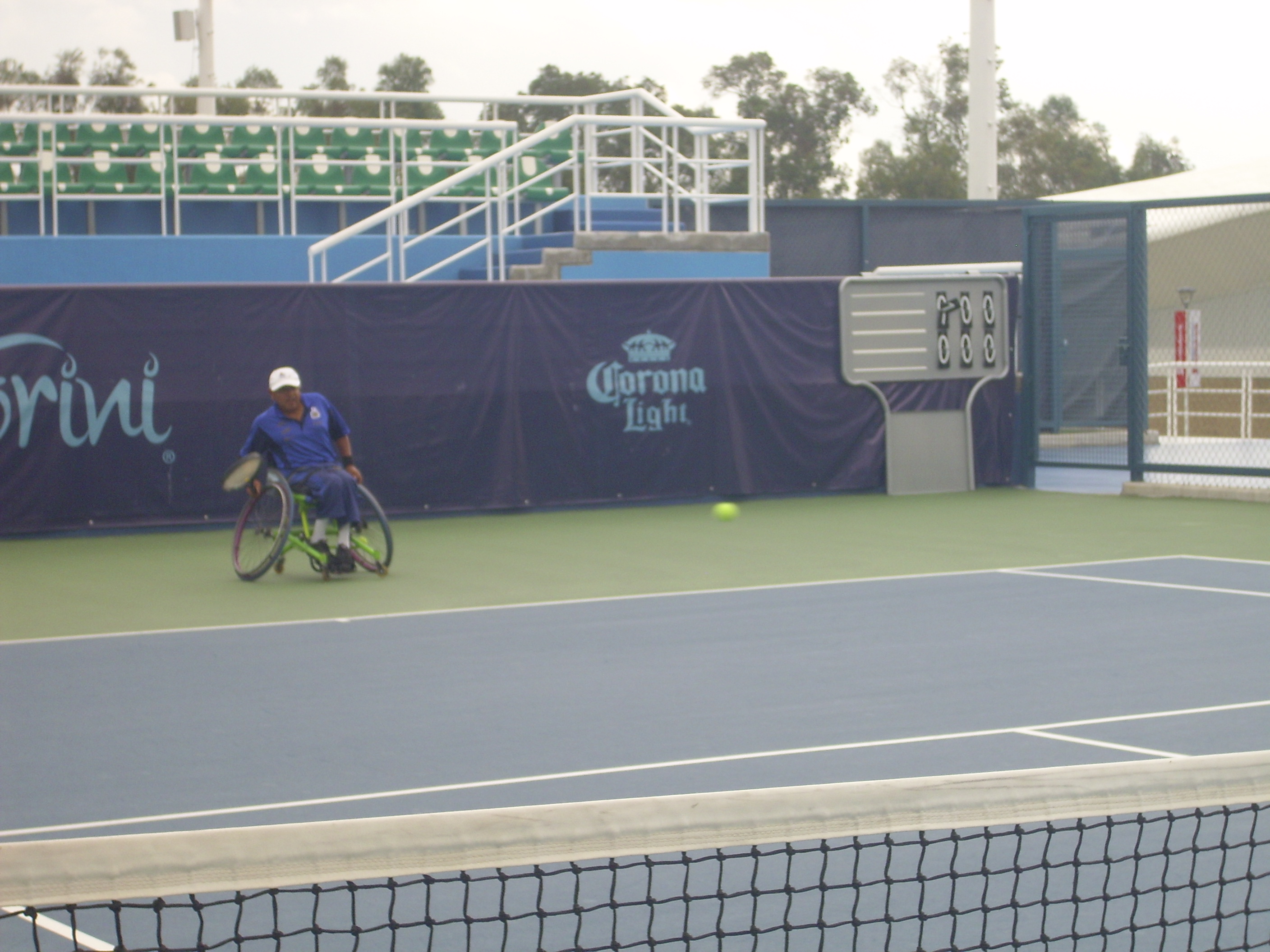
Back in Mexico, Bautista has been training at the impressive new complex in the Parque Metropolitano, where the aquatic and tennis events will be held during the Pan American Games. Gliding across the court in his specially made 6-lb titanium wheelchair, Bautista returns serves from his doubles partner, Isias Mendieta. “We’re training real hard to win the doubles this year,” he declares.
They have no shortage of motivation for success. “Whoever wins this tournament in November automatically qualifies to go to London next year for the 2012 Paralymipcs, although there are also opportunities to enter by wildcard,” Bautista explains.
Prior to the Parapan American Games, Bautista will be taking part in another free-to-attend wheelchair tennis tournament at the new tennis complex, from July 29 to 31. The tennis facilities are also currently open to the public, with courts available for rent on an hourly basis.
At the right place and at the right time, Bautista was among the first group of players to ever practice wheelchair tennis when it emerged as a sport in California in 1979.
“The only difference between regular tennis and wheelchair tennis is that we’re allowed two bounces before we return the ball,” he explains, “but the top players nowadays don’t actually need two bounces, they’re that good.”
The main appeal of the sport is that it allows disabled athletes to forget their physical limitations. As Bautista puts it, “tennis is one of the only sports where you can play with someone else standing up. I like it because I can play against my cousins, my brothers or whoever.”
Bautista has also rallied with a number of famous professionals over the years. “When I lived in Santa Barbara I hit a few balls with Jimmy Connors. I also played with Lindsay Davenport when she was world number one. When I lived in San Diego I went to the women’s professional tournament and I hit a couple of balls with Maria Sharapova.
“Then last October Andre Agassi came to Guadalajara. Unfortunately we couldn’t do an exhibition match with him but we got to meet and talk with him. That was a highlight for me because Andre has always been one of my heroes.”
Since returning to Mexico, Bautista has been trying to bring disabled people here the same benefits they would enjoy in the United States.
“I’m the sports director of an organization called World Access Project (WAP). What we do is solicit wheelchairs from people in the United States who maybe have an extra one or don’t have a use for theirs any more, and we give them to people who can’t afford them. A wheelchair is a huge investment here in Mexico. It’s difficult to get one. So when you’re able to give someone a wheelchair it’s a life-changing event for them.”
Having organized WAP sports camps in Jocotepec, Mazatlan and the state of Mexico, Bautista is running one in Puerto Vallarta in October and hopes to hold another in Guadalajara next year. At these camps they play “basketball, tennis, hockey, volleyball, American football – all the things you can do in a wheelchair, we’ve done them,” says Bautista. “American football is quite rough but it’s one of the my favorite sports, it’s really smashing up wheelchairs rather than football, but it’s fun.”
Bautista currently divides his time between homes in Guadalajara and Jocotepec, where he likes to relax at weekends beside Lake Chapala. Highly engaged in the local community, he is planning a project that will take disabled children horse riding in Jocotepec, emulating the success of a similar program in California.
On the first weekend of November, Bautista will be taking part in the Parapan American Games torch relay from Chapala to Jocotepec. “I was designated as one of the participants to carry the torch and I’ve elected to do it on my home turf. We have two main goals: firstly, to raise awareness about the lake. I remember when I was little the lake was clean and we used to swim in it, but now it’s polluted and people are not taking care of it. We need to clean the lake and keep it for generations to come. Secondly, we want to encourage people to come to the Parapan American Games in November because it’s not far from here and the tickets are going to be be really inexpensive.”
Bautista is confident that the Pan American Games can help improve Mexico’s image. “This is an opportunity that needs to be taken advantage of to counter all of the violence and the insecurity,” he says.
He also believes Mexico’s dangerous reputation has unfairly tainted the safer areas of the country. “I don’t feel at all unsafe here in Guadalajara. In fact I just went to Brazil last month and I actually felt more insecure there. The only time we went to the beach someone told us, ‘you’ve got to have a guard or a policeman otherwise you’re going to get robbed.’ So we actually hired a guard to be with us for a couple of hours.”
Bautista hopes that the Parapan American Games will also have a big impact on disabled access throughout the city. “Guadalajara has been constantly changing,” he says. “It has gotten better since I came here four years ago, but we still have a lot to do. I would like to see more ramps, and more accessible buses, but I think we’ll see more of that in September once we get closer to the event.”
Working closely with the organizers, he is optimistic the games will leave a positive legacy: “Right now the city government is trying to make the center of Guadalajara more accessible. I’m part of a committee to make sure we build these ramps, accessible elevators and wide doors. I want to show people we can make Guadalajara a more accessible place for everyone to enjoy.”
The outspoken archbishop of Guadalajara sought help from the U.S. government to prevent popular leftist candidate Andres Manuel Lopez Obrador from winning the 2006 presidential election, according to a WikiLeaks document released last week.
Sourced from the U.S. embassy in the Vatican, the cable reveals that Cardinal Juan Sandoval Iñiguez asked Francis Rooney, then U.S. ambassador to the Vatican, if President George W. Bush could help prevent the possible election of Lopez Obrador, the candidate of the left-of-center Party of the Democratic Revolution (PRD).
The cardinal was worried by the rise of popular socialist governments throughout Latin America, the likes of Fidel Castro, Hugo Chavez, Evo Morales, and more moderate leftists Christina Kirchner and Michelle Bachelet.
Sandoval described this as a “dangerous trend,” fearing that AMLO, as he is commonly known, would lead Mexico in the same direction as the aforementioned governments. He also said that levels of “crime and violence had risen in Mexico City” under the government of AMLO, who was mayor at the time.
“The cardinals felt the poor in Latin America did not understand the potential benefits to them of free markets and urged U.S. government help, acknowledging that the Church, though necessarily cautious, can also play a greater role,” reads the leaked cable.
Sandoval met with Rooney in the Vatican City on March 28, 2006, several months prior to the general election in July. The cardinal also mentioned to Rooney his dream of constructing a temple in Guadalajara to commemorate Mexico’s 1926-1929 Cristero War martyrs, although most of the conversation focused on politics.
The 2006 election proved highly controversial, with PAN candidate Felipe Calderon narrowly claiming victory by just 0.58 percent of the vote, amid allegations of electoral fraud. Refusing to concede defeat, Lopez Obrador still maintains that he won the election and is aiming to run for president again in 2012.
Sandoval is a notoriously polemic figure and is not unknown for interfering in local and national politics. In 2008 he was at the center of the “macrolimosna” scandal, in which it emerged that Jalisco state governor Emilio Gonzalez Marquez had donated 90 million pesos of public money to the cardinal’s project to build the martyrs’ sanctuary. Sandoval returned the money after a public outcry.
Sandoval has also voiced opposition to the use of condoms, sex education and emergency contraceptive pills. He has been criticized by gay rights groups for using homophobic language, and when the Supreme Court legalized gay marriage in August 2010 he accused the justices of having accepted bribes from the PRD’s mayor of Mexico City, Marcelo Ebrard.
Written hastily as it broke the night before, this story made the front page on 22 July 2010. The next week I wrote this follow up piece:
Polemic homage ruffles secular feathers
The Jalisco state government will go ahead with an homage to the archbishop of Guadalajara Friday, despite recent allegations that he interfered in Mexico’s electoral politics and sought to undermine the country’s democratic process.
Cardinal Juan Sandoval Iñiguez has denied accusations made last week (revealed by WikiLeaks) that he solicited U.S. government intervention to prevent popular leftist candidate Andres Manuel Lopez Obrador from winning the 2006 presidential election.
Undeterred by this political scandal and growing concerns over the convergence of church and state, the Jalisco government will pay homage to Sandoval at the Teatro Degollado on Friday, July 29, 7 p.m., his spokesman Antonio Gutierrez Montaño confirmed this week.
Following a large gathering in the Plaza Liberacion, the Jalisco Philharmonic Orchestra is due to play at a ceremony in the theater. This will also serve as a farewell party of sorts, with Sandoval approaching retirement and awaiting the announcement of his successor by the Vatican State Secretary.
Other famous Tapatios to have been honored recently include soccer player Javier “Chicharito” Hernandez (see page 28), singer Alejandro Fernandez and golfer Lorena Ochoa, leading critics to suggest that such homages are little more than an excuse for local politicians to share the limelight with popular and successful celebrities.
But the decision to publicly recognize Sandoval, a polarizing figure at best, has proved far more controversial and has a strong risk of backfiring.
The Civic Awareness Association condemned the homage as legally and morally wrong, citing previous accusations that Sandoval had allegedly covered up 12 cases of pedophilia among the clergy.
The leftist Party of the Democratic Revolution (PRD) also called for the homage to be cancelled, arguing that it would violate Article 130 of the Constitution, which guarantees the separation of church and state.
“The homage should be suspended, or at least paid for out of their own pockets and not with public funds,” said Roberto Lopez Gonzalez, leader of the PRD in Jalisco. He described the planned event as “evidence of the relationship that exists between a political party and a religious hierarchy that should not be meddling in electoral politics.”
Writing in El Informador, editorialist Diego Petersen Farah echoed these comments, arguing the “homage should be made with private funds in a private place” and warning that ahead of the upcoming elections “the government and the Catholic Church are closer than ever.”
The archdiocese of Guadalajara has denied recent allegations of partisanship within the church, affirming that “there has always been a relationship of mutual respect” between Sandoval and Lopez Obrador, that the cardinal “values the work of the left,” and “has no interest in intervening or involving himself in the political affairs of the country.”
Lopez Obrador responded saying he has no doubts that Sandoval had called for the United States to impede his election bid, and reaffirmed that he had been robbed of the presidency by fraud.
The archdiocese described the evidence published by WikiLeaks as “totally false” and a “malicious lie,” confirming that a meeting did take place in 2006 between the cardinal and then U.S. Ambassador Francis Rooney, but that “the only issue discussed was a request that the U.S. representative support the construction of the Shrine of the Martyrs.”
Poet brings peace campaign to Guadalajara
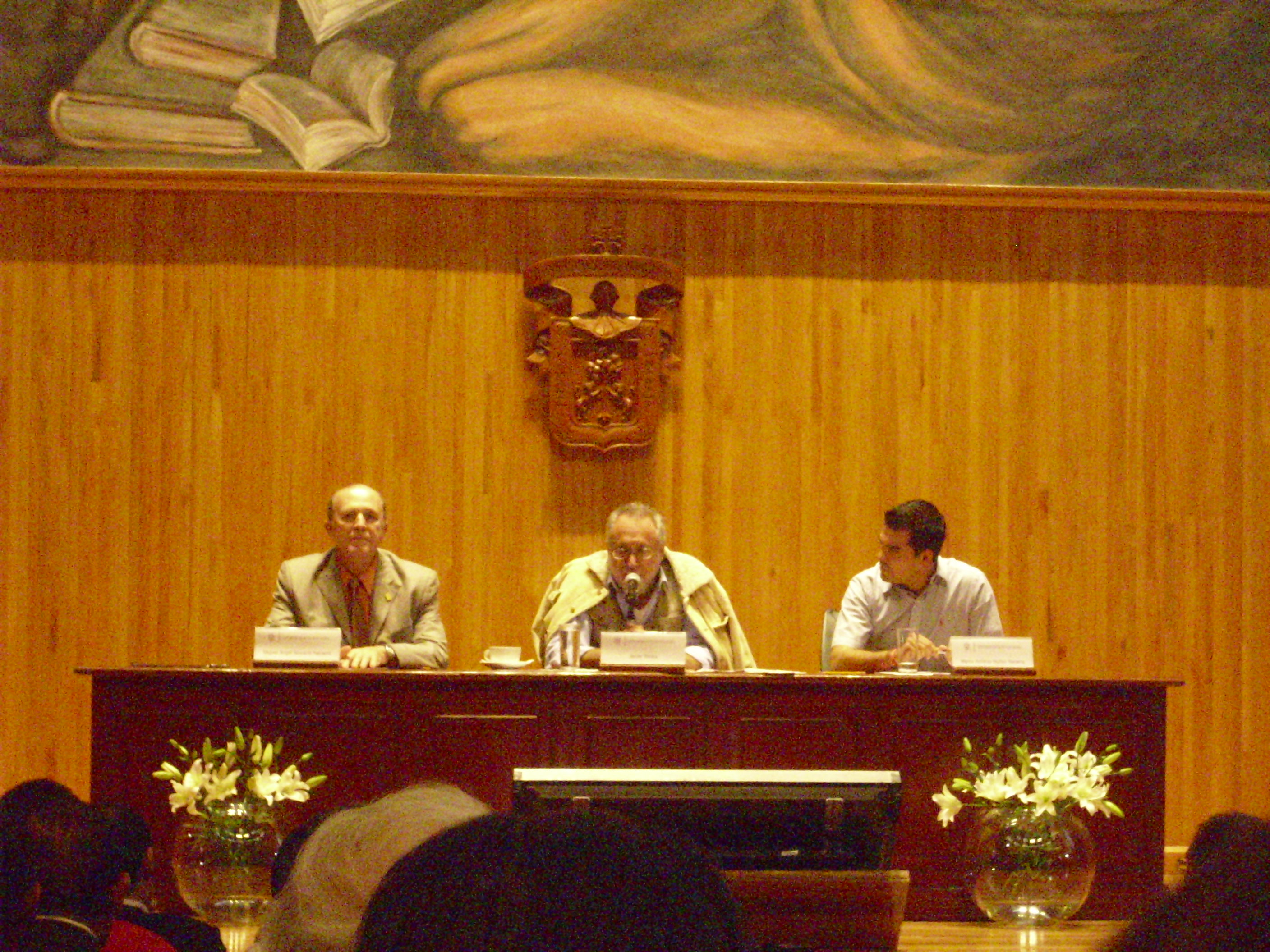 Poet turned peace champion demands greater funds for education instead of ‘failed war’
Visiting Guadalajara on Tuesday, July 12 to accept an award in recognition of his campaign against drug violence, renowned poet and journalist Javier Sicilia urged the government to provide greater funding for public universities.
Talking in the University of Guadalajara’s majestic Enrique Diaz de Leon assembly hall, Sicilia condemned President Felipe Calderon’s security strategy, citing investment in employment and education as the best means of reducing drug violence and calling for the president to “hand over the money this university is owed” – a reference to the bitter dispute over funding between the university and the Jalisco state government last year.
An acclaimed poet and writer for Proceso magazine and La Jornada newspaper, Sicilia found himself the unlikely leader of Mexico’s anti-violence movement following the murder of his son earlier this year.
The body of Juan Francisco Sicilia Ortega, 24, was found in a vehicle alongside six others near Cuernavaca in the central state of Morelos on March 28. Several of the corpses showed signs of torture.
The victims were considered mere collateral damage in a war that has claimed the lives of around 40,000 Mexican citizens since President Calderon announced the war on drugs in December 2006.
Sickened by the needless death of his innocent son, Sicilia gave up poetry and announced a new civic resistance movement to transform public consciousness and kick-start a dialogue in the absence of effective government policies. Protests have since occurred in over 40 Mexican cities, including a demonstration of around 50,000 people in Cuernavaca, the largest in the city’s history.
Armed with slogans such as “No más sangre” (No more blood) and “Estamos hasta la madre” (We’ve had it up to here), Sicilia and his supporters called for an end to the drug war, the withdrawal of military forces from the streets, the legalization of drugs, and the removal of President Calderon.
The activists want the government to abandon the military strategy which has provoked a sharp increase in the levels of violence over the past four years. Instead they favor tackling the poverty that drives young Mexicans to join gangs, and eliminating the endemic official corruption that inhibits a sound response to organized crime.
In May this year Sicilia led a convoy of around 20 buses on a journey of over 1,500 miles from Cuernavaca to Ciudad Juarez. The peace caravan, as it was dubbed, arrived in Mexico City on May 8, where around 200,000 people attended a demonstration in the Zocalo.
Crisscrossing the country, the convoy made its way to Ciudad Juarez, the epicenter of the drug violence where more than 3,100 people were murdered in 2010. Addressing the audience in Guadalajara, Sicilia recalled defiantly, “in Ciudad Juarez, the most dangerous city in the country, we told the government and the criminals that these are our streets, these are our roads, every corner of this country belongs to us, not to the criminals. We are stronger than all of them.”
Subsequently crossing the border into El Paso, Texas, Sicilia admonished the United States for its “grave responsibility” for failing to tackle the drugs crisis. High consumption levels north of the border drive the drug trade, with rival cartels competing for control of this lucrative market. Furthermore, recent reports indicate that 70 percent of arms seized in Mexico over the past two years have been traced to the United States, where gun laws are more relaxed.
After making his voyage across the country, Sicilia recognized that the money consumed by President Calderon’s “stupid, failed war” could instead be better invested in education and employment.
Speaking in Guadalajara before an auditorium packed with students and local citizens, Sicilia demanded that the government provide more funds for Mexico’s public universities, instead of wasting money on “arms, disaster and a spiral of pain.”
In a quiet, dignified address, Sicilia identified Mexico’s youth as those worst affected by the drug violence, noting that “the majority of the 40,000 dead, plus the 10,000 who have disappeared, are young people.” Sounding weary after the events of the preceding months, Sicilia argued the best way to help and protect the nation’s youth is through education.
He also commented on last year’s dispute between the Jalisco state government and the University of Guadalajara, which eventually had to settle for 210 million pesos less than the amount it claimed it was owed. “If the president wants to begin to bring justice and rebuild the social fabric of this country, he must hand over this money to the university,” Sicilio declared to great applause. “We want the same money for the country’s universities, its students and its youth, as is spent on this violence,” he added.
Following his speech, Sicilia was presented with the “Lion’s Heart” award by the president of the Federation of University Students, Marco Antonio Núñez Becerra. Sicilia is the first recipient of this title, which honors persons whose work in academic, social or cultural fields has benefited the Mexican people’s quality of life.
“I accept this in the name of all the victims in this country who are only beginning to be named,” declared the poet. “Behind every death caused by organized crime, there is a broken story, families that are torn to pieces and will never be the same again.”
Honoring victims of the drug violence is a key aspect of Sicilia’s campaign. After returning from his journey, Sicilia met with Calderon in Mexico City’s historic Chapultepec castle on June 23. The pair reached an agreement to create a victims’ law and construct monuments in memory of the victims, with plaques naming every one of them.
But this proved to be the extent of Sicilia’s influence. The president refused the poet’s principal demand that he modify his strategy against organized crime. Although he apologized on behalf of the state for being unable to protect the lives of victims, Calderon also refused to apologize for sending armed forces into Mexico’s streets to combat the cartels.
In his closing remarks at the conference, Sicilia called for greater democratic participation, noting that “Guadalajara has many large civic organizations.” He urged civic organizations throughout Mexico to continue their efforts to recognise the victims of drug violence and to keep mobilizing because this was what forced Calderon to enter dialogue with him.
Although his influence over government policy remains limited, Sicilia has proved an inspirational figure, leading thousands of Mexicans to reassert their right to live in peace and dignity.
Mother tells of disappeared son
In a press conference following his speech at the University of Guadalajara, Javier Sicilia was interrupted by a distraught mother whose son disappeared earlier this year.

Maria Guadalupe Aguilar Jauregui described her son Jose Luis Arana Aguilar: “He’s 34 years old, 173 centimeters, white skin, green eyes. No tattoos. He works, he is responsible, he doesn’t drink, smoke or take drugs.”
Arana Aguilar was last seen on January 17. He left his house at 11 a.m. and was driving on the freeway from Mexico City to Guadalajara. His vehicle was later found in Manzanillo.
His mother retains hope that he is alive, “My son is not dead. If he were dead he would have appeared by now. So where is he? He was not mixed up in crime, so what happened to him?”
Sicilia sympathized with the woman, saying, “As citizens we must make strong demands. In every city in every state, we must put the names of the disappeared and the dead on plaques at the entrances of town halls and popular attractions.”
Aguilar Jauregui replied, “It’s a very good idea. I’m thinking of everything I can do. I’ll put up photos of him; I’ll work hard so that this never happens to another mother. I haven’t felt alive since this day. I can’t sleep. I’m not complaining; the only thing I want is for no mother to have to feel this pain. It’s so heartrending not to know where your child is. It’s terrible.”
If you have information regarding the disappearance of Jose Luis Arana Aguilar please call Maria Guadalupe Aguilar Jauregui on (33)1410-0216 or 3689-7426.

