Cult Heroes: Teddy Sheringham
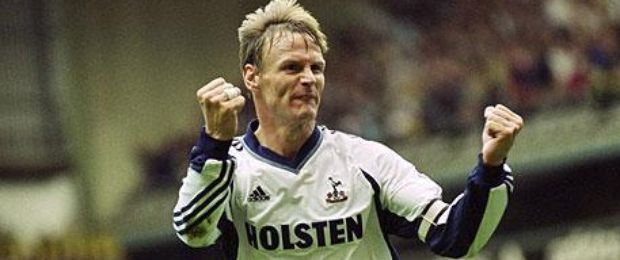
Everyone remembers their first football match. Mine was a 1-1 draw between Tottenham and Leeds in May 1995. I was only six years old so I don’t recall the finer details, but I do remember this being a big deal because it was Jürgen Klinsmann’s last game for Spurs (although he would later return on-loan to save the club from relegation and force mouthy chairman Sir Alan Sugar to eat a large slice of humble pie). Klinsmann failed to mark the occasion with a goal, but some bloke called “Teddy” did net one. This was my first introduction to Edward Sheringham.
Sheringham was a star from the outset. In the inaugural Premier League season he claimed top scorer with 21 goals for Tottenham Hotspur and one for former club Nottingham Forest. But it was not just his finishing that made Teddy such a valuable asset. A wily and underrated forward, he was adept at holding up play, finding space and playing the killer pass.
Sheringham’s fine form earned him a starting place in the national team, back when England were a likeable and half-decent side – wich is considerably more than can be said for today’s squad. As England’s number ten, he formed a strong partnership with Alan Shearer during Euro 96. The pair displayed their prowess most memorably by notching up two goals each in the famous 4-1 demolition of Holland.
Teddy had become a true Spurs legend over the years, but the fans’ adulation could not dispel his quiet but firm ambition. With Tottenham incapable of delivering the trophies he so desperately craved, Sheringham transferred to Manchester United in June 1997 for a fee of £3.5 million.
Drafted in to replace the suave Kung Fu master that was Eric Cantona, Sheringham endured a patchy first season in Manchester. A missed penalty on his debut against Spurs delighted many former fans, but Teddy did not take long to rediscover his form. By 1999 he had established himself as an integral member of United’s historic treble-winning team. At last Sheringham satisfied his hunger for silverware; proudly collecting Premier League and FA Cup winners’ medals – the latter secured by his opening goal in the final at Wembley.
But it was the Camp Nou that would witness Teddy’s finest hour. On literally the biggest of stages, Sheringham played a crucial role in United’s legendary comeback against Bayern Munich in the Champions League final. Having come on as a second-half substitute, he scored a dramatic last-minute equaliser and then provided the assist for Ole Gunnar Solskjaer’s injury-time winner. This was the moment when Sheringham transformed himself into a true cult hero.
Like the evergreen Ryan Giggs and Paul “never-learned-to-tackle” Scholes, Sheringham played some of his best football in his later years at Old Trafford. In the 2000-01 season, at the age of 35, he was named Player of the Year by both the Football Writers’ Association and the Professional Footballers’ Association.
Although he set the template for United poaching Tottenham’s most promising players (see Michael Carrick, Dimitar Berbatov, and hopefully not Gareth Bale), Teddy redeemed himself with the Spurs faithful by returning to White Hart Lane in 2001.
Never the fastest player, Sheringham overcame his lack of pace with a brilliant reading of the game. This enabled him to continue playing until the ripe age of 42, without having to drastically alter his style of play.
Upon leaving Spurs once again, the veteran striker capped an impressive career with further spells at Portsmouth, West Ham (having begun his career at Millwall, Sheringham was one of few footballers foolhardy enough to play for both the Hammers and their bitter East End rivals) and finally at Colchester United.
While few, if any, footballers make the perfect role model, Sheringham’s tireless commitment and obvious love for the game endeared him to fans for over twenty years throughout his career. The antithesis of the archetypal snood-wearing, airgun-wielding mdern footballer, Teddy was intelligent, modest and kept a relatively low profile off the pitch. Mario Balotelli he was not.
A penchant for sports cars and glamour models betrayed his laddish side, but he still retained a bit of class – more Michael Caine than Danny Dyer. He was driven more by ambition than money, and always handled his private life with a tad more dignity than the likes of John Terry or Wayne Rooney.
Since finally succumbing to retirement, Sheringham has indulged in his love of poker, a game which requires the same mental sharpness and competitive nature that made him such an effective footballer. He’s not bad either: last year Teddy finished fifth in a major tournament in Portugal, claiming winnings of €93,121 in the process.
Apparently he pledged the money to charity, but reneged when a local car dealer tempted him with a brand new Aston Martin DB9. Maybe scratch that “antithesis to the modern footballer” bit then. But he was still a bloody good striker.
This piece is featured here in the Warwick Boar, as my contribution to the “Cult Heroes” series in the sport section.
What’s that, you want more? A chronological list of the top ten Latin American footballers to ever play in the UK, you say? Oh, go on then. This is another thing I wrote for Candela Live, which was recently relaunched as Latino Life. It was written a few months ago, so in retrospect I think I’d move Roque Santa Cruz into the “flops” list.
Latino Life: Interview with Ricky Villa
The highlight of my foray into journalism thus far has undoubtedly been seizing the opportunity to speak with Argentine World Cup winner and Tottenham legend, Ricky Villa.
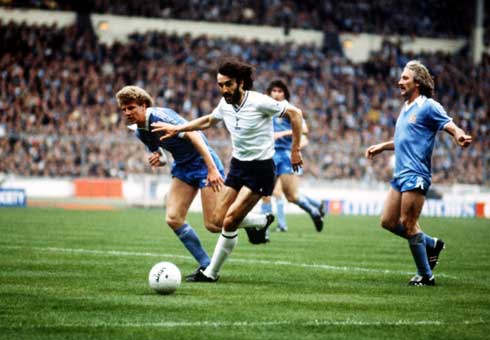
Villa is probably best known for his spectacular winning goal in the 1981 FA Cup final against Manchester City. This magic moment earned him the Wembley Goal of the Century award in 2001, but it was by no means the only memorable event in Ricky’s career.
Having just won the 1978 World Cup (although injury limited Ricky’s role in the tournament), Villa and his compatriot Ossie Ardiles arrived to great fanfare at “Tottingham”, as they would affectionately call the club. As the first South American superstars to ply their trade round these parts, Villa and Ardiles set the benchmark for foreign players in the English game.
But life in England was not without its complications. After sealing the 1981 FA Cup for Spurs, Villa withdrew from the following year’s final in protest at the Falklands War, having drawn criticism in his homeland for fraternising with the enemy. He later played in the US and Colombia before returning to Argentina, and also appeared alongside a young Diego Maradona for the Argentine national side.
Ricky recounts all this and more in his new autobiography, And Still Ricky Villa. I caught up with him back in February in an interview for Latino Life magazine. Read the full feature here.
I called Ricky at his house in Argentina and we spoke over the phone for about twenty minutes. I began the conversation in Spanish, which seemed to work well enough, so we continued en español throughout.
It may sound cliché, but Ricky was very friendly and down-to-earth. He didn’t seem bothered by me interrupting his day and I thought he was generally spot on about the current state of English football.
The interview took place shortly after Tottenham’s first-leg victory over AC Milan – back when the European dream was still alive.* Here’s the full, unedited transcipt:
Hi Ricky, first I’d like to thank you for doing this interview. As a Spurs fan it’s a real honour for me.
Ah, perfect.
My dad used to watch you play alongside the likes of Glenn Hoddle back in the eighties, and as a child I remember him showing me the video of your goal against Man City.
Ah yes, it was a good time for the club and Glenn was a wonderful player.
Have you been to any Tottenham games recently?
I have, and I’ll be there on 9th March for the game against AC Milan in the Champions League. I watched the first leg on TV. We played well and I felt we could even have had another goal.
How do you rate Spurs’ domestic and Champions League prospects?
Whether the club should prioritise either competition is a question for the manager. Personally, I’ve always liked the Premier League. I think it’s very important to win a local championship. The Champions League is important on an economic level and for marketing, but in my opinion the Premier League should always be the priority.
This is the strongest Tottenham team in years. How does it compare to when you played there?
They are worse than when I was there! Haha! No, seriously this team has a great attitude, great players, they play good football and I think that they could make club history. But I don’t like to make comparisons – I just like to think that this is another great Tottenham side that can go down in history like the team I played in.
Why did you and Ossie Ardiles decide to come here?
We didn’t have many options. Like all South American footballers we wanted to play in Europe, and Tottenham came knocking. We didn’t know much about Tottenham, but we liked the club and it felt like an adventure. It turned out well in the end, the club always treated us very well and we were happy we made this decision. We didn’t really know what the English league was like back then, but it was a beautiful adventure.

Did you find it hard to adapt to life in England?
It was very difficult for me. Living in England was a struggle because I was not used to your customs or ways of life. Not because the club treated me badly – they were always brilliant – but I used to miss my friends and family a lot. Argentina and England are very different countries with very distinct ways of life.
A number of clearly talented players from South America have struggled to adapt to life in England. Why do you think it is easier for them to play in Spain or Italy?
In South America we share more similarities with these countries because our families come from Spain and Italy. Most of us are descendents of Spanish or Italian immigrants, so the customs of these countries are closer to ours. England has less in common with us, but it is a great country, with the best league in the world today. But when you’re not playing football sometimes you miss home. Not everyone can adapt to it; some manage it but others cannot.
Is there any advice you would offer to young players coming from South America to play in England?
I think they have to go [to England], because the league is very good. They should try to live like an Englishman, because you cannot try to change the customs of a country. They must try to adapt to the English way of life, which is very pleasant and respectful.
Was the style of football in England very different to what you were used to in Argentina? Many people say it’s faster and more physical here.
Today, I think the English league has lost a little of its style, because there are so many foreign players now. But when we arrived, it was very, very English. It was very distinct from the football we used to play in Argentina. The English style of football involves long balls up to the centre forward, which has its positive and negative aspects, just as our style does here. But now, English football is more international. It used to be more English, and I often think it’s a shame when a country loses its style of football like this. On the other hand, you have the finest league in the world, and everyone wants to prove themselves by playing in an important league. But I don’t like it when certain clubs don’t field a single English player in their starting line-up. I think they need to have at least five or six English players in each team.
The English national team has been very poor in recent competitions. Do you think this is a result of the growing number of foreign players in the Premier League?
Yes, but I also think it’s because the England team is not considered as important. The clubs in England are bigger than the national team. It is always the second priority. But not for us; in Argentina the national team is more important than the clubs. So, although we haven’t won a title for a long time, we aid and support our national team more.
With the players you have, do you think Argentina can challenge Spain to become the best team in the world?
Spain play in a very similar style to Barcelona and today they have a very strong team. In Argentina we still haven’t found this identity but I think we have the best player in the world at this moment [Messi, obviously] and this is worth a lot.
What did you make of Argentina’s performance in the World Cup under Maradona?
I think that Maradona lacked experience, and as I’ve said before, I think that Diego is a better manager now than he was before the World Cup. But the Argentine FA didn’t support him and this was a very tough blow for him.
Will they fare better under Sergio Batista?
Batista doesn’t have much more experience than Diego, so we can only hope that it goes well.
You refused to play in the 1982 FA Cup final because of the Falklands War. That must have been a very difficult decision to make?
Yes. If I remember correctly it was a joint decision made with the club. It was a good decision because the conflict had reached a highpoint. With all its history I think the FA Cup is like a part of England. It was a very difficult time and it saddened me that these political situations sometimes enter the world of sport. It should be politics on one side and sport on the other, but occasionally they come together. I think that ultimately it was the right decision. I don’t regret it. It hurt a lot, and it upset me, but I think that everyone accepted my decision.
What is your favourite memory of playing in England?
Well, I have the [FA Cup-winning goal against Manchester City] of ’81. It made me really happy because I could repay the confidence that the club had showed in me and Ossie. They had bought two foreigners and it was a risky decision at the time. I felt happy to win something with the club because I had always found it difficult playing in England. This was my big moment.
Who was the best footballer you ever played with?
Diego Maradona. I did not play with him for long, but he was the best. In England, Glenn Hoddle was a fantastic player. He was a different class [he says this in English].
Finally, what are you up to these days?
I live in a ranch in a town called Roque Pérez, about 100 km from Buenos Aires. I’m not involved in Argentine football anymore. I do a little bit of political work in my town. It’s all just local work but I enjoy it.
Thanks Ricky, all the best.
Thanks, ciao.

Ricky’ autobiography, And Still Ricky Villa, is out now.
*It’s still too painful to delve into our capitulation against Real Madrid… But seriously, what were you thinking Crouchy?!? Most of all I’m just gutted we never gave ourselves a chance to compete 11 vs 11, as it could have been a thrilling contest. But that’s our European adventure over now, assuming we don’t pull off the greatest ever comeback in Champions League history.
Well it was a fun and thrilling ride while it lasted. I just hope it’s not back to Thursday nights on Channel 5 for us next season, but I fear the worst.
Banksy and Inter Milan vs. the Zapatistas; Brazil vs. an insane Chechen warlord; the many guises of Ronaldo; and more. Five bizarre happenings from the world of Latin America-related football.
No real purpose to this one, it’s simply a result of the mindnumbing boredom of sitting in Horsham for endless weeks and writing politics essays. Here it is then, five strange Latino football facts, and not an April Fools among them:
 1. Ronaldinho’s name means “Little Ronaldo”. The buck-toothed genius adopted this diminutive suffix in order to distinguish himself from Brazil’s other Ronaldo – the three-time FIFA World Player of the Year, who retired back in February. Confusingly, this Ronaldo was also once known as Ronaldinho, because there was already another older Ronaldo in Brazil’s 1994 World Cup squad. He played with the name Ronaldinho on his shirt again during the 1996 Olympics, due to the presence of yet another Ronaldo – this time centre back Ronaldo Guiaro – in the Brazil team. Nowadays he’s variously referred to as “Fat Ronaldo” or “Brazilian Ronaldo”, in order to avoid confusion with Portugal’s Cristiano Ronaldo, who is best known as a smug wanker.
2. Athletico Madrid striker Sergio “Kun” Agüero may be father to the world’s most talented two-year-old.* In February 2009, he had a child with Diego Maradona’s daughter Giannina Maradona. While old, coke-snorting, gun-toting Diego is considered by many to be the world’s greatest ever player, Agüero isn’t bad himself (as anyone who played Pro Evo 09 should know). Athletico are looking to raise up to £50 million should they be forced to sell him in the summer. And if his son Benjamín has inherited his grandfather’s infamous “Hand of God” then England better be wary of him roundabout the time of the 2030 World Cup.
*For more father-son footballing banter, see Robin Van Persie get merked by his kid here.
3. Honduran midfielder Wilson Palacios’ playing career in England unfolded amidst a family hostage crisis. In October 2007 Wilson’s brother Edwin, aged just 14 at the time, was kidnapped at gunpoint from the family home in La Ceiba. His family paid over £300,000 in ransom money for his release, but Edwin remained in captivity. Wilson played with this hanging over him for two and a half years, yet his solid performances for Wigan Athletic and Tottenham Hotspur betrayed no sign of the strain he was under. The tragedy concluded when police in Honduras discovered Edwin’s body in May 2009. He was honoured a year later in South Africa, when Honduras made history by naming the three surviving Palacios brothers in their World Cup squad.

4. Inter Milan captain Javier Zanetti is an outspoken supporter of the Zapatista movement in Southern Mexico. The Argentine fullback has visited their autonomous communities in Chiapas, while his club Internazionale has sent football equipment and other supplies to aid the Zapatistas in their revolution. The mysterious rebel spokesman Subcomandante Marcos even challenged the Nerazzurri to a friendly against a Zapatista eleven, but sadly the tantalising prospect of Inter playing a team of balaclava-clad guerrillas never transpired.
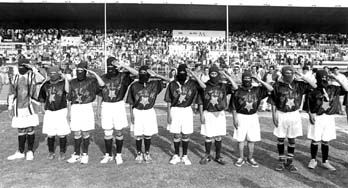 But this would not have been the first run-out for the EZLN FC. Back in 1999, way before the likes of Brad and Angelina were fawning over his work, anonymous graffiti artist Banksy also popped over to visit the autonomous communities. After painting a few murals he went one better than Zanetti and actually gave the Zapatistas a game. Playing for Bristol based anarchist club, the Easton Cowboys, Banksy was part of the first European team to travel to Chiapas. The Cowboys took part in a series of tournaments against the Zapatistas, and have since raised over £100,000 to provide clean water for the local people.

5. In an equally unlikely kick-around, members of Brazil’s World Cup winning squads from 1994 and 2002 recently took on a Chechen side led by warlord-turned-President Ramzan Kadyrov. This surreal match-up took place just three weeks ago in Grozny. The Brazilian side included Romário, Cafu, Dunga, Denílson and legendary left-back Roberto Carlos, who recently signed for Russian club Anzhi Makhachkala in neighbouring Dagestan. The ever-so-slightly less glamorous Chechen team was comprised of various Soviet ringers, German midfield veteran Lothar Matthaeus and Dutch ace Ruud Gullit, who for some reason (lots and lots of oil money?) is also Terek Grozny’s current manager.
As if the story needed another bizarre subtext, Ramzan Kadyrov’s father was blown up by terrorists in the very same stadium in 2004. With teammates, opponents and even the referee all keen to gift him scoring opportunities, the maniacal host missed two penalties before eventually netting with a tap-in and converting a third spot-kick. Ultimately, despite their best efforts to throw the tie, Brazil’s old boys emerged victorious in a shambolic 6-4 thriller.

