Two police officers killed in shootout in Guadalajara
An unexplained shootout on a busy Guadalajara intersection left two police officers dead and two Colombians wounded on Friday evening.
The firefight took place at approximately 6:30 p.m. on the corner of Terranova and Avenida Mexico in the city’s upmarket Providencia neighborhood.
Having reportedly just left a local restaurant, the two police officers were traveling in a gray Dodge Ram with Colombian pair Juan Carlos and Maria Ines Pacheco Bercerra when a white Mercedes Benz pulled up in front of them, blocking their exit. At least two assailants armed with AK-47 assault rifles then opened fire from a green Nissan Pathfinder with Jalisco license plates.
The police officers returned fire but one was killed on the spot and the other died in hospital, according to Mexico’s Proceso magazine. The two Colombians, whom local newspapers identified as either a couple or brother and sister, were also hospitalized.
The assassins are thought to have escaped in a black Chevrolet Silverado, while those in the white Mercedez Benz also evaded arrest.
Pablo Villaseñor y Manuel Acuña agresores del occiso d Terranova abandonan camioneta Pathfinder con 2 AK47 @AlertaGDL pic.twitter.com/TY1Pb9V37n
— Eloy Arellano (@Eloy_Arellano) September 6, 2014
Agents from the Jalisco Prosecutor General’s Office recovered the abandoned Pathfinder, which had been struck by at least ten bullets, several blocks away. Inside they discovered a gold-plated AK-47 and a nine-millimeter handgun. There were also blood stains indicating that one of the killers had been wounded in the shootout.
It remains unclear why the police officers and their Colombian companions were attacked or who the intended target of the hit was. Authorities in El Salto, a small town on the southeastern outskirts of the Guadalajara metropolitan area, confirmed that the policemen were bodyguards of Francisco Aceves, the local Director of Public Security.
It is not known if Aceves was present during the attack but the El Salto municipal government said in a statement that his escorts were off-duty on Friday and that it had no knowledge of their activities at the time of the incident. What the two Colombians were doing with the pair also remains a mystery.
Adding further intrigue to this unexplained turn of events, local radio host Pablo Lemus Navarro reported that Jalisco Governor Aristoteles Sandoval was traveling along the same point of Avenida Terranova at the time of the shootout, raising the possibility that he could have been the intended victim.
Camionetas que transportan a Gobernador @aristotelessd se encontraban al mismo tiempo de la ejecución en Av Terranova pic.twitter.com/ElNmDH7u8O
— Pablo Lemus Navarro (@pablo_lemus) September 6, 2014
Over three million dead fish wash up in Mexico’s Lake Cajititlán
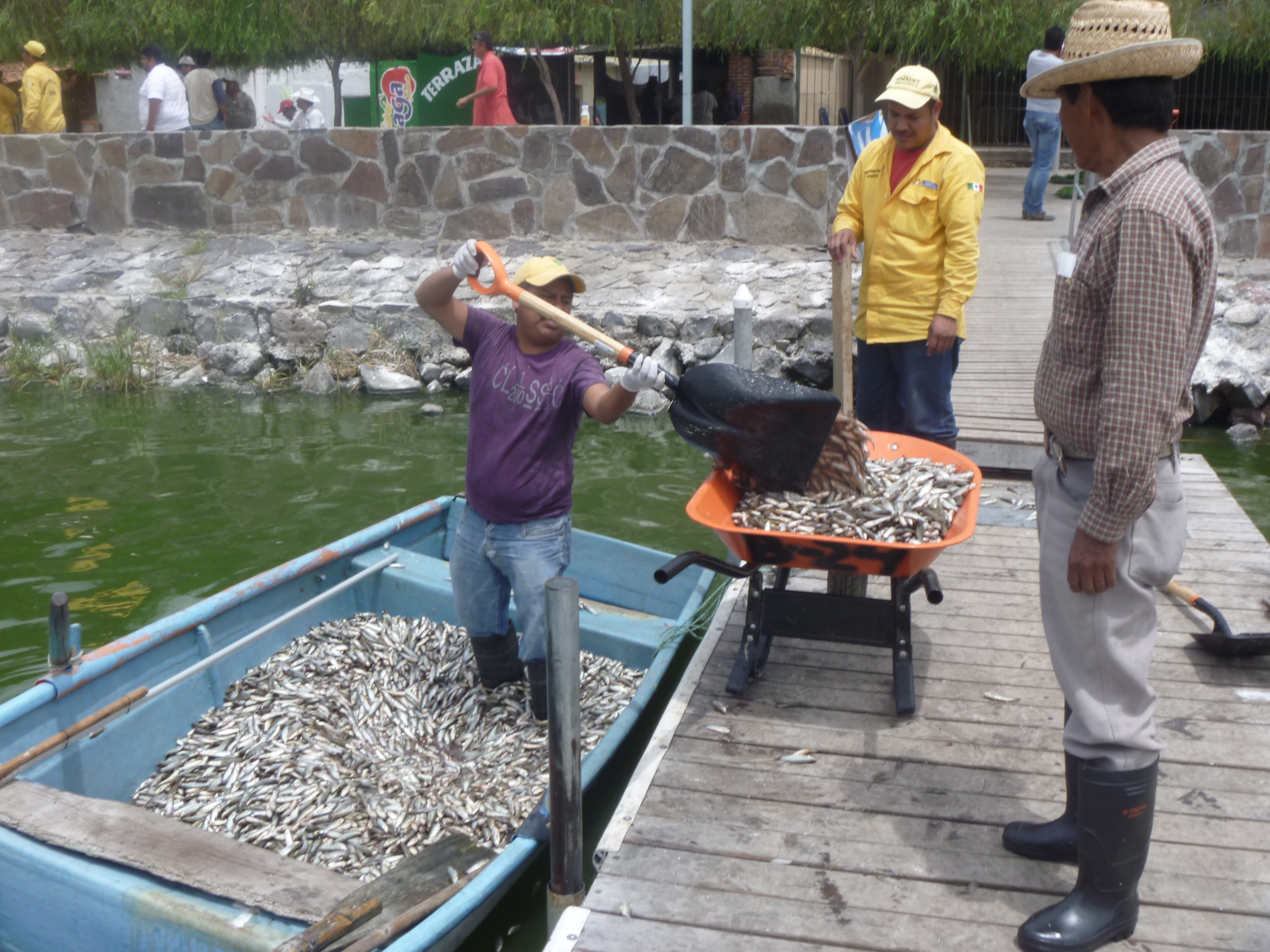
Over 82 tonnes of dead freshwater fish have been hauled from Lake Cajititlán this week.
“The water used to be blue and crystal clear. You could see the sand and the fish beneath the surface,” said Dolores Herrera, a middle-aged fisherman’s wife from Cajititlán, a lakeside village in western Mexico. “The entire town used to bathe in the lake. Now I wouldn’t dare dip my feet in it.”
Over 82 tonnes of dead popoche chub fish have been hauled out of Lake Cajititlán since Sunday, when the now grey-green surface was covered in floating bodies for about as far as the eye could see.
The sudden death of approximately 3.2 million freshwater fish remains an unsolved mystery, but this is only the latest in a string of ecological disasters to hit Mexico in recent weeks.
It came just days after illegal drilling in the eastern state of Veracruz led 4,000 gallons of crude oil to leak into a nearby river, turning the water red and killing hundreds of turtles, rabbits, mice, birds and fish.
Earlier in August, Mexico suffered another environmental catastrophe when over 10 million gallons of toxic waste from a copper mine spilled into two rivers in the northern state of Sonora, leaving 24,000 people without clean water…
Click here to read this story in full over at The Independent.
Four Mexican drug gangs meet to form ‘cartel of cartels’
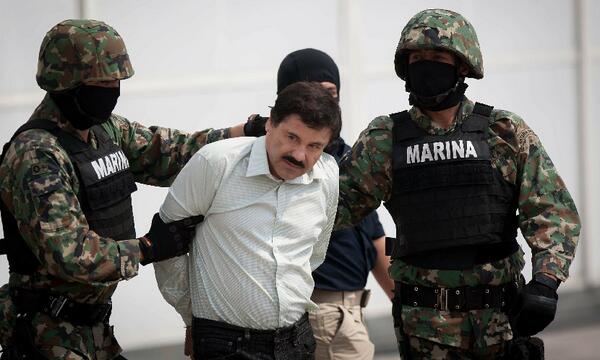
The arrest of Joaquin “El Chapo” Guzman has left the Sinaloa Cartel vulnerable against its rivals who appear to have banded together.
Citing U.S. and Mexican intelligence documents, Mexico’s Reforma newspaper reported on Friday that four of the nation’s most powerful drug gangs have discussed banding together to form a “cartel of cartels”.
Leaders of Los Zetas, the Cartel Jalisco Nueva Generacion (CJNG), the Juarez Cartel and the Beltran Leyva Organization (BLO) reportedly met at a summit in Piedras Negras, Coahuila in a bid to form an alliance that would have a serious impact on the world of Mexican drug trafficking. News of the meeting came from informants working for the U.S. and Mexican authorities, Reforma revealed.
Among those said to be present at the meeting were Nemesio “El Mencho” Oseguera, the head of the CJNG; Vicente Carrillo Fuentes, alias “El Viceroy,” the leader of the Juarez Cartel; Omar Treviño Morales, alias “Z-42,” the current leader of Los Zetas; and another Zetas leader known as “Z-43”. BLO boss Hector Beltran Leyva was absent, but he was reportedly represented at the summit by his right-hand man, Fausto Isidro Meza, alias “El Chapo Isidro”.
Between them, the four cartels have a presence in a dozen states: Chihuahua, Coahuila, Durango, Hidalgo, Jalisco, Mexico State, Nuevo Leon, Sinaloa, Sonora, Tamaulipas, Veracruz and Zacatecas.
Sinaloa Cartel absent
The Sinaloa Cartel, which is widely considered Mexico’s most powerful drug trafficking organization, was conspicuous by its absence from the talks. Headed by Joaquin “El Chapo” Guzman up until his arrest in February, the Sinaloa Cartel is a fierce rival of Los Zetas, the Juarez Cartel and the BLO. It was previously allied to the CJNG, but the news of the summit suggests that the four gangs are teaming up to take on the Sinaloa Cartel while it is in a weakened state.
On top of Guzman’s arrest, the Sinaloa Cartel has lost a string of key leaders and lieutenants in the last nine months. Most notably, Juan Jose “El Azul” Esparragoza Moreno – who had led the cartel alongside Guzman and Ismael “El Mayo” Zambada, and served as a mediator with the Juarez Cartel – reportedly died of a heart attack in June. If the rumors of his death are true (the Mexican government has been unable to confirm them) then the cartel leadership now lies solely in the hands of 66-year-old Zambada.
Strength in numbers
Senator Omar Fayad, president of the Senate Security Commission, told Reforma that the meeting to form a possible alliance was evidence of the weakness of each cartel.
“They don’t feel strong on their own anymore and this is a good sign which the authorities must take advantage of,” Fayad said. “There is a sign of weakness among the Mexican cartels due to the persecution of organized crime by the federal government and the cooperation and coordination with states and municipalities.”
Los Zetas, the ultraviolent gang that controls much of Mexico’s Gulf coast, has been weakened by the arrests and killings of many of its top leaders in the last two years, while the BLO and Juarez Cartel, respectively led by the remnants of the Beltra Leyva and Carrillo Fuentes families, have suffered from being on the receiving end of Sinaloa Cartel offensives.
Previous pacts
A pact between cartels “is not unprecedented,” Fayad added, noting “that alliances have not worked for them in the past because they betray one another. There is almost always someone who wants complete hegemony.”
This proved the case when the Sinaloa Cartel established the Federation, a loose array of drug gangs with allied interests that soon fell apart when “El Chapo” Guzman began to fall out with his partners. The BLO and the CJNG both started out as offshoots of the Sinaloa Cartel, but the former forged an alliance with Los Zetas in around 2008, while the latter now also seems to have turned against its former ally.
 The Tequila Files