
Subcomandante Marcos said it was a “diffiult decision” to step down as EZLN spokesman.
Enigmatic Zapatista spokesperson Subcomandante Marcos announced on Sunday his retirement as the mouthpiece for the indigenous rebel group.
“My voice will no longer be the voice of the Zapatista National Liberation Army (EZLN),” Marcos said, citing unspecified “internal changes” within the movement.
An iconic and charismatic figure forever hidden behind military fatigues, ski mask and his trademark pipe, Marcos helped draw global media attention to the plight of Mexico’s marginalized indigenous population for over 20 years after leading the initial Zapatista uprising in the southern state of Chiapas on January 1, 1994.
However, aside from issuing sporadic communiqués peppered with humor and poetic denunciations of the Mexican political establishment, he had kept a notably lower profile of late. Within hours of making his first public appearance in five years, Marcos declared that he would “stop existing” because his persona had become a “distraction” for the Zapatista movement.
“The handover of command is not due to illness or death, not to an internal shift, purge or purification,” Marcos said in a statement issued at 2:08 a.m. on May 25.
Marcos had rarely been seen in public since mounting “La Otra Campaña,” a national campaign to unite disaffected groups across Mexico that coincided with the 2006 presidential election. The campaign was met with a somewhat underwhelming response, while current President Enrique Peña Nieto, who was then governor of Mexico State, dealt the movement a fierce blow by launching a brutal crackdown on protesters in San Salvador Atenco.
Marcos only reappeared on May 25 to attend a memorial service for Jose Luis Solis Lopez, a Zapatista teacher better known as “Galeano,” who was viciously murdered by militant agricultural workers during an attack on the autonomous community of La Realidad earlier this month. Wearing an eye patch and carrying a machete, Marcos stood before some 3,000 Zapatistas while his companion Subcomandante Moises delivered a eulogy for their fallen comrade.
Although he made clear the following morning that he will no longer serve as the primary Zapatista spokesperson, Marcos did imply that he would continue to serve the movement under a new alias. “We think it is necessary for one of us to die so that Galeano can live,” Marcos said. In order for Solis to “cheat death,” he explained that he would kill off the “Marcos” persona and assume the name “Subcomandante Galeano.”
Marcos’ announcement was met with surprise and some criticism. “Marcos retires from media narcissism. He spoke for the indians without being indian, and he sent them to die armed with sticks for rifles. They’re worse off today,” tweeted former Mexican presidential candidate Gabriel Quadri, making reference to the poorly armed rebels that participated in the 1994 uprising.
The Zapatistas have always favored non-hierarchical power structures and advocated participatory democracy, so while Marcos served as their symbolic figurehead he was always a spokesperson, not a leader. Thus no direct replacement need be appointed, although the aforementioned Subcomandante Moises has already become one of the movement’s more prominent representatives in recent years.
Ending his farewell address on a typically humorous note, Marcos, who was identified by the Mexican government as Rafael Guillen Vicente, a former philosophy professor from the northern state of Tamaulipas, but has never appeared unmasked in public, joked, “Can I walk around naked now?”
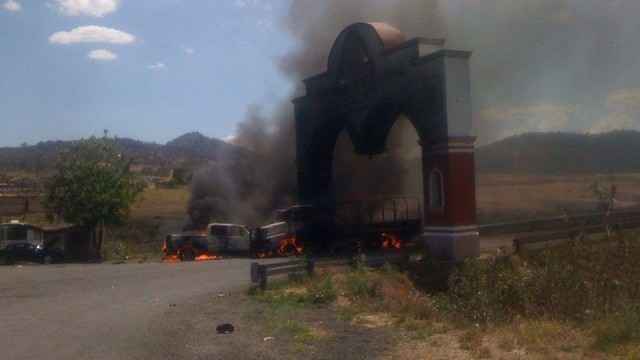
The ambush took place beneath the archway marking the entrance to Guachinango.
Four soldiers were killed and two injured when a military convoy was ambushed by cartel gunmen in the municipality of Guachinango in the western state of Jalisco on Monday.
The Cartel Jalisco Nueva Generacion (CJNG) is believed to have been behind the attack, which took place shortly after 4:30 p.m. on the Ameca-Mascota highway, approximately 140 kilometers west of Guadalajara.
The Jalisco Prosecutor General’s Office (FGE) reported that the soldiers from the XV Zona Militar division had discovered about 1,000 liters of stolen gasoline at a nearby farmhouse shortly before they came under attack.
As the convoy passed beneath the archway that welcomes visitors to Guachinango, “the land of gold and friendship,” around thirty masked paramilitaries pulled up aboard eight luxury pickup trucks. The assailants rammed one of the
military vehicles, hurled at least two grenades and fired off hundreds of rounds with AR-15 and AK-47 assault rifles.
Two of the military vehicles caught fire, with the blaze exacerbated by several liters of decommissioned fuel that the soldiers had brought onboard. Three soldiers were burned to death aboard one of the vehicles, while another was found dead in a nearby ravine, having reportedly leapt from the vehicle when it came under attack. Two other soldiers were injured and airlifted to a Guadalajara hospital.
The assailants fled the scene, leaving a trail of blood as they withdrew their wounded or deceased comrades. The FGE dispatched a helicopter to the area and the military set up roadblocks the following day in an attempt to capture the aggressors, but no arrests have been reported to date.
The CJNG’s profile and reach has risen in recent months, with InfoSur reporting that it now operates in the states of Colima, Guerrero, Jalisco, Mexico, Michoacan, Nayarit and San Luis Potosi. The cartel traffics marijuana, heroin, cocaine and crystal meth, and has contacts in Colombia, Peru, Bolivia, Central America and the United States, according to security analyst Maria Idalia Gomez.
CJNG second-in-command Ruben Oseguera Gonzalez was arrested in Guadalajara in January, but his father, cartel leader Nemesio Oseguera Ramos, alias “El Mencho,” remains at large.
 The Tequila Files