Michoacan struck by outbreak of narco terrorism
Although the arson attacks claimed no civilian casualties, as many as 22 people were reportedly killed over the weekend in the escalating conflict between Michoacan’s Knights Templar cartel and local vigilante groups, which is believed to have triggered the violence.
Mexico’s Federal Electricity Commission (CFE) reported that 18 of its facilities, including at least nine electrical substations, were attacked by men armed with guns and homemade explosive devices, leaving 420,291 homes in at least 14 municipalities without electricity for hours. The near-simultaneous attacks took place from around midnight to 3 a.m. in the towns of Aguililla, Apatzingan, Buenavista Tomatlan, Ciudad Hidalgo, La Piedad, Sahuayo, Tepalcatepec, Tuxpan, Uruapan, Zamora and Zinapecuaro.
In Sahuayo, the criminals reportedly came equipped with heavy machinery which they used to tear down the fencing protecting the power station before setting it alight. In the ensuing chaos, four Pemex gas stations were also set alight: one in Apatzingan, another in Patzcuaro and four more in the state capital of Morelia.
Two of the assailants were killed and three others were arrested following a brief shootout at one of the power stations, the federal Interior Ministry said on Monday. The authorities also recovered four cases filled with 131 Molotov cocktails from beside the Morelia-Salamanca highway.
Electricity was restored in 95 percent of the affected areas by 7 p.m. Sunday, the CFE said. The federal Attorney General’s Office (PGR) is investigating the coordinated attacks, but has not yet indicated who was responsible.
“The opportune intervention of the army, the federal police and the local authorities was able to re-establish public order,” Mexico’s Interior Ministry affirmed in a statement released Sunday night. “The actions of the criminals will not stop the actions of the government to protect the population.”
The Knights Templar cartel, which controls drug trafficking operations in Michoacan and even serves as the de facto authority in the more remote areas of the state, is believed by many to be behind the attacks. The gang was previously accused of firebombing gas stations in the neighboring state of Guanajuato last year, as well as attacking distribution centers and delivery trucks belonging to PepsiCo subsidiary Sabritas, but the latest outbreak of violence represents the clearest evidence yet of Mexican cartels carrying out terrorist-style attacks against the state.
The attacks may have come in retaliation for the authorities protecting local vigilante groups during a violent confrontation in the Templar stronghold of Apatzingan on Saturday.
The conflict between the Knights Templar and the community-led groups has intensified considerably in the last year. Frustrated by the weakness of the state, the vigilantes say they simply seek to defend their communities from a wave of extortion and kidnappings, while the Templars claim these groups are a front for rival gang the Cartel Jalisco Nueva Generacion.
The tension came to a head on Saturday when self-defense groups from across Michoacan’s mountainous Tierra Caliente region congregated in Apatzingan to demonstrate against the Templars.
Having surrendered their weapons to the military in return for the promise of protection, the protesters came under fire in the city center from snipers positioned on the roof of the cathedral. At least three people were wounded and three vehicles were set alight as the cartel gunmen threw grenades and exchanged fire with the federal police.
Elsewhere in Michoacan, Jose Manuel Mireles, member of a self-appointed community police force in Tepalcatepec told Spanish-language daily Mural that 12 Templars and one member of a self-defense group were killed in another clash in the municipality of Aguililla on Saturday night.
The following evening, five young men said to be wearing self-defence group T-shirts were shot dead in the outskirts of Apatzingan. Two more suspected gang members were killed in a clash between the Army and armed assailants in the town of Turicato on Sunday afternoon.
The Mexican government has struggled to impose law and order in Michoacan ever since former President Felipe Calderon initiated the ongoing war on drugs by sending the armed forces into his home state in December 2006. Despite having repeatedly pledged to take a different approach to the drug war, Calderon’s successor President Enrique Peña Nieto deployed thousands of troops to Michoacan in May in a bid to quell the violence that has led many local communities to take up arms.
Yet the Army has failed to restore control and a vice admiral in the Mexican Navy was murdered in the state in July, just days after two federal police officers and at least 20 Templars were killed in a major shootout.
The latest challenge to security in Michoacan came just days after Governor Fausto Vallejo returned to office last Thursday, having taken an extended leave of absence to undergo a liver transplant.
Angry student slams government at business summit
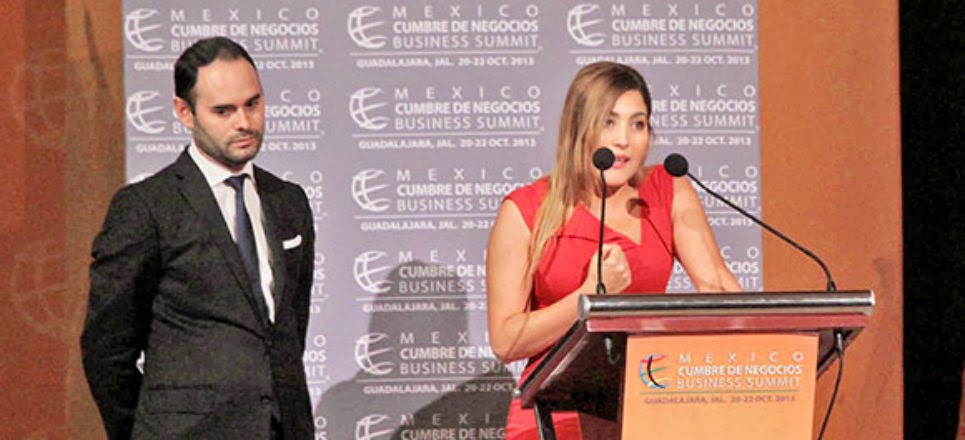
“The government is crushing the young people. They’re not letting us grow,” said Bianca Patricia Treviño, a postgraduate at the University of West Virginia, on Tuesday. She explained that she had been angered by conference organizers who rejected the original speech that she had prepared and just told her to say “thank you, I liked the event.”
“The government doesn’t want to listen to us … they’ve brainwashed us, it’s very difficult to wake people up,” she continued, as the organizers scrambled to cut off her microphone, “but we’re only just beginning this fight.”
Once she left the stage, an apparently unflustered Governor Aristoteles Sandoval welcomed Treviño’s comments and invited her to become engaged in the political process. “Today we cannot have a silent society; it is the worst thing that can happen to our country. We need an active and critical society,” Sandoval said.
The government then blocked footage of the event on YouTube and later posted a censored video in which the girl’s speech had been edited out.
Deals worth 496.2 million dollars of investment in Jalisco were formalized at the summit, which ran from October 20 to 22, including 30 million pesos of investment in the state’s tourist sector.
The event drew leading business owners and government officials from 17 countries, including Mexican President Enrique Peña Nieto. It cost 4.4 million dollars to stage the summit, with the Jalisco government contributing 19.7 million pesos.
Child prostitution ring busted in Jalisco
The arrests were made after members of Guadalajara’s municipal police force stopped a man driving in a stolen BMW on 8 de Julio and Natividad Macias. He was caught in possession of 100 grams of crystal meth and in the company of two girls, aged 14 and 17, who confessed that they were members of a prostitution ring run by Ana Laura Vazquez Alvarez.
The FGE charged the driver and another man with soliciting prostitutes and corrupting under-age girls. FGE officers also arrested Vazquez, 24, who went by the name of Angeles, and stands accused of taking at least 15 adolescent girls into her home and arranging for them to have sex with clients.
Vazquez allegedly supplied the girls with drugs and alcohol at her home, where she dressed them and did their makeup, before phoning clients and agreeing for them to meet the girls at motels in the metropolitan area. A 20-year-old male taxi driver who allegedly transported the girls to and from the motels was also arrested.
The girls would receive 700 pesos for each session, Vazquez would take 300 and the driver would get 200, according to the FGE. Medical examinations of the victims revealed signs of drug addiction and harm by sexual abuse, the FGE added.
Vazquez reportedly told the FGE that she created the prostitution ring because she was tired of poorly paid bar work.
 The Tequila Files