El Chapo’s daughter arrested in San Diego

The daughter of Mexico’s most wanted drug lord lives and works as a doctor in Guadalajara, her lawyers revealed following her arrest in the United States last week.
Alejandrina Gisselle Guzman Salazar, 31, the daughter of Sinaloa Cartel boss Joaquin “El Chapo” Guzman, was detained at a San Diego border crossing last Friday. She had presented a false passport for inspection and was subsequently charged with trying to enter the United States with fraudulent documents.
Guzman appeared at an initial hearing in a federal courthouse on Monday, with attorneys Jan Ronis and Guadalupe Valencia, both known for representing high-profile drug trafficking figures. They revealed after the court session that their client is a medical doctor from Guadalajara.
Her father’s whereabouts remains a mystery but Mexican authorities believe Alejandrina’s brother Jesus Alfredo Guzman Salazar also resides in Guadalajara. They even announced his capture following a raid in Zapopan in June, but it was later dismissed as a case of mistaken identity.
Prior to her arrest at the San Diego border, Guzman had told authorities she was pregnant and planned to give birth in Los Angeles.
Her father’s current wife Emma Coronel also gave birth to twin girls in a Los Angeles hospital in August 2011. A joint U.S.-Mexican citizen, Coronel was not stopped at the border as there no outstanding warrants against her and her documents were in order.
Far-sighted architects draw up utopian future for Guadalajara
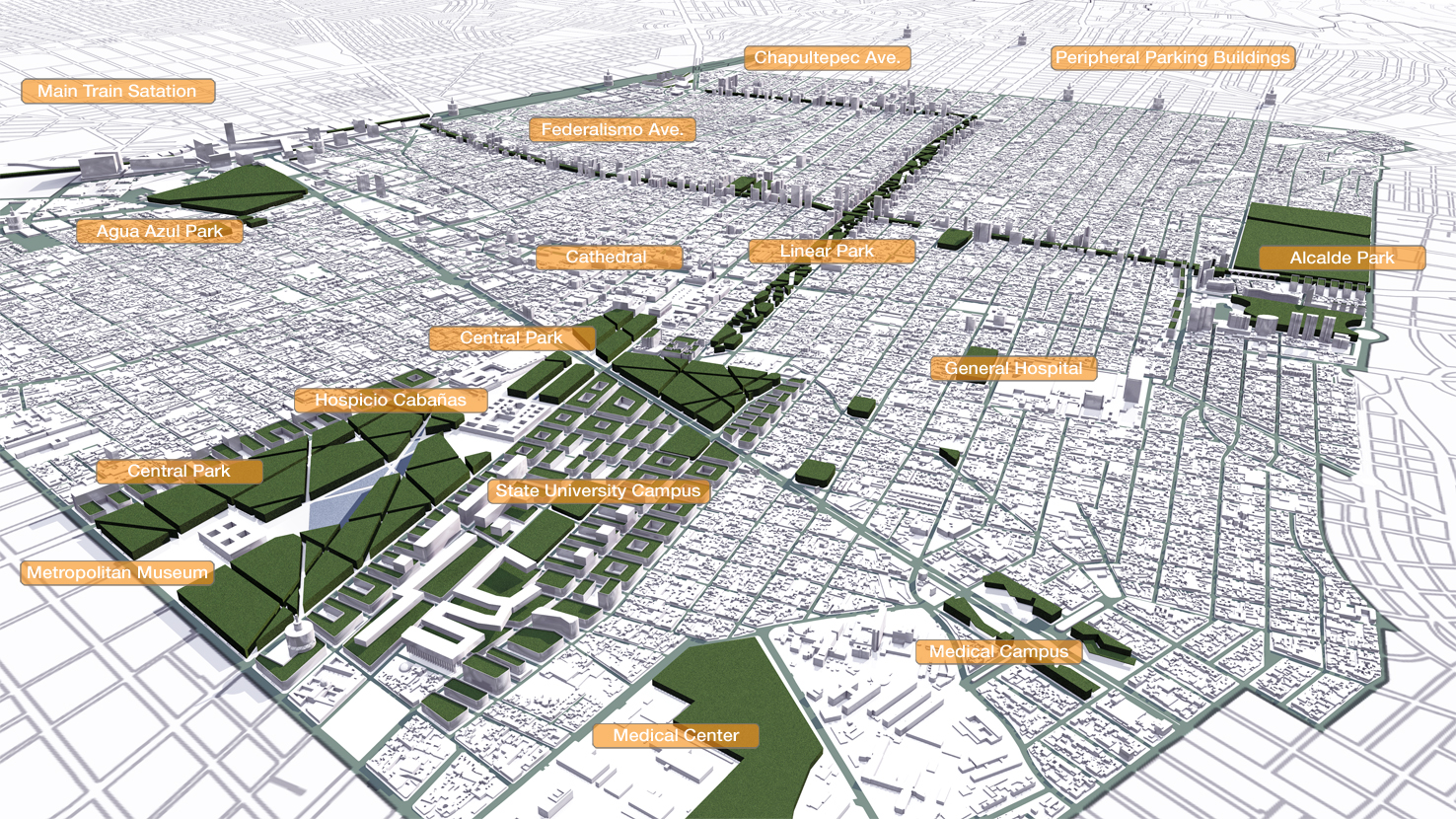
The year is 2042. Guadalajara is celebrating its 500th birthday. You board an electric train in Chapala’s renovated railway station and 30 minutes later you are in downtown Guadalajara. Stepping out onto the city streets, you see a stream of pedestrians and cyclists, but not a car in sight. After a short stroll you stop to relax on a bench in the lush green surroundings of the Central Park.
This is how a group of local architects envisage Guadalajara in 30 years’ time. The Progressive Architecture Laboratory (LeAP) and Total Quality Management (MTQ) have spent over a year working respectively on the creative and technical aspects of plans to transform the metropolitan zone.
The evolution of a previous study commissioned by the state government in 2008, their “vision of a car-free city with extensive green areas and sustainable communities living downtown” was first presented at the 13th Biennale of Architecture in Venice, Italy in August. The reaction was “very positive” and their proposals “generated a lot of interest,” says Raul Juarez Perezlete of LeAP.
Although “the project is entirely feasible,” Juarez admits “it’s not very likely” to be realized because of a lack government commitment. It is difficult for municipal governments to back such long-term projects, with mayors serving just three-year terms and often spending their final year campaigning for a higher post in government, notes Heriberto Hernandez Ochoa, also of LeAP.
Even so, Juarez says they decided it would be more interesting to present something ambitious that would generate discussion and awaken public interest instead of a limited but more feasible plan.
The architects believe downtown Guadalajara should be the focal point of the city and that public spaces such as the Plaza Tapatia should be reclaimed for the benefit of everyone. Under their plans, the giant plaza would be transformed into a “Parque Central,” inspired by New York’s Central Park.
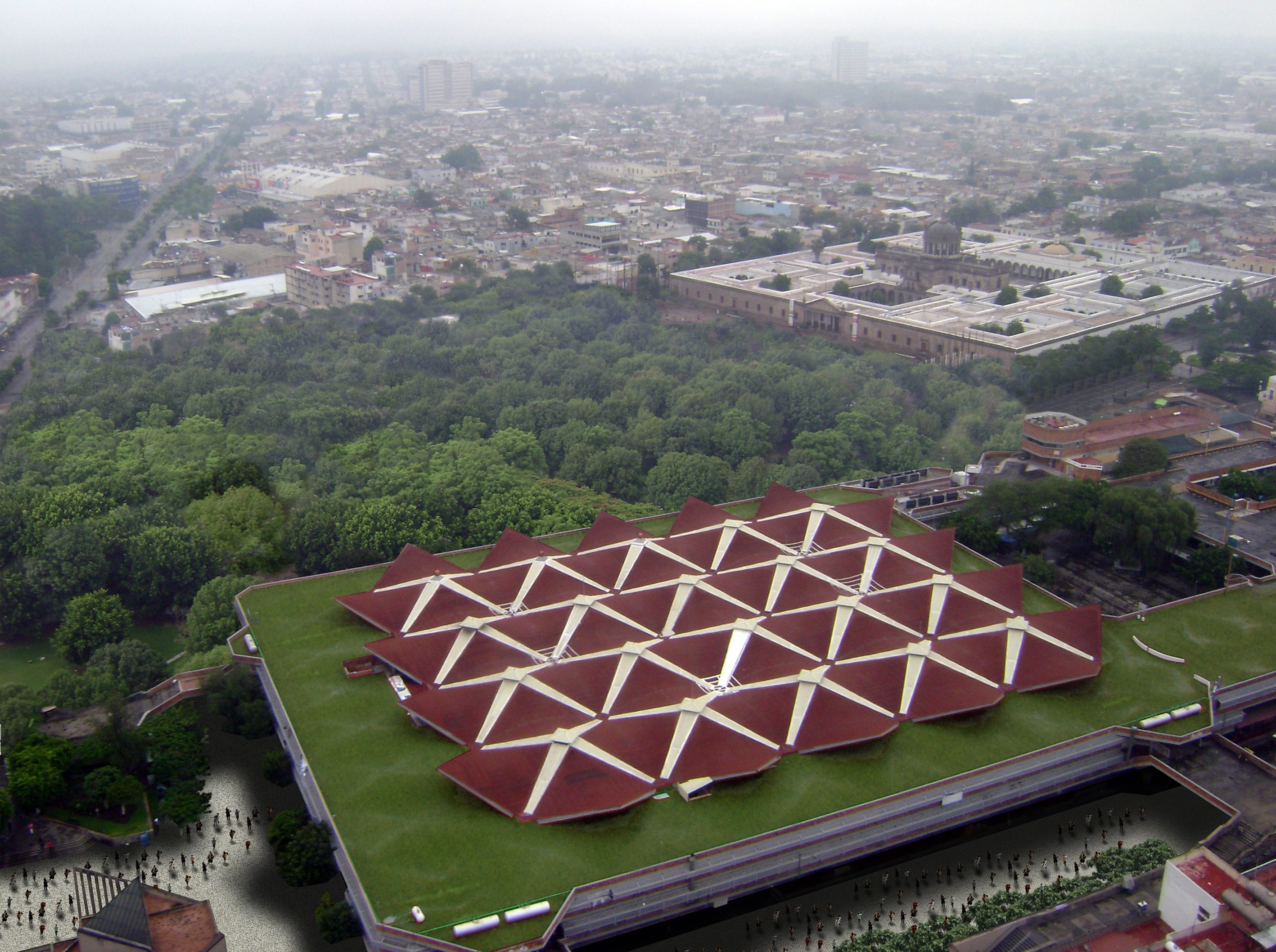
Stretching from Parque Morelos to the San Juan de Dios market, with the Metropolitan Cathedral and the Teatro Degollado at one end and the Hospicio Cabañas at the other, the park would be the city’s center piece. It would host social and cultural events, with new educational centers and museums to be built nearby.
The city center would be closed to cars, with only electric emergency and service vehicles permitted to enter. A new system of electric public transport would link the center to rail networks, with the main central station located in Parque Agua Azul.
The metropolitan area would then become a central hub in a regional network of medium-sized cities across Jalisco. The electric rail network would link 17 cities within a 150-kilometer radius of Guadalajara, mostly utilizing existing but abandoned railroads.
“Guadalajara already has much of the necessary infrastructure,” Hernandez says, noting that “many unused lines already exist in the state.” These would have to be converted to electric rail, but this “would not require such a big investment” as laying a new transportation network, he explains.
The work would be realized through a mixture of public and private investment. It is difficult to put an exact figure on costs in such an ambitious project, the architects say, but they assure that the long-term benefits would easily justify the costs. As Hernandez says, “it is 100 times more expensive to revive a collapsed city than to implement a long-term plan to keep it healthy.”
The municipal, state and federal governments are currently working on separate plans to renovate downtown Guadalajara by building a Creative Digital City (CCD) in the Parque Morelos area. The idea is to entice major entertainment companies to invest in state-of-the-art studios for animation, film and video game production.
“It is entirely possible that the two projects could coexist, but one has to exist before the other,” Hernandez says, noting that the area is currently “insecure, very deteriorated and not attractive to investors.”
By seeking investment first, Hernandez believes that those behind the CCD are going about their work the wrong way around. “They should first renovate the urban zone and create the conditions that would inspire confidence in investors,” he says. This could be achieved through LeAP and MTQ’s plans to redevelop the city center.

Asked which cities they consider an inspiration for sustainable urban development, the architects cite Amsterdam as “bike heaven,” Copenhagen, “for its pedestrianized city center,” and also Florence, where pedestrians have right of way over vehicles.
Despite their European influences, they hope to restore a more Mexican feel to the city center. “It is a very Mexican custom for people to go out and sit in public places,” says Hernandez. “This still happens in towns and villages but it has been lost in big cities like Guadalajara.”
If the architects can succeed in arousing the public’s attention with their impressive plans, such traditions might well have returned to the city by 2042.
New police chief narrowly avoids assassination
Having only taken up his post at the beginning of the month, Roberto Rodriguez Preciado was attacked just before 8 a.m. while driving through Vallarta’s Colonia Emiliano Zapata.
Two men armed with AK-47 and AR-15 assault rifles opened fire on his vehicle at the intersection of Basilio Badillo and Insurgentes. The assailants then threw a fragmentation grenade, causing Rodriguez’s driver to crash into a taxi parked outside a pharmacy two blocks down, on the corner with Lazaro Cardenas.
Rodriguez and his bodyguards escaped the burning vehicle but the would-be assassins threw another grenade which exploded on the sidewalk. The shrapnel wounded at least three innocent bystanders, including two children.
The two men then fled in a white Ford Lobo pickup truck, which was found abandoned several minutes later, with the guns and grenades still inside. Rodriguez and his bodyguards survived the attack without injury.
Edit: This story has been getting a huge amount of hits today. I was contacted earlier by the makers of the following video, which seeks to put the incident in context:
I have some reservations about the video — the incident is downplayed a little too much, what happened is not fully explained and one of the Canadian’s comments is borderline racist. However, some of the speakers make more valid points regarding how safe Vallarta is and how Mexico is often unfairly portrayed in the foreign press. What do you think? Is Vallarta safe? Does it get a bad rap in the media?

