New state library second biggest in Mexico
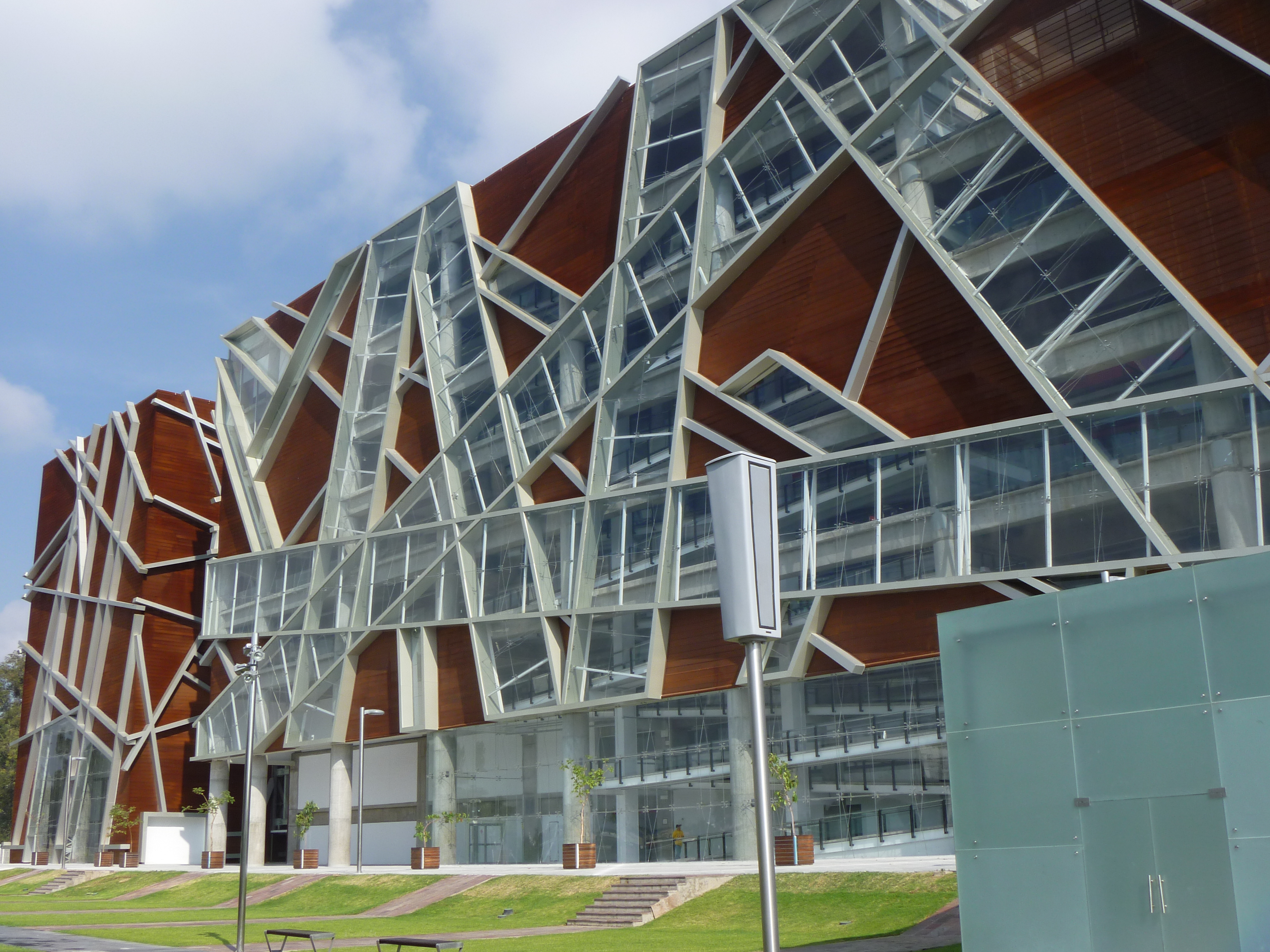
Located in the new University of Guadalajara (UdeG) Cultural Center, the library opened to the general public on Monday.
Built on a 200-hectare plot of land, the 43,000-square-meter structure is modern and striking, with a jagged exterior and large slanted windows. Originally scheduled to open in 2008, the library was hampered by delays and ended up costing 570 million pesos – 60 percent more than estimated.
With a capacity for up to two million books, the library currently holds one million, including 20,000 children’s titles; eight million digital images; over 5,000 Mexican films; and 500,000 archival records. Eclipsing Mexico City’s Jose Vasconcelos library, which holds 580,000 books, it is home to the nation’s second largest literary collection, behind the National Autonomous University of Mexico (UNAM) National Library, which houses 1.25 million books.
“This library is the model 21st century library,” said Calderon last week, describing its opening as “a real cultural milestone in Guadalajara and Jalisco.”
Touring three of the six floors, Calderon was accompanied by the president of the University Cultural Center, Raul Padilla, who described it as one of the most important libraries in Latin America, because it “not only preserves the history of Jalisco, but also the 300 years of the history of western and northern Mexico and the southwestern United States of America.”
 Founded in 1861, the state public library has now existed in four different locations across the city. The new building is named after Jalisco-born writer Juan Jose Arreola, who served as director of the library from 1991 to 2001.
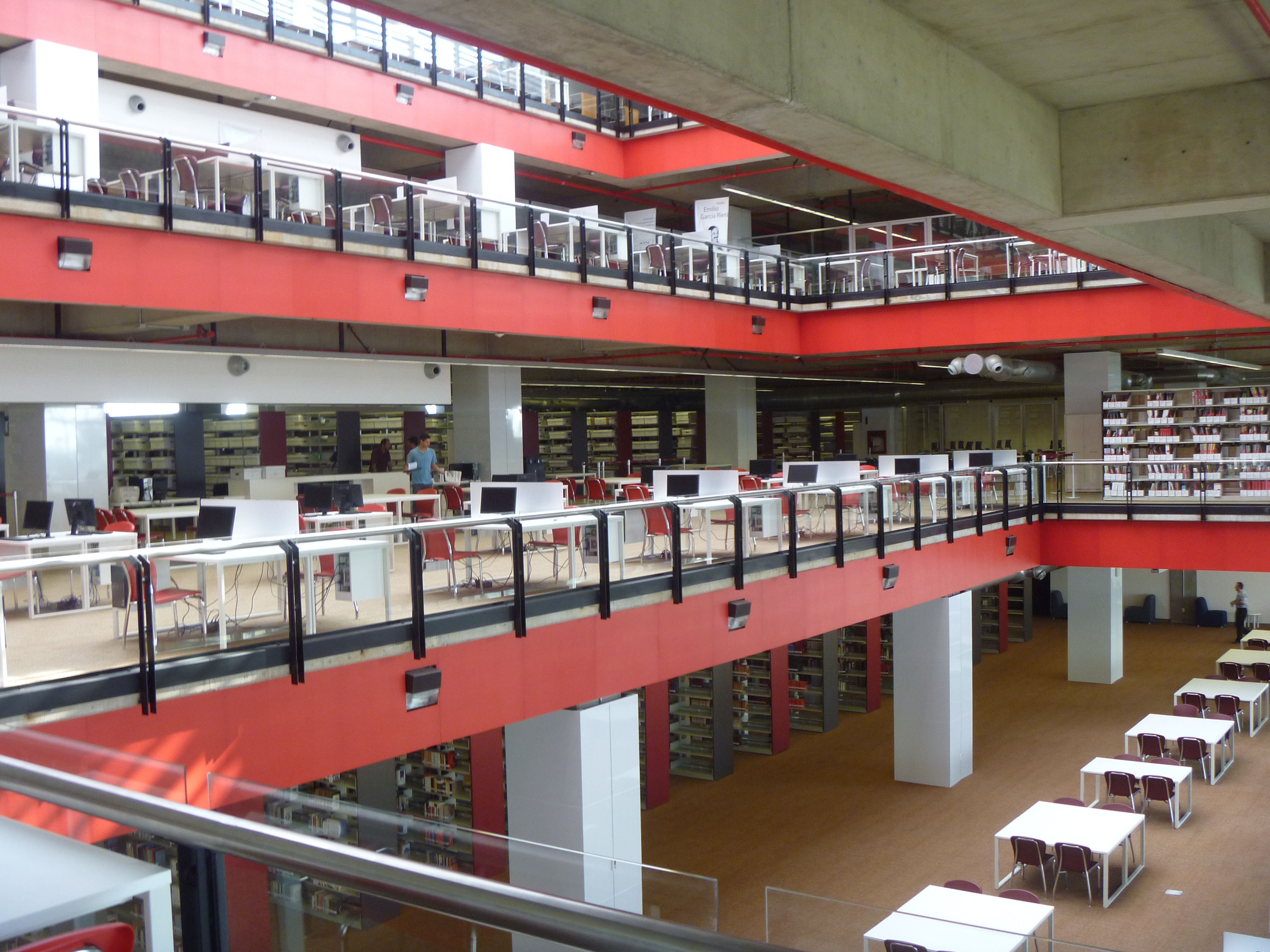
On every floor there are large seating areas and computers with access to the internet and the library’s digital catalogue. Among the archives are newspapers dating as far back as 1809 and books written in 17 indigenous languages for evangelization purposes, which were published between the 16th and 20th centuries and recently accepted in UNESCO’s Memory of the World program.
There is also an area dedicated to the visually impaired, with audio books and over 700 texts in Braille. The fifth floor houses international titles, in English, French, German and Chinese. The English-language works come from the former Benjamin Franklin library, previously donated to the UdeG by the U.S. Consulate General in Guadalajara.
The library is expected to draw around 50,000 visitors per month. It is not yet possible to borrow books from the premises, but Director Juan Manuel Duran Juarez said they hope to operate a loan service next year, when at least three copies of each title should be available for loan.
The library is situated on the northern Periferico ring road at the intersection with Camino a Los Belenes, across from the UdeG Center for Economic and Administrative Sciences (CUCEA).
It is open from Monday to Friday from 8 a.m. Floors one and two of the contemporary collection are open until 8 p.m., but floors three, four and five currently close at 3 p.m. due to staff shortages. The historical collection closes at 4 p.m. For more information visit http://www.bpej.udg.mx.
Solar energy turning Jalisco green

Jalisco is home to more solar panels than any other Mexican state, and the majority of these are found in the expat community at Lakeside.
The Lake Chapala area has become known as the “solar capital of Mexico,” says Jsun Mills, a Californian who founded eSun Energy in Ajijic around five years ago. eSun has another office in Guadalajara and in January opened a third outlet in Puerto Vallarta to tend to clients on the coast from Colima up to Nayarit.
“Most clients are members of the expat community but we are doing a lot of projects with Mexican nationals as well,” he says, adding that they install most solar panels in homes, “because that’s where the best economic returns are.”
Installation costs depend on geography, Mills explains, with houses on the coast typically using much more electricity (mostly on air conditioning) and requiring more panels than those inland.
In Guadalajara or Chapala, installation normally costs between 7,000 and 15,000 dollars, while on the coast it tends to vary from 10,000 to 20,000. Electricity bill savings are from 75 to 100 percent each year and it usually takes four to four-and-a-half years to make back the money invested.
“Everybody’s interested in using cleaner energy and making the world a better place,” Mills says, “but at the end of the day if the economics don’t make sense the vast majority will not invest.”
At first, education and information was the toughest challenge, he adds, but “in the last couple of years the numbers have begun to make sense,” making solar energy a much easier sell. It has also become easier to convince people to turn green because “the CFE (Federal Electricity Commission) keeps raising the electric rates.”
There was no solar energy market when he arrived here, says Mills, who has utilized his 14 years of experience in the industry to build such a market. As reward for his endeavor, eSun now has more panels installed than any other solar energy company in all of Mexico.
Despite a slight drop off in the summer months, “business is good” and the new Vallarta office is “going very well,” Mills says. In tourist areas business can be cyclical, he explains, with the winter bringing more “snowbird” clients to the Lakeside and coastal areas, “but we stay busy even through the low season.”

Another potential problem eSun has overcome is the fact that the “CFE is supposed to provide digital meters but they typically don’t have them,” Mills says. “So what we did is go out and buy them directly from the manufacturer and we turn them into the CFE on behalf of our clients.
“It’s really a very simple process now. It used to take three or four months and now the installation usually takes two to four days and the entire project is finished in less than two weeks.”
In recent weeks, Mills has been busy attending five national and international expos on solar energy. At Solar Panel International, the largest such expo in the Americas, he “gave the first ever technical training in solar energy in the United States, all in Spanish, with 20 participants from seven countries.”
Mills is clearly proud of his work, keenly pointing out that “all of our businesses are making more than 100 percent of our electricity” and have even built up surplus credit with the CFE.
Among eSun’s rivals in the solar energy sector is e2 Energias, founded four-and-a-half years ago by Guadalajara-born Guillermo Corona Jazo and German citizen Frank Weiss. Their primary product is interconnected photovoltaic (solar panel) systems, although they also install solar thermal collectors for heating water or warming swimming pools.
With offices in Guadalajara, Puebla and Morelia, e2 also operates in Puerto Vallarta, Cocula, Queretaro and Oaxaca. They have sold solar panel systems to around 280 clients nationwide, of whom about 190 are from Jalisco, including 120 in Lakeside, Corona says.
“Two years ago there was more demand in Lakeside but there’s now more of a boom in Guadalajara, although obviously it’s a bigger city,” he adds.
Corona is proud of his company’s “quality product,” noting that all e2 systems use Sharp technology and are guaranteed for 25 years. Sharp is a world leader in solar cell production, a manufacturer that will still be going strong in 25 years, unlike other rivals with less weight and experience behind them, he suggests.
Similarly, Mills notes that “over the years we’ve seen many manufacturers come and go.” Referring to eSun’s Bosch technology, he says “we may not be the cheapest but we’re using the best quality.”
Both Corona and Mills agree that “word of mouth” is crucial in the industry, with customers quick to recommend companies that offer a good service or badmouth those who do not.
“We pride ourselves on our attention to service,” Corona says. “We don’t want them to have any problems, we want them to be 100 percent satisfied.”
Navy kills top Zetas boss; body promptly vanishes
The alleged head of Los Zetas, Heriberto Lazcano Lazcano, alias “El Lazca,” was killed along with an associate in a shootout with the navy in the town of Progreso at around 1.30 p.m. However, both bodies then went missing before authorities could even announce this major achievement.
A group of masked and heavily-armed assailants seized the corpses from the Garcia morgue in the town of Sabinas, Coahuila Attorney General Homero Ramos revealed on Tuesday. The navy then confirmed that Lazcano was one of the dead, citing fingerprints and photographs taken before the theft of his body.
Ramos said the navy received an anonymous tip-off on Sunday that Lazcano was watching a game of baseball. The two suspects fled when the military arrived, throwing grenades to deter their pursuers, before they received fatal bullet wounds. A navy spokesperson said that two rifles, a grenade launcher, 12 grenades and a rocket launcher were recovered in the operation.
A former member of an elite Mexican Army unit, Lazcano, also known as “Z-3” and “The Executioner,” is believed to have been a founding member of Los Zetas. He is thought to have led one of two factions following a recent split, with Miguel Angel Trevino Morales, alias “Z-40,” heading the other.
The U.S. government had offered a reward of five million dollars for information leading to Lazcano’s capture, while Mexican authorities were also offering a bounty of 2.3 million dollars.
Lazcano is the most prominent of many leading Zetas to have been captured or killed in the last 15 months. Ivan Velazquez Caballero, alias “El Taliban” or “Z-50,” was arrested in San Luis Potosi a fortnight ago, and the navy also detained Salvador Alfonso Martinez Escobedo, another regional leader of Los Zetas, in Nuevo Laredo on Saturday.
Martinez has been linked to the escape of 151 prisoners from a Nuevo Laredo jail in 2010, the recent flight of 131 prisoners in Piedras Negras and the 2010 killing of U.S. citizen David Hartley on Falcon Lake beside the U.S. border.

