Drug lords falling like flies as government ups the pressure
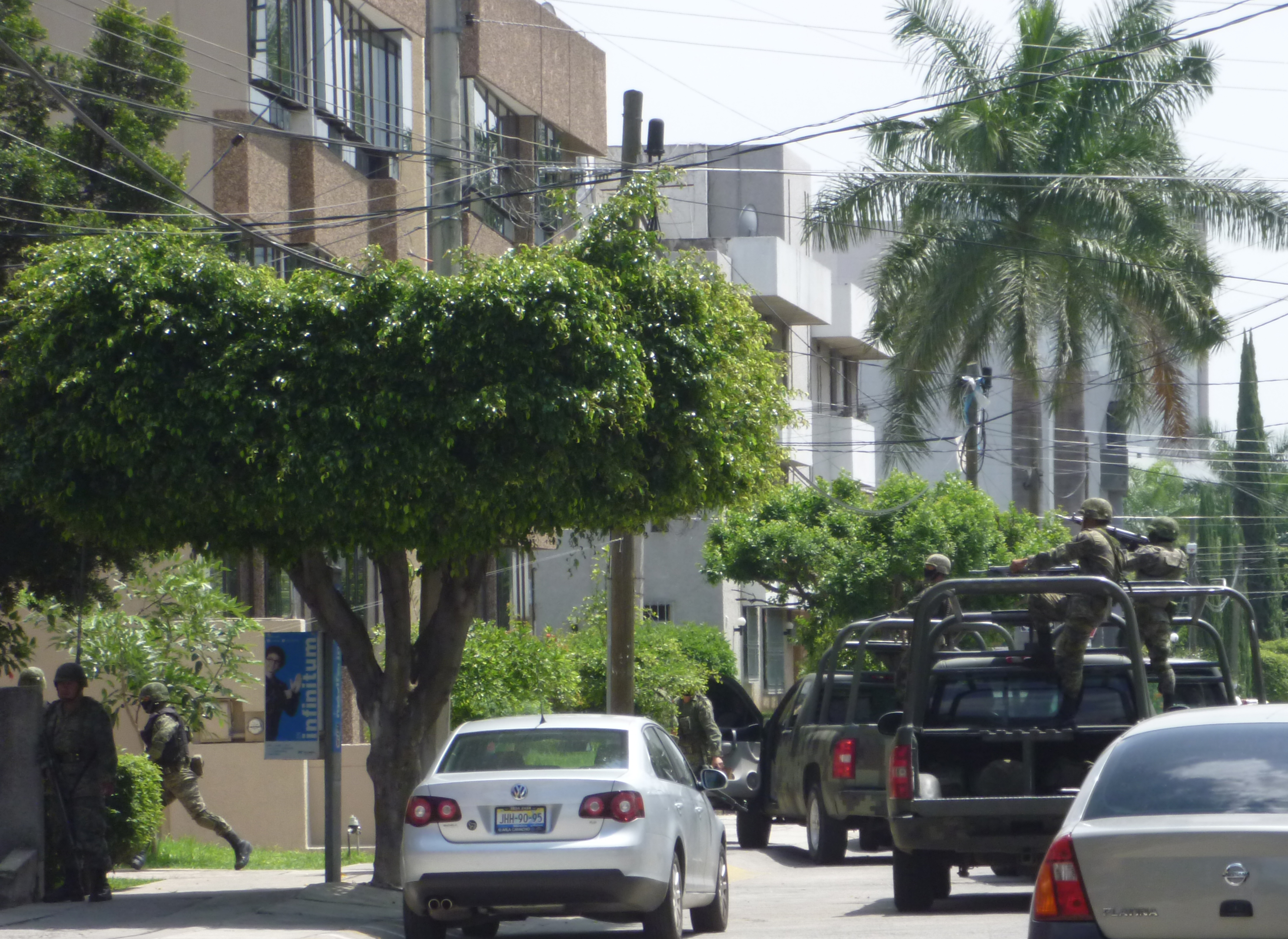
Most significantly, the Mexican navy detained two powerful rivals vying for control of the Gulf Cartel in the space of just nine days.
Mario Cardenas Guillen, alias “El Gordo,” was arrested in the city of Altamira, Tamaulipas on September 3. Previously imprisoned from 1995 to 2007, he is believed to have sought control of the Gulf Cartel following the respective arrest and death of brothers Osiel and Ezequio Cardenas Guillen in 2007 and 2010.
The latter event led to a split between those loyal to the Cardenas Guillen family and another faction led by Jorge Eduardo Costilla Sanchez, alias “El Coss,” a former agent of the Tamaulipas state police.
The U.S. and Mexican governments offered rewards of five million dollars and 30 million pesos respectively for information leading to Costillla’s capture and on Wednesday he was arrested in Tampico, Tamaulipas.
The Gulf Cartel has been significantly weakened since its one-time enforcers Los Zetas broke off to form their own organization and turned on their former employers.
On Tuesday an alleged founding member of Los Zetas was extradited to face drug-trafficking charges in the United States. With the same bounties on his head as Costilla had, Jesus Enrique Rejon Aguilar, alias “Z-7,” is suspected of involvement in the fatal roadside shooting of U.S. Immigration and Customs Enforcement agent Jaime Zapata in February 2011. He was arrested in a Mexico City suburb in July of that year.
Also arrested this week was Zapopan native Ramiro Pozos Gonzalez, alias “El Molca.” Mexican federal police anti-drug chief Ramon Pequeno said Pozo was a former member of the Milenio Cartel who went on to form local drug gang La Resistencia with members of the Gulf Cartel and La Familia Michoacana.
Now allied with Los Zetas, La Resistencia is engaged in a bloody turf war in and around Guadalajara with the Cartel Jalisco Nueva Generacion (CJNG), which has also been heavily targeted by authorities in recent weeks and months.

Pozos was detained in Metepec in the State of Mexico on Tuesday, in possession of a gold-plated AK-47. He smiled maniacally and gave two thumbs up when presented to the media the following day.
President Calderon has been widely criticized for his aggressive war on Mexico’s criminal gangs, but the recent spate of arrests may be part of one last offensive before he leaves office. The capture of high-ranking cartel members can often have a knock-on effect, as the detained turn on rivals or former associates, providing information that leads to more arrests in return for more lenient treatment by the authorities.
Defeated presidential candidate cuts all party ties
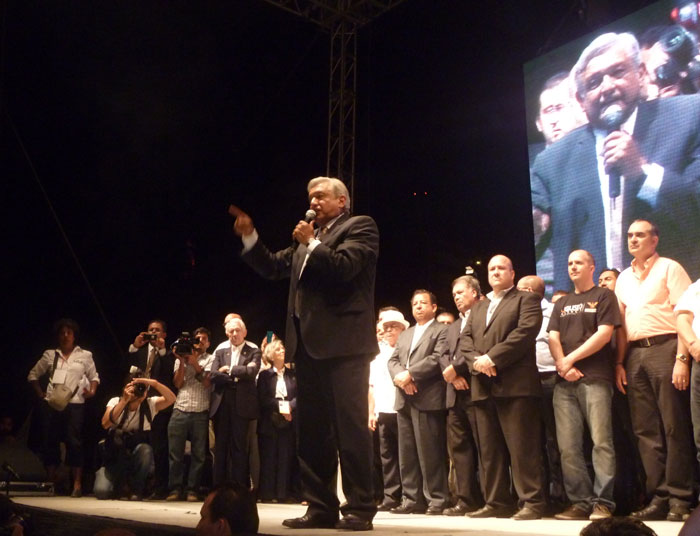
Addressing tens of thousands of supporters in Mexico City’s Zocalo on Sunday, the veteran politician said he was leaving the Party of the Democratic Revolution (PRD), Labor Party (PT) and Citizen’s Movement in order to focus on transforming Mexico through his National Regeneration Movement (Morena).
“This isn’t a rupture, I leave on the best of terms” Lopez Obrador said. “I have separated from the parties that form the Progressive Movement, but I must express my deep gratitude to all party leaders and supporters.”
Lopez Obrador is widely expected to turn Morena into a political party later this year. He built the social movement while touring every municipality in the country following his narrow defeat to Felipe Calderon in the 2006 election.
The future of Morena will be decided at a national conference attended by 125,000 members on November 19 and 20. The movement claims some four million members from 2,500 municipalities in 66,740 electoral districts.
“With Morena we will defend those who suffer injustice, protect the weak and care for our national heritage,” Lopez Obrador promised on Sunday.
Although he has amassed great national support, Lopez Obrador remains a divisive personality weighed down with political baggage. He refuses to recognize the victory of Enrique Peña Nieto, but the PRD, now the second biggest force in Congress, must accept that it is irreversible, move on and concentrate on its legislative agenda.
Lopez Obrador’s departure may enable the Mexican left to move forward with a clean slate under Marcelo Ebrard, who has already succeeded him once as mayor of Mexico City. Ebrard described his former mentor’s transformation of Morena into a political party as a “logical and predictable” move on Tuesday, but warned that the left must maintain unity.
“The worst thing we can do is go into the [2018] elections as every man for himself,” Ebrard said. While Lopez Obrador will enjoy greater political freedom having split with the PRD, if he were to run for president again as a Morena candidate he would risk splitting the leftist vote and condemning both himself and Ebrard to failure.
At a press conference on Monday, Lopez Obrador’s regional ally Enrique Alfaro ruled out joining Morena, affirming that his “political path is with the Citizen’s Movement.”
Alfaro insisted he had not split with Lopez Obrador and plans to meet with him next week. The former mayor of Tlajomulco reserved his criticism for the PRD, with whom he also cut his ties earlier this year.
“The PRD does not meet the conditions to form the backbone of the project we are talking about,” said Alfaro, who missed out on the Jalisco governorship in the July 1 election.
Calderon flaunts record on economy and security
Calderon took credit for stabilizing Mexico’s economy and confronting organized crime during his six-year term.
“It’s been our generation’s job to assume the costs and risks of making urgent changes in politics and security,” he said in a speech at Mexico City’s Palacio Nacional. “The reform has begun to bear fruit, but real results will only be seen in the future.” (The written Informe was delivered to Congress as required by law.)
Despite the global economic crisis, Calderon said his government had overseen the creation of nearly 1.9 million jobs, accumulated 159.8 billion dollars in international reserves, and brought in 126 billion dollars of direct foreign investment.
He also used the occasion to discuss reforms to the federal Labor Law that he presented to Congress on Saturday.
“The aim is to enable millions of people who are unemployed to have access to work, particularly women and young people,” Calderon said of the bill, which will facilitate recruitment via outsourcing, introduce 180-day “learning contracts,” limit the right of workers to strike, and increase the accountability and democratization of labor unions.
Labor Law has not been significantly altered in four decades. Presently, it is both difficult and expensive to fire workers, a fact that discourages small businesses from taking on new staff. Moreover, union leaders are not directly elected or required to reveal the fate of tens of millions of dollars that they receive each year.
Calderon hopes to push the bill through before he steps down on December 1. He introduced it as a “preferred initiative,” meaning the Chamber of Deputies must discuss and vote on it within 30 days.
Regardless of whether such reforms are passed, Calderon will be remembered above all for his war on the nation’s drug cartels. Of Mexico’s 37 most-wanted drug traffickers, 22 are now either dead or in prison, he boasted, but this strategy of targeting kingpins has led to splits in many cartels, with new factions emerging. There are now aound twice as many drug-trafficking organizations operating in Mexico as when Calderon took up office.
Authorities have confiscated 14.5 billion dollars in assets, including one billion in cash from drug gangs, Calderon said, while the federal police has been expanded from 6,500 officers to 37,000. However the police remain dogged by allegations of corruption and the murder rate has also soared, with over 50,000 dead since Calderon first sent the Army to combat drug gangs in December 2006.
If the July 1 election served as a public referendum on his presidency then Calderon will not go down in history among Mexico’s more popular leaders. Having won the previous two elections, the National Action Party (PAN) slumped to a disappointing third place, allowing the Institutional Revolutionary Party (PRI) to reclaim power after a 12-year absence.

