President Calderon inspires fear and loathing in Mexico
The dubiously elected President Felipe Calderon was busy this week, seeking to simultaneously undermine the main opposition party and a popular peace movement in a futile effort to justify his disastrous approach to Mexico’s drug-trafficking problems.
President Calderon: PRI will entertain drug pact
Amid continued criticism of his militarized campaign on organized crime, President Felipe Calderon angered the Revolutionary Institutional Party (PRI) last weekend by suggesting the opposition party would consider a deal with Mexico’s drug cartels if elected next year.
“There are many in the PRI who think the deals of the past would work now,” said the president in an interview with the New York Times last weekend. “I don’t see what deal could be done, but that is the mentality many of them have. If that opinion prevails it would worry me.”
Calderon’s comments allude to the PRI’s dubious history of tolerating the cartels’ activities in order to ensure peace throughout the party’s unbroken 70-year rule. Having finally been thrown out in 2000, the PRI is now favorite to return to power in 2012.
Asked whether a priista candidate might fall into a corrupt relationship with organized crime if he were to win the presidency, Calderon replied, “it depends on who it is. There are many in the PRI who agree with the policy I have, at least they say so in secret, while publicly they may say something else.”
PRI politicians have dismissed Calderon’s comments as “absurd” and “irresponsible,” demanding the president either prove or retract his comments, which amount to a “dirty campaign” against the main opposition party ahead of next year’s general election.
A presidential spokesperson clarified Calderon’s comments on Sunday, explaining that while not all of the opposition would consider a deal, “other priistas, such as as the former governor of Nuevo Leon Socrates Rizzo, have publicly stated the benefits of forming agreements with organized crime.”
Diego Peterson, a renowned columnist in the local daily El Informador, believes Calderon’s comments regarding the PRI were uncontroversial and have been widely exaggerated. Had they been made in a national paper instead of the New York Times, he argues they would never have attracted the same attention.
Although the PRI vigorously denies such claims, the party has frequently been accused of making secret deals with drug capos while it was in power. A prevalent climate of impunity and corruption grew steadily under the PRI until it got out of hand, culminating in the kidnapping, torture and murder of U.S. Drug Enforcement Agency (DEA) agent Enrique Camarena in Guadalajara in 1985.
Ordered by the boss of the Guadalajara Cartel, Miguel Angel Felix, the kidnapping was reportedly carried out in broad daylight by corrupt police officers. The case provoked a strong reaction from the U.S. government, which launched the largest DEA homicide investigation ever undertaken and put great pressure on the Mexican government to crack down on organized crime.
It was not until the election of Calderon in 2006 that a war on the nation’s cartels became the government’s central security strategy. Calderon has been outspoken of late in defending this controversial strategy of deploying the Mexican Army to combat organized crime.
This has widely become considered the defining policy of his presidency. For many Mexicans, Calderon’s only legacy will be the spiralling violence that has already claimed over 40,000 lives during his five years in office.
“It’s possible some will remember me for that,” he admitted. “But if Mexico triumphs as I am sure it will, if Mexico subdues the criminals and reconstructs its social fabric, there will also be those that remember me as the president who dared to take on the criminals.”
Although Calderon was unable to say the country is safer now than when he took power, he affirmed that “Mexico will be safer … and if I had not acted the situation would have deteriorated even more.”
Felipe Calderon clashes with peace movement
President Felipe Calderon denied Mexico has become an “authoritarian state” under his tenure during a meeting with representatives of the Movement for Peace with Justice and Dignity at Mexico City’s Chapultepec Castle last Friday.
“If this were an authoritarian state believe me we would not be having this dialogue,” the president said in response to criticism from Javier Sicilia, a former poet and journalist who has been transformed into a national peace activist since the murder of his son in March.
The meeting, which lasted nearly six hours, marked the second occasion Calderon has entered into a dialogue with the peace movement, the first being in late June.
Sicilia, who heads the movement, was scathing of the president’s policies, arguing that militarization of the country in the name of national security is threatening the civil liberties guaranteed in the Mexican Constitution.
“Your decision, Mr President, that the military assume responsibility for national security, requires at the very least a road map defining the limits of their presence on the streets, now that there are serious risks of the military weakening Mexican democracy and undermining civil power.”
But the president remained steadfast, affirming that the Army will remain on the country’s streets until the police are “trustworthy and effective.”
“The atmosphere of violence and horror, which grows day by day, is contaminating the discourse,” said Sicilia, who warned of “a greater threat, of which we the citizens disapprove: that of authoritarianism and its most brutal facades: militarism and fascism.”
Sicilia also accused the government of fostering the growth of violent paramilitary groups. “Besides generating more violence and terror, your actions are provoking a surge in paramilitary groups, which … consider themselves authorized to operate, killing more Mexicans with impunity.”
Calderon denied these allegations, declaring “it is not the case that (paramilitaries are) tolerated, much less that they are supported, I can assure you.”
Finally, Sicilia said the government is ignoring the victims of its war on drugs and expressed concern that the current strategy will lead to an “endless war.”
“The government is not the obstacle to peace, the main obstacles to peace are the criminals,” retorted Calderon.
Packing pistols for peace

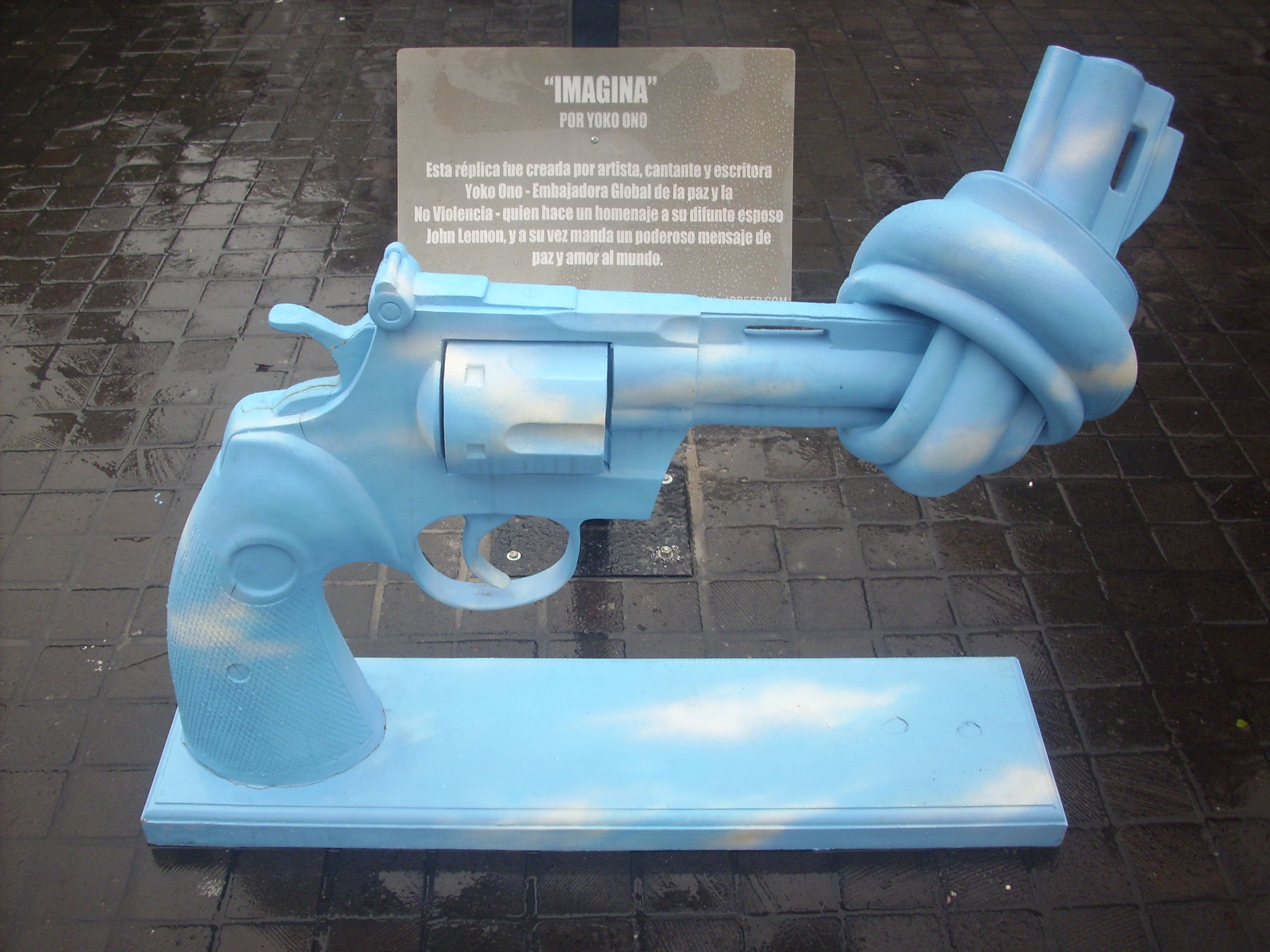
Imagine one billion faces for peace. This is the goal of the Non-Violence Tour, which has brought its “Pistols for Peace” urban exhibition to Guadalajara.
A series of pacifist artworks are now on display until December 13 on the Rambla Cataluña beside the University of Guadalajara rectory on Avenida Juarez.
Featuring individually painted revolvers with their barrels twisted in a knot, the sculptures were created or inspired by a range of well-known figures and local artists, including John Lennon’s widow Yoko Ono, Tapatio soccer star Javier “Chicharito” Hernandez, and Italy’s veteran World Cup-winning goalkeeper Gianluigi Buffon.
The latter personally designed and painted a pistol entitled “football for peace” during the 2010 World Cup in South Africa. Other contributions came from Jose Gomez, a primary school student from Comitan, Chiapas; Mexican artist Mallinali Ruvalcaba; and the lucha libre (wrestling) star “El Hijo del Santo.”
The symbol of a subverted pistol was originally created as a memorial tribute to the Beatles’ John Lennon, an outspoken peace advocate who was murdered in New York on December 8, 1980.
The Non-Violence Project has adopted the image to promote Lennon’s dream of peace and non-violence around the world. Since 1995, the organization has traveled through 30 countries promoting “the non-violent resolution of conflicts.”
The sculptures were installed beside the university building on last week in the pouring rain. “We wanted a well known place to display these works,” said Carlos Gonzalez, the city council’s coordinator of museums. “Here they are easily accessible and right beside the Sunday Via Recreactiva so many people will see them.”
The pistols have traveled the world from Verbier in Switzerland to London’s Trafalgar Square. More locally they have been displayed in Mexico City and will next make their way to Rio de Janeiro, before returning to Mexico to be shown in Monterrey.
One aim is to establish training offices in every city the project visits, offering free courses on how to promote peace.
“As a foundation, we have a series of education projects for children, explaining to them what violence is and how to prevent it,” said Mauricio Bermudez, director of the Non-Violence Project in Mexico.
Questioned on the problems of violence in Mexico, Bermudez draws on the project’s experience in South Africa. “We have been working on this since 1993. I’ll give you a very quick comparison, in South Africa we were working all of last year with the secretary of education and in the schools and there was a 50 percent reduction in the levels of violence that year.”
Bermudez is firm in his belief that “it really is possible to reduce this problem of violence. I think that Mexico needs to work with the young people, teaching them to resolve conflicts not with violence but with respect and tolerance.”
While he respects other like-minded efforts such as the Movement for Peace with Justice and Dignity led by Mexican poet-turned-activist Javier Sicilia, Bermudez clarified that “we are not looking to start a political protest, we are just trying to sow the seeds of education.”
These unique artworks are well worth seeing and greater public involvement in the project could help transform this country. Go and check them out. In the words of the late John Lennon, give peace a chance.
For more information on the Non-Violence Project visit http://www.iobffp.com.
Breaking into Heaven: the unlikely resurrection of The Stone Roses
My article for the Huffington Post on the return of the greatest band ever:

This is the one, the resurrection, what the world is waiting for. After years of rumour and denial, it has finally been confirmed: The Stone Roses have reformed, with two live shows in Manchester, a world tour and a new album in the works.
This being one of the most unlikely but eagerly anticipated reunions of all time, there are plenty of reasons why it shouldn’t work.
A seemingly work-shy band, the Roses produced just two albums in their 13-year career. With a singer who cannot sing and a guitarist who apparently prefers painting – neither of whom had spoken to each another for the past 15 years – plus a brilliant but enigmatic drummer who seemingly disappeared off the face of the earth in early 1995, theirs is hardly the perfect recipe for reunion success.
But the second coming of The Stone Roses will be something truly special.
The reformation was officially announced at a press conference in a Soho hotel on Tuesday. Frontman Ian Brown was in typically assured form, declaring “our plan is to take on the world”.
But it was the affable bassist Mani who best summed up the Roses’ appeal: “something magical happens when us four are in the room together, you can’t put your finger on it. It’s just beautiful to capture it again. I’ve missed it.”
The band have already been working on new material in secret rehearsals over the summer. Crucially, this promise of a new album justifies the reunion as a realisation of artistic potential and not just a money-spinning nostalgia trip.
In recent years Blur and Pulp have proved that 90s bands can pull off high-profile reunions with class and critical acclaim. Both were great acts but neither cultivated the same mystique as the Manc legends, nor did they keep fans waiting as long as the Roses.
Never before has there been a band with such a case of unfinished business. The Roses could have been their generation’s Beatles had they managed to keep it together and put out enough records. Instead, drugs, contract disputes and the souring of personal relationships took hold.
With the world at their feet, the band “George Best-ed it,” as Brown puts it. The great tragedy of the band’s career is that they only released two proper albums and a clutch of stand-alone singles and b-sides. Now they finally have the chance to put that right.
Any concern that a reunion might tarnish the band’s legacy is redundant, for there is no way the upcoming shows could be worse than their last gig. With two of the classic line-up having already quit, singer Brown finally called time on the remnants of his once-great group after a disastrous headline performance at Reading Festival in 1996. It was a horrible way to bow out, with a woefully off-key Brown backed by cheesy session musicians labouring through the most painful of swan songs.
Having already pissed on their own legacy and with nothing left to lose, the Roses can now go out there and remind the world of their genius. The band has always enjoyed a fairly cult-like status, especially compared to their disproportionately more popular but less talented successors Oasis.
But the brief highlights of their career were stunning. Channelling Jimi Hendrix and the Byrds with a uniquely Manc swagger, their classic eponymous debut is widely recognised as one of the best ever and was named the greatest British album of all time by both the Guardian and the NME.
Although hampered by lousy sound, their performance before almost 30,000 fans at Spike Island in 1990 was hailed as the Woodstock of the ecstasy generation. This would be one of their triumphant last acts before disappearing into the wilderness.
A five-year wait followed, before the Roses finally returned with the criminally underrated and immodestly titled “Second Coming.” Refusing to rehash a winning formula, they bravely ditched the crystalline pop of their debut in favour of a darker, heavier sound.
A diverse if slightly overlong record, “Second Coming” flows from hard rock to blues, funk, acoustic folk and even big-beat dance. The epic opener “Breaking into Heaven” and the first single “Love Spreads” (hailed by Primal Scream’s Bobby Gillespie as “the greatest comeback record of all time”) are up there with the very best of Led Zeppelin, while the tender “Ten Storey Love Song” gloriously revisited the classic Roses sound.
Initially considered a disappointing, anticlimactic follow-up, crushed by a tremendous weight of expectation, in hindsight the album is a “flawed masterpiece”, as guitarist and principal songwriter John Squire once described it.
Yet the making of the record left fatal scars on the band, with both Reni and then Squire quitting shortly after its release. Brown’s fall-out with former best mate Squire was so bitter that the pair did not speak again until they were reunited by tragedy at the funeral of Mani’s mother earlier this year.
Although the band may now be pushing 50, the prospect of hearing a new record or seeing them onstage again is mouth watering. If anyone has the ability to pull off a reunion it is the Roses.
Squire is a virtuoso guitarist, and although Brown’s vocals provide the weak link of the group he somehow makes up for it with his shamanic onstage presence. Such is Brown’s influence that a 16-year-old Liam Gallagher realised exactly what he wanted to do immediately after attending an early Roses gig in Manchester.
Mani is a very accomplished bassist, while Reni is one of the most gifted drummers these shores have ever produced (after the Roses’ first ever gig in 1984 he was labelled the best drummer since Keith Moon by none other than Pete Townsend).
Together they comprised the tightest rhythm section in rock since John Bonham and John Paul Jones. The pair took Brown and Squire’s brilliant songs and injected them with a sense of funk and groove, something that has since been sorely missing from most British indie rock.
If the band can recover just one tenth of their once infinite potential, that alone would justify the reunion and put them streets ahead of contemporary pretenders like Kasabian. The world can only be a brighter place with The Stone Roses in it.

