Mariachi Festival
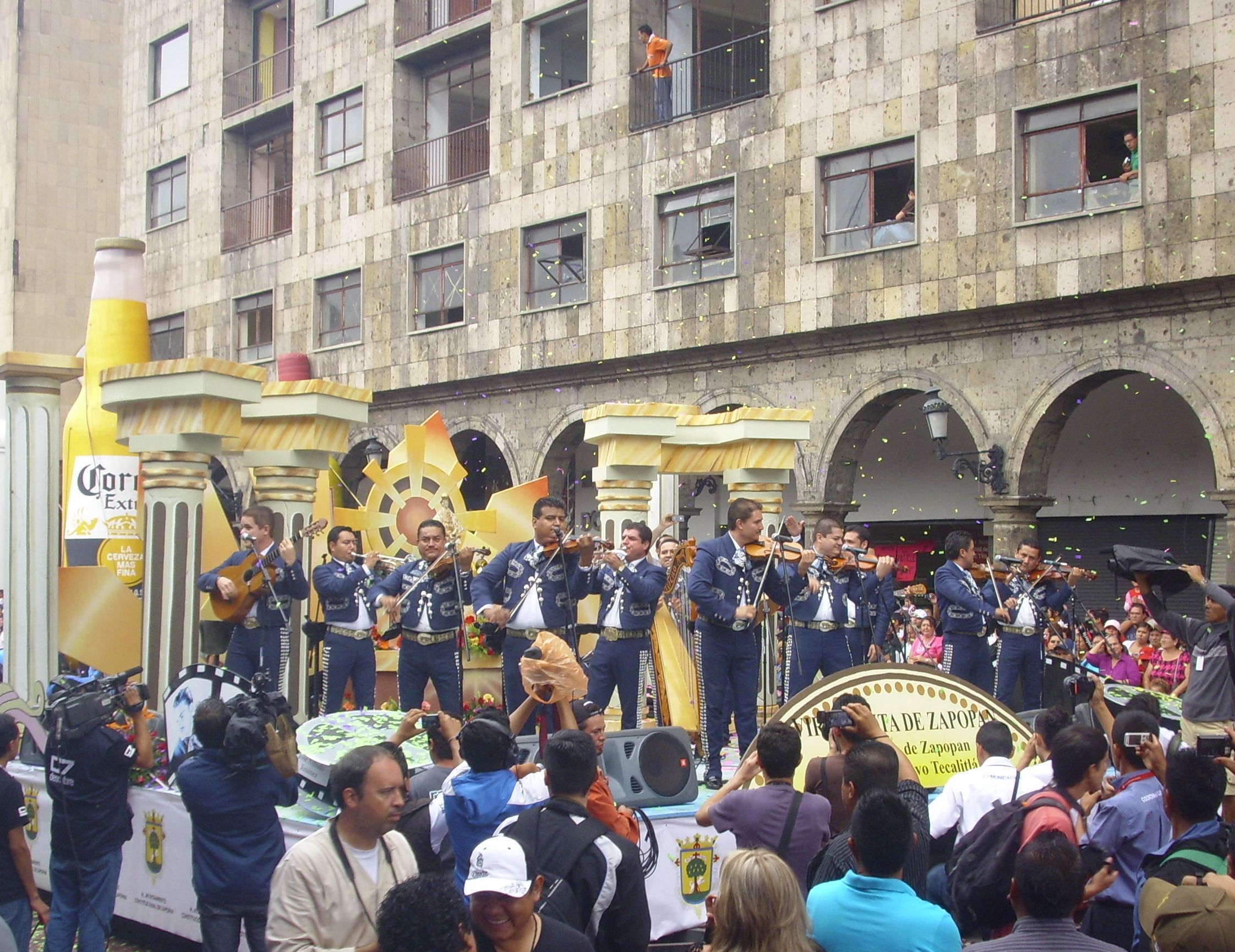
Last Sunday I got up at 7 a.m. to watch Tottenham get absolutely destroyed by Manchester City. Then I had to go to cover a parade in the rain. I was working on a Sunday morning and it was literally raining on my parade. Thankfully the rain didn’t last too long and things picked up afterwards. Here’s my write up for the paper:
Rain fails to dampen mariachi merriment
The mood was subdued among the rain-soaked crowd awaiting the inaugural parade of Guadalajara’s International Mariachi Festival on Sunday morning.
It felt as if the news of Thursday’s tragedy in Monterrey had taken the wind from the sails of the hundreds who lined the route along Avenida 16 de Septiembre.
At 10 a.m. Jalisco Governor Emilio Gonzalez briefly addressed the crowd gathered beside the Plaza de Armas, before cutting the ribbon to officially open the event.
In the end the weather failed to dampen the atmosphere, with both the rain and people’s spirits lifting shortly after the parade began.
Horsemen and women, acrobats, girls dancing in brightly colored traditional dress, men dancing with knives, and a charro performing rodeo-style tricks with a lasso all contributed to the spectacle.
The lively event was enhanced visually by machines giving off colored smoke and endless streams of confetti blasted above the passing floats.
But the most striking aspect was of course the music. Mariachis from as far afield as France, Sweden and the United States took part, alongside representatives from a host of Latin American nations including Colombia, Ecuador and Peru.
They were joined by traditional groups from all over Mexico. The infectious sounds of the “Virgencita de Zapopan” mariachis went down particularly well, eliciting wild cheers from the largely family comprised audience.
After the parade Francisco Gouygou, or the “French charro” as he is known, expressed solidarity with the victims in Monterrery, before proclaiming, “Mexico has everything to be the greatest country in the world.”
I also shot and edited this short video for the paper’s website:
Huffington Post: Is the Premier League becoming a two-club dynasty?

The Huffington Post, one of the biggest news sites in the USA, recently launched a UK edition, entitled, unsurprisingly, The Huffington Post UK. Earlier this week I heard through a friend that they were looking for sports writers so quickly fired off a pitch. They responded very promptly and within 48 hours of hearing about the whole thing I had an article published online. They don’t pay bloggers but it’s great exposure and will good on the old CV. Plus once you’re set up as a blogger it seems you can just write about whatever you like whenever you like and as long as it’s good and accurate they’ll publish it to an audience of thousands.
Inspired in equal measure by the 5-1 battering from Man City that ruined my Sunday, and Arsenal’s humiliating 8-2 defeat by Man Utd which almost made up for it, here’s my first, hastily written and slightly knee-jerk (i.e. like virtually all football blogs, ever) article:
Is the Premier League becoming a two-club dynasty?
The 13-goal mauling dished out by both Manchester sides to their north London opponents on Sunday raises an intriguing question: is this the future of English football?
Having dominated the opening fixtures of the season, Manchester United and Manchester City look streets ahead of their closest rivals, leading to suggestion that the Premier League could become a perennial two-horse race akin to the Spanish and Scottish leagues.
Such a development would undoubtedly be to the detriment of English football. As brilliant as the Spanish clásicos may be, the predictability of seeing Real Madrid and Barcelona quash their opponents in every other game of the season rather detracts from the excitement.
The two great rivals have won nine of the last eleven La Liga titles, while in recent seasons the chasm has only widened between the best and the rest. The gap is now so entrenched that Barcelona strolled to a 5-0 victory over Champions League side Villareal on Monday, despite only fielding one recognised defender.
In Scotland it is the same story. You have to go back to 1985 to find the last time a side other than Celtic or Rangers won the Scottish league. The winners that year? Aberdeen; managed by none other than Alex Ferguson.
Thankfully there remains one crucial difference between the English Premier League and Spain’s La Liga: in the distribution of revenue from broadcasting rights. In England television revenue is shared out relatively evenly, although obviously the clubs that qualify for the Champions League stand to make a lot more, thus reinforcing their position at the top.
But in Spain each team negotiates separate agreements over broadcasting revenue, meaning mega-clubs Barcelona and Real Madrid earn as much as the rest of the league combined. As a result of this structural inequality, only these two teams have any realistic chance of winning the title.
While it remains early in the season to say with certainty that the Premier League is going the same way, the signs are ominous. The current trend dates back to 1992, when England’s biggest clubs broke away from the Football League to create their own lucrative division. Now, with every year that passes English football becomes more of an elite sport in which financial might outweighs all else.
As the wealth gap grows more extreme, the top six has now become a top two or three. While Chelsea might just challenge the Manchester clubs for first place, Arsenal, Liverpool and Spurs will be scrapping it out for the final Champions League place this season.
Neither Arsenal nor Tottenham can afford to pay the requisite wages or transfer fees to attract the game’s top players. Arsene Wenger’s sound philosophy of financial responsibility may be admirable but try telling that to a trophy-starved Arsenal fan after the 8-2 humiliation at Old Trafford. Meanwhile Liverpool have strengthened considerably and look unrecognisable from the sorry outfit of the recent past, but would realistically settle for a return to the top four this season.
Thanks to Roman Abramovich’s billions, Chelsea remain the side best equipped to compete with the red and blue halves of Manchester. Yet even Chelsea have grown so desperate not to fall behind that they’ve already spent the best part of £100 million in 2011, half of which was on a misfiring striker Fernando Torres.
Manchester City spent the same figure last year just to force their way into the top four, and they have not let up since, most notably bringing in Sergio Agüero and Samri Nasri over the summer.
Having long since established themselves at the top of the Premier League hierarchy, Manchester United can take their pick of the league’s most talented prospects, such as Phil Jones and Ashley Young. While United’s talented young side might seem a refreshing antidote to their noisy neighbours’ expensively assembled dream team, it should be remembered that the Red Devils are consistently ranked as the richest club in the world. While Ferguson can take great credit for their success, it is no coincidence they always finish in the top two.
While FIFA’s financial fair play regulations should even things up in theory, both Manchester sides have moved to pre-empt these restrictions by signing unprecedented sponsorship deals. In July Manchester City sold the naming rights to their stadium as part of a record £400 million sponsorship deal with Etihat Airlines, amid whispers of links between the company and City’s Abu Dhabi-based owners.
The following month Manchester United announced a new £40 million sponsorship deal with DHL for their training kit – worth more than all but five of the league’s main shirt sponsorship deals. The biggest clubs, it seems, will always find new ways to bring in greater revenue.
So after three games played, United and City sit top of the table. We should get used to it. A real gulf in class has opened up among the Premier League’s top sides in 2011. If English football is destined to follow the same path as in Spain and Scotland then this season may well prove the moment it became a duopoly.
Guadalajara feels aftershocks of the Monterrey massacre
In a nation all too accustomed to outbreaks of drug related violence, it takes a truly horrific incident to shock the entire population. The murder of 52 people in a casino set ablaze in the northern city of Monterrey last week did just that.
Five suspects have since been arrested in a crime that President Felipe Calderon described as an “abhorrent act of terror and barbarism.” In Guadalajara, half of the city’s casinos have been shut down, while Sunday’s Mariachi Festival parade was overshadowed by protests against the government’s security policy.
Nuevo Leon Governor Rodrigo Medina confirmed Monday that five men have been arrested, while two others are still being sought in connection with the deadly arson attack.
Medina told Mexican television that the suspects, believed to belong to the Zetas drug cartel, had confessed to involvement in the attack.
The armed men reportedly burst into the Casino Royale shortly after 3 p.m. on Thursday and doused the establishment with flammable liquid. Some reports suggest they ordered those inside to leave before setting it ablaze, but many panicked and fled further into the casino where they became trapped and, with the emergency exits apparently locked, perished in the fire.
The consequences of the attack have been felt across the nation. Following a review of security measures in the wake of the tragedy, six casinos were closed in Guadalajara and Zapopan this weekend.
These casinos comprised half of Guadalajara’s ten gambling establishments: the Capri, the GDL, El Gran Nevada, the Twin Lions, and Yak; along with the 777 in Zapopan (Avenida Patria and Vallarta).
Speaking after the inaugural parade of Guadalajara’s International Mariachi Festival on Sunday, Guadalajara city hall’s legal officer Roberto Lopez Lara said he understood the inconvenience to the business owners affected, but stressed security was more important.
Lopez confirmed surveillance operations will continue indefinitely and that the casinos will not reopen until they comply with municipal safety regulations.
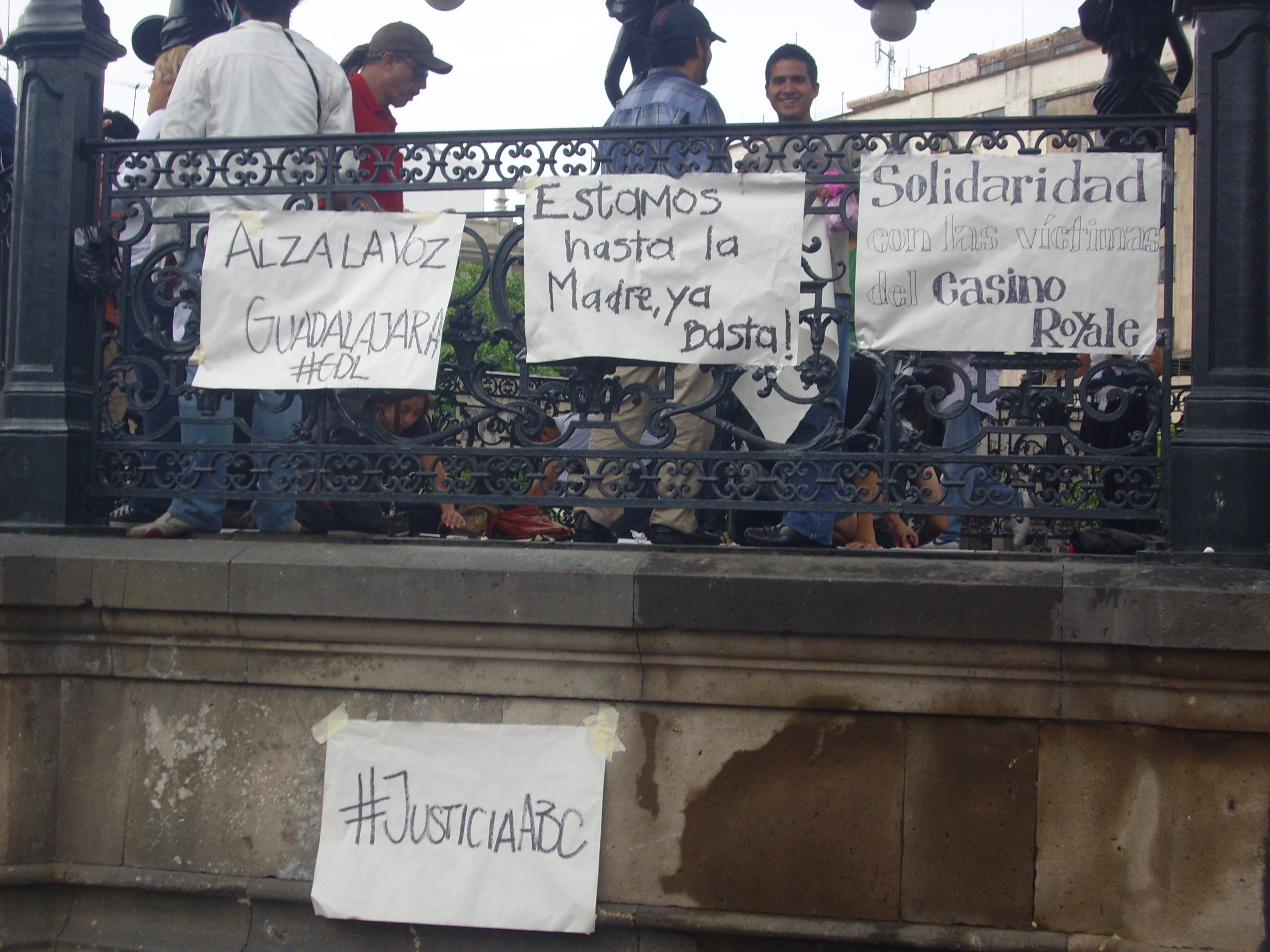
Lopez was not the only one to speak out after the parade. Following the event around 100 people congregated in Guadalajara’s Plaza de Armas to condemn the insecurity that plagues Mexico and to show solidarity not only with the victims in Monterrey, but all those who have suffered in the drug wars that have claimed over 40,000 lives since Calderon took office in 2006.
Organizers hung placards on the plaza’s bandstand: “Stay strong Monterrey,” “I want my country back” and “We’ve had it up to here, enough” read some of the messages.
The demonstration drew a number of sympathizers and curious onlookers who had attended the parade. They were encouraged to write messages of solidarity, remember the victims and express their dissatisfaction with the government.
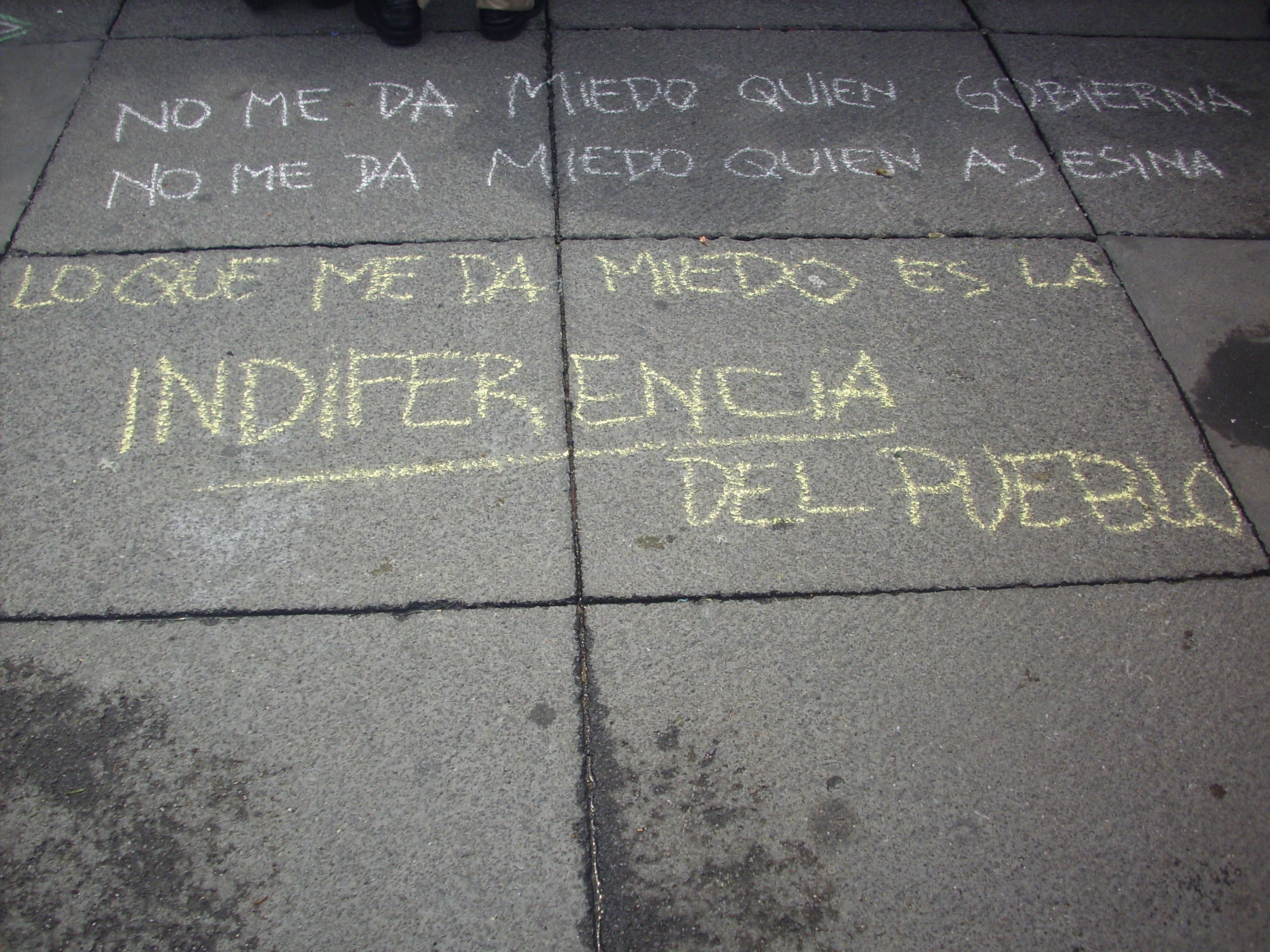
“The government does not scare me, the assassins do not scare me, what scares me is the indifference of the people,” read one message.
But most of the anger was directed toward Mexico’s politicians. “We are citizens with no party affiliation, we are tired of politicians who say they want to end this war but then throw more police on the streets … They want to militarize our country more,” said Claudia Ocampo, one of the organizers.
The protesters also criticized the decision to go ahead with the parade despite the three days of national mourning that had been announced after the attack. “We find it disrespectful that during these days of mourning, the authorities continue as if nothing has happened,” said Ocampo.
Another of the organizers, Isaac Cardenas, made a series of demands to the authorities, including the resignation of “inept politicians,” the conviction of criminal groups who have shown no mercy toward civil society, and the retraction of the restrictions on individual freedoms and human rights proposed in the National Security Act.
President Calderon has been trying to push the controversial National Security Act through Congress in the wake of the tragedy in Monterrey. The new law, which has met general congressional approval but the specifics of which require greater discussion, would grant the executive branch and the military far greater power in their prosecution of the war on organized crime.
Casino fire detainees say they didn’t mean to kill gamblers
Five men who have been arrested in connection with the murder of 52 people in Monterrery’s Casino Royale last week told investigators they did not plan to kill anyone and “only wanted to scare” the casino owners.
The suspects, who federal investigators say admitted responsibility for the attack, said the tragic loss of life was the result of a botched operation to intimidate the owners of the establishment.
The original plan was to evacuate the casino before setting it alight, but many of those inside fled further into the building and the fire quickly grew out of control.
The suspects, four of whom are native to Monterrey and the other is from Chihuahua, are believed to have been working for the notorious Zetas cartel. They claimed to have been subsequently “scolded” by their bosses for causing so many deaths.
The authorities are now seeking seven more suspects in connection with the attack.