Ruling party’s fresh female face to challenge for presidency
Could Mexico be about to follow Brazil and Argentina’s lead by electing a female president?
With few convincing male contenders for the right-of-center National Action Party (PAN) candidacy, 50-year-old Josefina Vazquez Mota has emerged as the most likely to resurrect the party’s ailing fortunes in the 2012 presidential elections.
Despite not having officially announced her candidacy, Vazquez held a thinly disguised campaign rally in Guadalajara’s Auditorio Telmex last week.
In a somewhat audacious move, Vazquez addressed the packed crowd of 9,000 supporters in the territory of Jalisco Governor Emilio Gonzalez, another possible contender for the party’s nomination.
On August 30 Vazquez will step down from her position as party leader in the federal Chamber of Deputies, to concentrate solely on her presidential bid.
“Mexico is ready for a female president, the time has come for women to make decisions in government,” Vazquez said this week, confident that she can win the PAN primary on February 18, 2012.
Now considered the party’s frontrunner, Vazquez has built up a commanding lead in the polls, with Senator Santiago Creel the closest of the pack behind her.
Vazquez has said if she were president she would prioritize education, providing wider access to secondary school and university, and promote better teacher-training.
“Facing organized crime, there will be neither negotiation nor surrender,” Vazquez has maintained. However, she has also said she would focus less on the drug war and more on fighting impunity and corruption.
Most polls suggest Vazquez still trails 30 to 40 points behind Enrique Peña Nieto, the most likely candidate of the Institutional Revolutionary Party (PRI). Despite initial optimism, many voters have tired of the PAN after seeing little substantial improvement during the party’s eleven-year rule, plus a dramatic increase in drug violence since President Felipe Calderon was elected in 2006.
The Mexican Constitution prohibits Calderon from seeking a second six-year term. With the leftist Party of the Democratic Revolution (PRD) having also declined in popularity since their controversial narrow defeat in the last election, the PRI are now the clear favorites to win in 2012.
But with a serious woman candidate running for the first time, the female vote could prove a unknown quantity. Should Vazquez be able to turn it around for the PAN she will join a growing list of female presidents in Latin America:
Dilma Rousseff, Brazil (2011-)
Ranked by Forbes as the third-most-powerful woman in the world, Rousseff was arrested, imprisoned and tortured by Brazil’s military dictatorship for her involvement in the left-wing resistance movement of the 1970s. Still in her first year in office, Rousseff has vowed to continue many policies of her predecessor Lula de Silva.
Laura Chinchilla, Costa Rica (2010-)
A social conservative, Chinchilla maintained a tough stance during a prolonged territorial dispute with neighboring Nicaragua and was eventually vindicated when the International Court of Justice ruled that Nicaragua must withdraw its troops from the contested region. She has also adopted a strong anti-crime platform amid growing concerns over security in Central America.
Cristina Fernandez de Kirchner, Argentina (2007-)
A former First Lady, Fernandez de Kirchner succeeded husband Nestor Kichner in 2007. The Peronist couple were dubbed the “Clintons of the South.” Evoking the spirit of Eva Peron, she has been an advocate for human rights, poverty awareness and health improvement.
Michelle Bachelet, Chile (2006-2010)
Bachelet led Chile’s Socialist Party to victory in 2006, marking the first time a leftist party had held power since Salvador Allende’s government was overthrown in the violent coup d’etat led by General Pinochet in 1973. Previously Chile’s Defence Minister, Bachelet was prohibited from pursuing a second term by the Chilean constitution, she stood down last year with an approval rating of over 80 percent.
Mireya Moscoso, Panama (1999-2004)
The widow of three-time president Arnulfo Arias, Moscoso oversaw the U.S. handover of the Panama Canal in 2000. Despite initial popularity, she left office with the lowest ever approval ratings for a Panamanian president.
Violeta Chamorro, Nicaragua (1990-1997)
An anti-Sandinista candidate, Chamorro was strongly backed by the United States, which lifted sanctions against Nicaragua after her election. Remarkably, having beaten Daniel Ortega, she remains the first and only woman in the world to defeat an incumbent president.
Isabel Peron, Argentina (1974-1976)
The first female president in Latin America, Isabel Peron succeeded her husband Juan Peron after he died during his third term in office. Never as popular as his previous wife Eva Peron, Isabel was removed from office in a military coup in 1976 and later fled to Spain.
Chelsea to sign Mexican Ulises Davila
Why Chelsea’s latest prospect Ulises Davila is no little pea, yet…
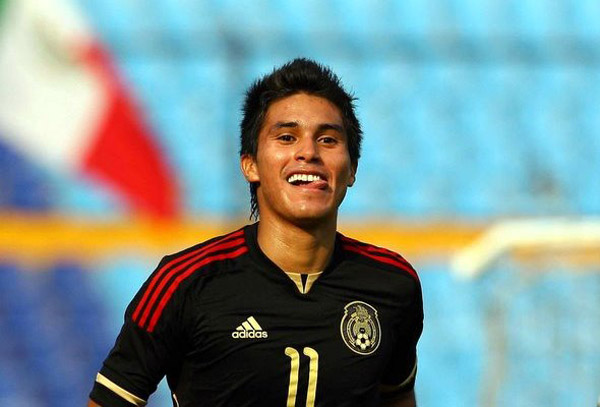 In the next few days Chelsea seem certain to sign 20-year-old Mexican midfielder Ulises Davila from Chivas de Guadalajara for a fee of around £1.75 million.
Although a deal has yet to be signed, Chivas president Jorge Vergara has encouraged the Chelsea bid and said that his club will not stand in the way of any player looking to make their dream move to Europe.
So who is Ulises Davila? And what can Chelsea fans expect of him?
First of all, they should be wary of the hype surrounding a player who remains unproven at senior club level.
Since the success of Javier Hernandez at Manchester United last season, the English press now describes every Mexican player linked with a move to Europe as “the new Chicharito”, regardless of their position or style of play.
Let’s be clear: Chelsea are buying potential in the form of Davila; they are not signing a ready-made star who will adapt to English football as quickly as Hernandez did at Old Trafford.
For one thing, Davila won’t even be at Chelsea this season. He will be loaned out to Dutch club Vitesse Arnhem on a one-year deal in order to secure a work permit and gain some first team experience.
Furthermore, when Hernandez signed for United he had already established himself in the Chivas side over the course of the season, scoring regularly at club level. By contrast Davila has never started a competetive match for the club. In 15 appearances as a substitute he has managed a total of just 341 minutes playing time.
With exorbitant prices being paid for homegrown talent, British clubs are understandably looking for greater value in the Mexican market. Last month Liverpool signed 17-year-old Marco Bueno from Pachuca, while Tottenham took Antonio Pedroza Whitham on trial before realising he wasn’t up to scratch and leaving him to sign for Crystal Palace.
There is a danger that these players are making the move to Europe at far too young an age. How much playing time can they possibly hope to get? They would be better off establishing themselves in Mexico first and then moving once they have the maturity to adapt successfully to life in Europe.
Hernandez aside, very few Mexican players have adapted well to English football. Both the English lifestyle and the more physical style of football are very different from what Mexicans are accustomed to.
Having made the move alongside his entire family, Hernandez has been the exception in England.
How often have other undeniably talented Mexicans such as Carlos Vela and Giovani Dos Santos been able to reproduce their international form for club teams Arsenal and Tottenham?
The fact that both are on the move this summer, along with Fulham’s Carlos Salcido, should provide the answer.
That said, this does not mean Davila doesn’t have the potential to one day force his way into the Chelsea side.
Like Chelsea’s other new signing, Juan Mata, Davila is a skillful attacking midfielder who can play across the line or up front behind the main striker. He will take players on, is unafraid to shoot from distance, and has also been known to score with his head.
Davila was a stand-out performer in the under-20 World Cup in Colombia in August and scored in Mexico’s 3-1 win over France in the third place playoff.
He has graduated from Chivas’ acclaimed youth academy which also produced both Javier Hernandez and Carlos Vela.
The Guadalajara club’s policy to only field Mexican players is now paying off, with the youth system producing a host of talented players.
This investment in young Mexicans was further vindicated by El Tri’s triumph in July’s under 17-World Cup, the second time the country has won the competition in 6 years.
Moreover, only last month Chivas fielded a young team who more than held their own against Spanish and European champions Barcelona in a pre-season friendly.
After falling a goal behind Chivas romped home to an unlikely 4-1 victory against the best of Barcelona’s La Masia academy and a host of senior World Cup and Champions League winners.
Although Davila played no part in the match, it provided ample evidence that young Mexicans have the potential to compete against Europe’s best.
For an example of Davila’s ability, check out this goal he scored back in June for Mexico’s under-20 side:
Gunfight brings Mexican football match to a halt
I went to a football match on Friday night (Tecos vs. Pachuca). Thankfully it wasn’t this one:
Gunfight brings Mexican soccer match to a halt
The drug related violence that has plagued Mexico in recent years entered the world of Mexican football for the first time this weekend.
Panic gripped the players and fans alike as shots rang out midway through the soccer match between Santos Laguna and Monarcas Morelia in the northern city of Torreon on Saturday.
The game was abandoned after 40 minutes when the shots were heard, seemingly from inside the 20,000-capacity Corona stadium. The players fled the pitch while fans dived for cover in the stands.
It later became clear that the gunfire actually came from outside the stadium and no one inside was hurt.
The incident occurred when three vehicles full of armed men failed to stop at a nearby army checkpoint. One policeman was wounded in the ensuing firefight, while stray bullets hit the outside of the stadium. The authorities have yet to make any arrests in connection with the shooting.
The images of fear and panic inside the stadium were captured on live television and quickly spread across the internet. Although unrelated to the football match itself, the incident will raise further doubts about security in Mexico ahead of October’s Pan American Games in Guadalajara.
The rest of the weekend’s games in Mexico went ahead as planned, with in-form Chivas climbing to the top of the league after a 2-1 win over Monterrey in the Omnilife Stadium on Saturday. The win took the Guadalajara side ahead of Pumas, who succumbed to a 2-1 defeat in Puebla.
On Friday night Estudiantes Tecos sealed a 2-1 victory over ten-man Pachuca with a last-minute winner in Zapopan’s Tres de Marzo stadium, while Atlas’ poor start to the season continued as they were beaten 5-2 by America in the Azteca stadium on Sunday. Meanwhile local student side Leones Negros drew 3-3 with Dorados in the promotion league.
Finally, Mexico’s under-20 national side wrapped up a respectable World Cup campaign with a 3-1 win over France to claim third place. Last week El Tri juniors were beaten 2-0 by Brazil, who went on to win 3-2 in the final against Portugal.

